Issue 83: Climate change hits insurers; methane capture heats up

In this issue: The Asia-Pacific region appears vulnerable when it comes to insurance coverage for natural disasters, while businesses are paying more attention to curbing methane emissions.
Singapore and South-east Asia
Climate change increases need for insurance – but also its complexity
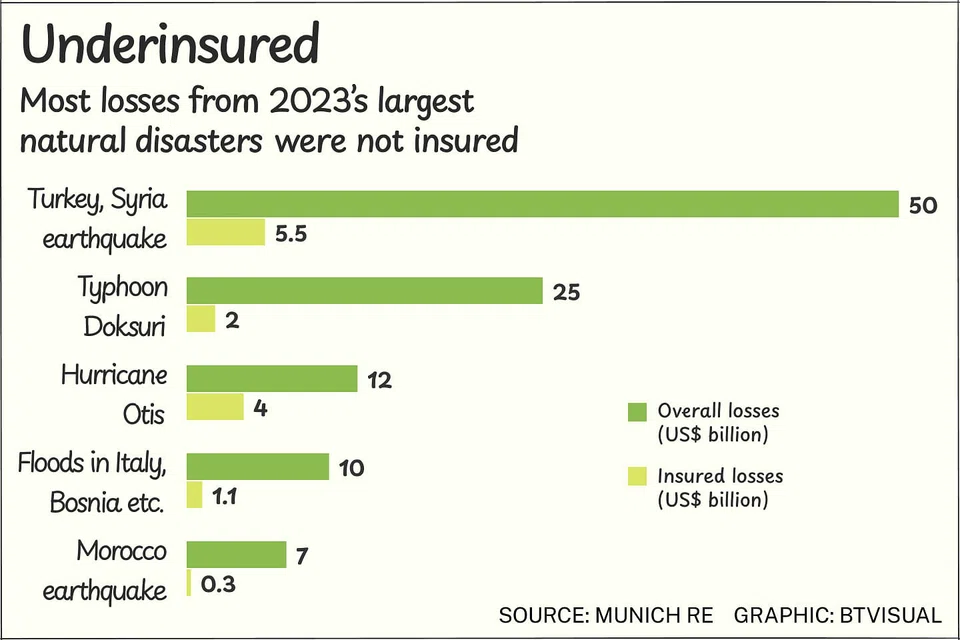
Typhoon Doksuri swept across large swathes of Asia last year, bringing heavy rainfall and high winds that led to US$25 billion worth of losses. Only US$2 billion of those losses, or 8 per cent, was insured.
A new report by reinsurance provider Munich Re this week cast a light on insurance gaps when it comes to natural disasters – from earthquakes to floods and cyclones.
The gap is particularly pronounced in this part of the world. Asia-Pacific and Africa suffered US$64 billion worth of losses from natural disasters in 2023, but only 12.5 per cent of these losses were insured – lower than the global average of 38 per cent.
This is risky. Insufficient insurance hinders post-disaster economic recovery and could feed into bigger crises, such as when people who have lost their homes get turned into climate refugees.
Insurance is not just a financial safeguard for individuals and companies; It is also a critical tool for climate adaptation and resilience.
While climate change increases the need for insurance, it also makes underwriting much more complex. Many of the probabilities associated with climate change are yet unknown, such as the frequency and severity of weather phenomena.
Without accurate data, it is challenging to put a price tag on specific risks. Scientists can model climate scenarios, but there are many wild cards that create huge variances.
Take, for instance, Singapore’s latest national climate change study. Assuming a scenario in which greenhouse gas emissions are effectively managed, Singapore’s mean daily temperature could increase by just 0.6 deg C by 2100.
If countries rely on fossil fuels for development over the century, however, the rise could be as severe as 5 deg C. It’s hard for an insurer to predict which way the world will go. Investing in predictive models and analytical tools could help, along with close collaboration with the scientific community.
This is crucial in the face of increasingly extreme weather. According to the European Union’s climate change service, 2023 was likely the world’s hottest year in the last 100,000 years.
Additional moisture in the atmosphere could, in turn, fuel increasingly severe storms, said Munich Re’s chief climate scientist Ernst Rauch in the report.
Other Singapore and South-east Asia reads
Not meaningful for Singapore to contribute monetary support to loss and damage fund: Grace Fu
Heat stress from climate change could worsen social inequality
Decarbonisation
The race to capture methane
Companies are finally starting to pay more attention to curbing methane emissions. Palm oil player Bumitama Agri told The Business Times’ Janice Lim that it is looking to set up methane capture facilities in its mills.
Its plans could reduce methane emissions at each mill by between 60 per cent and 70 per cent. The captured methane can be put to alternative uses, such as to power boilers. Methane doesn’t linger as long in our atmosphere as carbon dioxide, but it traps 80 times as much heat. Over a 100-year period, methane has 28 times the impact of carbon dioxide on climate change.
Methane reduction is complicated, though. The pandemic years uncovered a troubling paradox: Lockdowns led to less carbon emissions and better air quality, but methane levels surged to all-time highs in 2020 and 2021.
One possible explanation is that wetlands were exposed to higher temperatures and rainfall, creating more decaying matter that released more methane.
Another potential factor was the fall in emissions of nitrous oxides, which are produced from burning fossil fuels, during the pandemic lockdowns. Nitrous oxides trigger reactions that form hydroxyl radicals, which in turn remove methane from the atmosphere.
What should we make of such findings?
“People tend to focus on the sources of methane emissions, but this is a reminder that the processes that remove methane from the atmosphere, especially the amount of hydroxyl in the atmosphere, are critically important for controlling atmospheric methane,” said one scientist.
A lot more research is needed into the nature of methane emissions and the best means to tackle them, so that companies can step up their efforts accordingly.
Other decarbonisation reads
Mandates needed for sustainable aviation fuel to resolve supply impasse
Singtel ramps up 2030 emissions-reduction ambitions with new science-based targets
Other good reads
ESG bond and loan proceeds to rise in 2024 on lower rates
Asia-Pacific ‘highly exposed’ to climate change risks; Singapore the sole exception: Fitch
TRENDING NOW
Grab CEO’s wife Chloe Tong on life with Anthony Tan and finding her purpose
Three ex-employees of Envy group join Ng Yu Zhi in bankruptcy
He built the Vingroup empire. Now South-east Asia’s richest man is handing some key roles to his sons
If AI has a one-in-five chance of destroying us, what do we do with the remaining four?