ESG Insights

Issue 84: Coal production heats up; accounting for nature

Janice Lim
Published Sun, Jan 21, 2024 · 05:23 PM
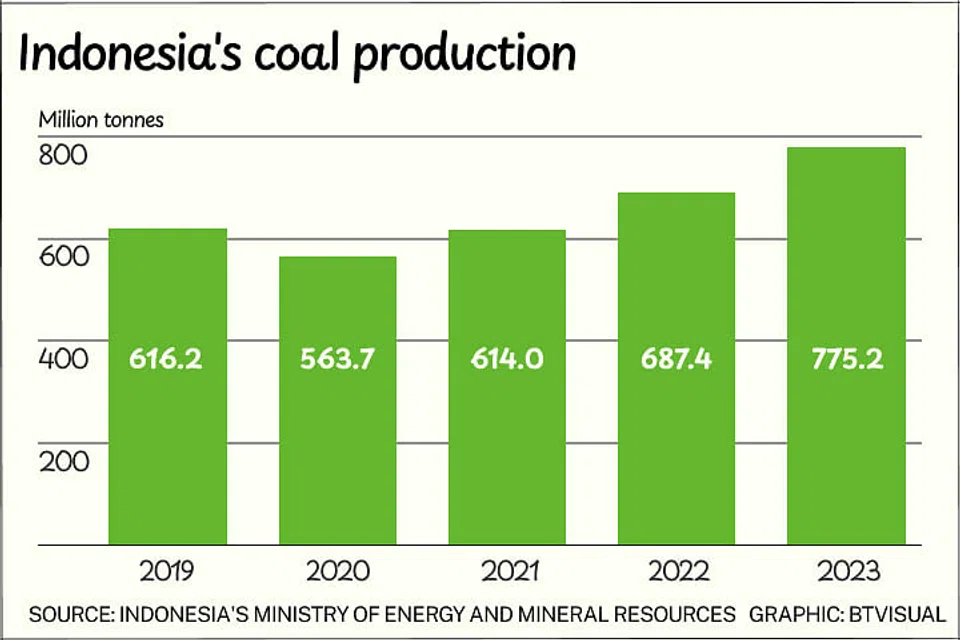
    • Indonesia’s coal production has been going up, overtaking the US and Australia as the world’s third-largest coal producer.
    • Indonesia’s coal production has been going up, overtaking the US and Australia as the world’s third-largest coal producer. GRAPHIC: BTVISUAL

    South-east Asia

    Ain’t no (coal) mountain high enough

    It seems a US$20 billion climate deal is not enough to stop Indonesia’s coal ambitions. 

    The country is aiming to produce 710 million tonnes of coal in 2024, its Energy and Mineral Resources Minister Arifin Tasrif said recently.

    This comes after Indonesia hit a record output of 775 million tonnes in 2023, which was way above its target of 695 million tonnes. Around 518 million tonnes of that coal was exported – cementing the country’s status as the world’s largest exporter of thermal coal. 

    No doubt, a target of 710 million tonnes represents a reduction. At 8.4 per cent, however, the reduction is uninspiring for a country that has committed to weaning itself off coal.

    Coal production in Indonesia has been steadily increasing.

    In the last five years, Indonesia has overtaken the US and Australia to be the world’s third-largest producer of coal. China is the largest, and India is the second largest.

    A collective of developed economies has offered to help Indonesia reduce its on-grid power sector emissions – to no more than 250 million tonnes of carbon dioxide equivalent – and to increase its share of renewable energy generation to 44 per cent, all by 2030.

    In spite of that offer, dubbed the Just Energy Transition Partnership (JETP), Indonesia’s National Energy Council has recently proposed cutting its renewable energy target to between 17 per cent and 19 per cent of total energy use by 2025, down from 23 per cent.

    Only 13 per cent of the country’s energy mix was represented by renewables last year, and about half was powered by coal.

    Coal is not just an important source of energy. It is also an important source of livelihood.

    Across the archipelago, around 160,000 workers are employed in coal mining. According to an analysis by the Global Energy Monitor, the shift to clean energy would result in around 30,000 coal miners being displaced between 2020 and 2040. 

    Indonesian officials have said the grant and concessional funding from JETP is insufficient to plug the resulting gaps from a bigger coal withdrawal.

    Complicating matters further: A price cap on domestic sales of coal has meant that coal-fired power generation is cheaper than renewables. Power producers do not have the financial incentive to make a transition.

    With the coal industry entrenched in every aspect of Indonesia’s economy and energy infrastructure, the need for policy reform was recognised in the JETP investment plan.

    How that policy reform can be pushed through, especially in an election year, is unclear.

    Other South-east Asia reads

    South-east Asia’s private equity investors eye healthcare, energy, digital infrastructure

    Malaysia to review migrant labour deals to stamp out exploitation

    Singapore

    Companies ramping up on nature-based disclosures

    Corporations in Singapore are entering the next phase of sustainability reporting, with five companies here among the first 300 in the world to be making nature-based financial disclosures based on the framework developed by the Taskforce on Nature-related Financial Disclosures (TNFD). 

    Among the early adopters are UOB, City Developments, and two of Olam’s subsidiaries.

    To be clear, these companies, as well as several others listed on the Singapore Exchange, have been taking stock of nature-related impacts in their annual or sustainability reports.

    TNFD’s finalisation of its framework in September last year, however, will give them a more standardised set of ground rules for reference.

    The framework was also designed to be consistent with the disclosure standards put forth by the International Sustainability Standards Board (ISSB) – standards that companies may have to align their reporting to from their 2025 financial year, with regulators mulling over whether to make it a requirement.

    How equipped are companies here to make meaningful nature-based disclosures?

    Not so much, according to a study by the Centre of Governance and Sustainability – a research institute under the National University of Singapore’s Business School.

    Nature reporting requires companies to assess risks from, for instance, biodiversity loss or water scarcity. GRAPHIC: BTVISUAL

    Singapore companies had a disclosure rate of 27.1 per cent when it came to nature reporting, based on the researchers’ assessment of their 2021 and 2022 sustainability reports. This put Singapore in the bottom half among Asia-Pacific markets that were part of the study.

    Of course, this data is not the most recent. Companies may have since improved on their nature-related reporting.

    Companies that have already been making disclosures based on the framework established by the Taskforce on Climate-related Financial Disclosures would have an advantage in starting on nature-related reporting since the TNFD framework has the same four pillars.

    TNFD reporting comes with another difficulty: metrics are dependent on location.

    Climate reporting focuses a lot on carbon emissions, which have a universal unit of measurement in the form of tonnes of carbon dioxide equivalent.

    Nature reporting requires companies to assess risks from, for instance, biodiversity loss or water scarcity. There are varied methods of data collection, and the expertise required may be highly specialised.

    This could mean that companies have to spend more if nature-related reporting is assessed to be relevant for their businesses.

    Other Singapore reads

    Temasek-backed ABC Impact secures US$550 million impact fund, expects final close in 2024

    Singapore players anticipate resurgence in voluntary carbon market activity

    Good reads

    Temasek-backed Climate Impact X lays off ‘a few’ employees

    Forest offsets with carbon leakage safeguards are preferred but could still be flawed