ESG Insights

Issue 90: Singapore’s PUB to capture seawater’s carbon; CBAM won’t save the world

Kenneth Lim
Published Fri, Mar 1, 2024 · 07:30 PM
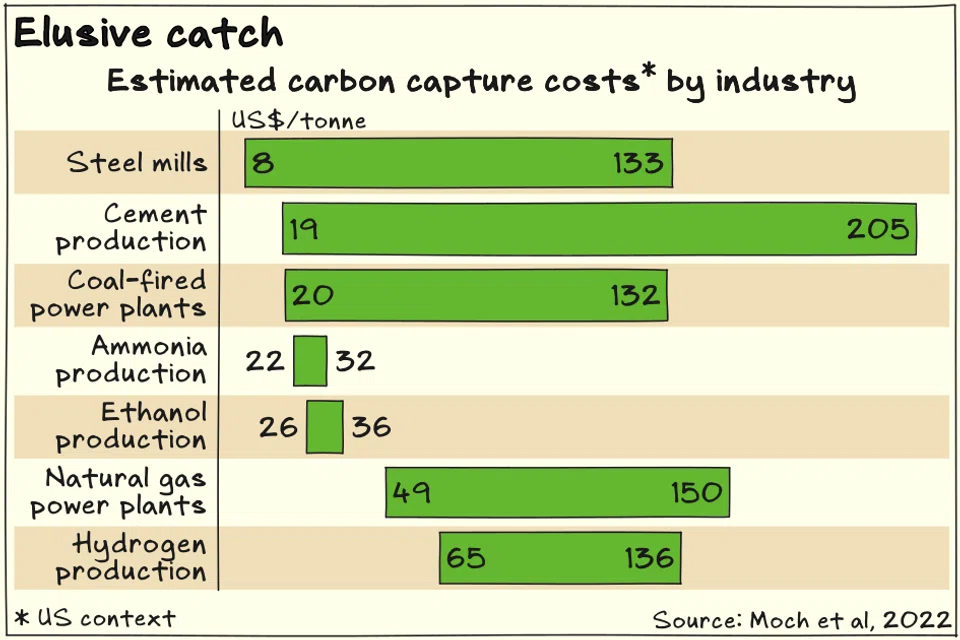
    • Cost projections for carbon removal vary widely, but low cost at large scales continue to elude the industry.
    • Cost projections for carbon removal vary widely, but low cost at large scales continue to elude the industry. ILLUSTRATION: KENNETH LIM

    In this issue: A planned seawater-based carbon capture project must overcome cost and scale hurdles, while the Asian Development Bank report says Europe’s carbon levy on imports won’t decarbonise Asian manufacturers.

    Singapore

    To catch and not release

    Singapore will build a US$20 million marine-based carbon dioxide (CO2) removal plant that aims to remove about 3,650 tonnes of the greenhouse gas per year from seawater.

    To become a commercial reality, the project’s technological innovations will have to cross a number of hurdles: cost, scale and ecological impact.

    The plant is a joint effort by Singapore’s national water agency PUB; US startup Equatic; and the University of California, Los Angeles (UCLA).

    The underlying principle of Equatic’s technology is that the earth’s oceans and seas continuously absorb a considerable amount of CO2 from the atmosphere, so a similar mechanism driven by electrolysis can be used to capture CO2.

    Equatic extracts hydrogen from seawater through electrolysis, then passes atmospheric air through the now-alkaline seawater, which traps the CO2 in the air as soluble carbon salts or as carbonate precipitates.

    The seawater is then neutralised before being returned. The precipitated carbonates are similar to the stuff with which seashells are made, so they are stable storage media for the extracted carbon.

    Equatic’s technology happens to straddle two hot areas in climate change at the moment. Amid mounting criticism about the viability of more conventional direct air capture, the CO2 removal sector has found a new wave of popularity with ocean-based carbon removal solutions.

    Equatic’s approach doesn’t just sequester CO2 through seawater, though. It also produces hydrogen as a by-product, which allows the company to dangle the possibility of green hydrogen – hydrogen that is sustainably produced – before investors.

    The three partners have worked together on two pilots –in Singapore and Los Angeles – each with an annual removal rate of 36.5 tonnes of CO2.

    When fully operational in 2025, the new plant is expected to have an annual removal rate 100 times as high.

    The key objective of the new plant is to demonstrate that scaling up means lowering unit costs. Equatic said it has started developing a larger, commercial-scale plant that will remove CO2 at three times the rate of the coming Singapore plant, relying on improvements developed in Singapore. That commercial plant is planned for as early as 2026.

    Cost is a major challenge for carbon removal and storage technologies. The industry is aiming to achieve less than US$100 per tonne of CO2 removed by 2030 at a gigatonne scale. The US$100 target is believed to stem from the US Department of Energy’s Carbon Negative Shot goal launched in 2021.

    There is considerable debate about whether US$100 per tonne is realistic. Technology that relies on concentrated CO2 streams – such as a scrubber in a factory exhaust system – can be relatively cheap, from less than US$10 in industrial processes with highly concentrated CO2 streams, to just over US$100 per tonne with more diluted streams. However, these industrial solutions only work under specific conditions and won’t scale up enough to meaningfully remove CO2 from the atmosphere.

    Solutions that can remove CO2 from the atmosphere, whether through direct air capture or through seawater, are much more expensive largely because the concentration of CO2 in nature is rather diffuse. An estimate by the International Energy Agency puts direct air capture’s cost between US$134 to US$342 per tonne. Furthermore, many solutions can be energy-intensive, which means that a negative carbon footprint can be achieved only if sufficient renewable energy is available.

    Some of the key variables that will affect Equatic’s cost and scale include their source of electricity and the cost of green hydrogen. Because Equatic’s product aims to remove CO2, it needs to consider the emissions generated from its power consumption so it isn’t generating more CO2 than it’s putting away.

    The excess hydrogen Equatic produces could be sold to offset operating costs; for every tonne of CO2 removed, Equatic produces about 30kg of hydrogen. This is, however, an uncertain pathway to cost reduction because there are also significant efforts underway to bring down the cost of green hydrogen.

    The same year that the US Department of Energy set its US$100 per tonne target for CO2 removal, it also set a US$1 per kg goal for green hydrogen. One hand giveth, the other taketh!

    Cost will ultimately determine the level of demand for Equatic’s solution. In Singapore, for instance, current official indications for the carbon tax are for the rate to be between S$50 per tonne and S$80 per tonne of emissions by 2030.

    Even if Equatic brings its cost down to S$90 per tonne, companies paying Singapore’s carbon tax rate in 2030 would probably not want to pay more to Equatic to offset their emissions.

    Users also have a choice of many different ways to reduce emissions, such as using renewable energy. Costs of solar energy, for instance, have been falling over the years, which makes it a natural choice over more expensive decarbonisation options whenever circumstances allow for solar.

    PUB will also have to decide whether the money for the project might be better spent elsewhere if Equatic’s performance falls below expectations.

    Another issue Equatic could face, one which might take time to properly study, is the ecological impact of its solution. By extracting carbon from seawater, Equatic’s process changes the composition of minerals in the water.

    When carbonates are precipitated out, for instance, minerals such as calcium and magnesium in the water are also reduced. An environmental impact assessment will need to consider whether the process is enough to meaningfully affect local ecosystems – especially if a plant is operating at a significant scale, is stationary, and its ecological impact accumulates.

    Other Singapore reads

    Asia

    CBAM won’t save the world. Surprised?

    Europe’s Carbon Border Adjustment Mechanism (CBAM) might not be effective in lowering greenhouse gas emissions, and could instead hurt developing countries in Asia, the Asian Development Bank (ADB) said in a new report.

    CBAM imposes a tariff on imports into the European Union in six high-carbon sectors. The levy was introduced as a way to plug a hole in Europe’s emissions trading scheme – European companies could have moved their supply chains overseas to avoid having to account for the emissions from those supply chains at home.

    With the tariff, imports from suppliers that are not paying an appropriate carbon price for their emissions will not be cheaper than goods that face carbon pricing.

    ADB said CBAM will reduce imports from Asia into Europe but will probably not help reduce greenhouse gas emissions. That is because carbon-intensive Asian manufacturing will continue to grow even with diminished exports to Europe. CBAM’s scope is also limited to a handful of sectors, not the full spectrum of trade between the two continents.

    ADB argued that it might be more effective for Europe to share emissions-reduction technology with Asia.

    Many cynical businesses in Asia reading the report will probably go: “But of course! This policy was always about protecting domestic business rather than about saving the Earth!”

    Yes and no. CBAM is about levelling the playing field for European businesses that are paying for their carbon emissions and could be uncompetitive against businesses elsewhere that don’t face that cost. So, it wouldn’t be far off the mark to view CBAM through a protectionist lens.

    Still, CBAM is plugging a hole in emissions policy – which means it is still about addressing climate change. If the EU’s carbon pricing policies leak, those policies won’t work.

    The important takeaway from the ADB report is that there is a win-win path for both sides. Technology sharing and developmental aid could lay the foundations for longer-lasting impact.

    Climate change is a global problem. The EU’s environmental policies won’t matter if the rest of the world isn’t able to cut its emissions as well.

    Other South-east Asia reads

    Other good reads