Issue 95: Dissecting Singapore banks’ financed emissions; justifying the just transition

In this issue: Banks’ financed emissions mostly improved despite some trouble spots, while standard ways of assessing impact might not be enough to understand the trade-offs in a just transition.
Singapore
Banks’ financed emissions: What year is it?
Singapore banks are making headway in lowering the emissions intensity of activities they finance in the aviation, power and real estate sectors but are facing challenges in timely reporting.
All three of Singapore’s local banks have published their latest sustainability reports, and the numbers show overall progress in reducing their financed emissions. DBS, OCBC and UOB are all on track or ahead of their glide paths in most of the key sectors in which they have made net-zero commitments.
Here are some takeaways.
Reporting isn’t timely
Of the three banks, DBS was the only one that provided financed emissions figures for 2023. OCBC and UOB’s numbers were only for 2022, even though their sustainability reports were for 2023.
OCBC has explained that its financed emissions numbers rely on clients’ reported emissions data, which are typically published at least three months after the clients’ respective financial years. The bank therefore publishes 2022 financed emissions in its 2023 sustainability report. UOB’s 2022 financed emissions numbers in its 2023 sustainability report come from an October 2023 progress report published by the bank.
Financed emissions are considered Scope 3, which are the emissions that a company indirectly generates in its supply chain. OCBC illustrates the timing challenges of reporting Scope 3 numbers. Since some Scope 3 emissions are generated and measured by other entities, some companies may face delays in their Scope 3 disclosures. This would make it difficult to get a complete picture of some companies’ ESG performance in a timely manner. It would be like having to wait an extra year or half a year to get one line item on the company’s balance sheet.
OCBC and UOB will soon have company in trying to get timely Scope 3 data. Scope 3 reporting is expected to become mandatory for Singapore-listed companies for fiscal 2026 onwards.
For some companies, not having timely Scope 3 numbers would not be a big deal for stakeholders. For instance, most of an airline’s greenhouse gas emissions are considered Scope 1, which are directly generated through its operations. However, most of a bank’s emissions fall under Scope 3 since the emissions generated by a bank’s loans far outweigh the emissions that the bank generates on its own.
Calm before the storm for airlines
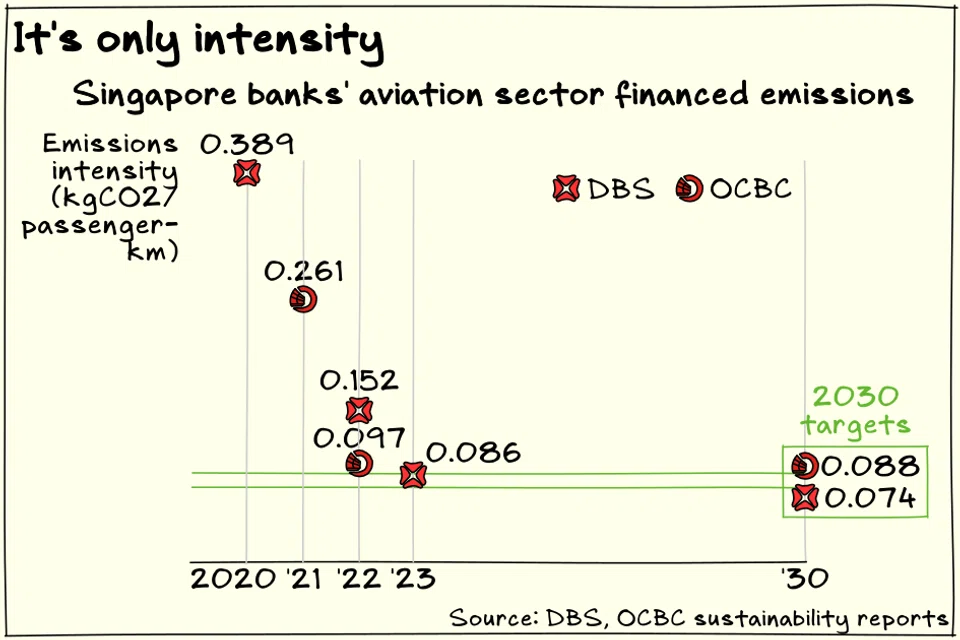
A quick glance at the financed airline emissions for DBS and OCBC suggests a sharp improvement in the emissions intensity in that sector, but a deeper dive shows that things aren’t as rosy as they might appear.
Aviation emissions financed by DBS almost halved to 0.086 kilogrammes of carbon dioxide per passenger kilometre (kgCO2/passenger-km) in 2023 from 0.152 kgCO2/passenger-km a year earlier. For OCBC, the sector’s financed emissions fell to 0.097 kgCO2/passenger-km in 2022 from 0.261 kgCO2/passenger-km in 2921.
The big drop in emissions intensity means that both banks are ahead of their respective targets for the sector. While this gives the banks and their airline clients some breathing room to meet their 2030 interim goals and eventually get to net zero by 2050, it is unlikely that they can maintain this pace of improvement.
That is because the reduction in emissions intensity reflects the airlines’ higher load factor as travel and freight recovered after the pandemic. Emissions intensity for the sector is calculated per passenger kilometre, which means that emissions intensity is lowered if there are more passengers on a plane. The reduced emissions intensity doesn’t mean that the aircraft have become cleaner.
Indeed, DBS acknowledged that airlines “remain heavily dependent on fossil fuels, with the majority of emissions in the aviation sector coming from fuel burned during flight”.
Furthermore, DBS explained that aircraft have long lifespans, which slows down the pace at which fleet renewal replaces more pollutive aircraft with newer, cleaner ones. Sustainable aviation fuel is currently also highly expensive with limited supply, a significant hurdle to the transition to cleaner fuels.
It’s also important to keep in mind that DBS and OCBC report emissions intensity for the aviation sector, not absolute emissions. Although intensity is down, it’s highly probable that absolute emissions have gone up with more planes in the skies. Until and unless the aviation sector can significantly reduce emissions intensity via cleaner aircraft, the sector is still a major contributor to global warming.
Progress in power, property
All three banks showed progress in greening the power and real estate portions of their portfolios.
A key driver of emissions intensity reduction in the power sector has been the growth of the renewable power slice of the banks’ portfolios.
In real estate, improvement also reflects portfolios with higher proportions of greener buildings.
Steel stuck at DBS
While UOB and OCBC are ahead of schedule in reducing the emissions intensity of their steel loans, DBS is behind where it needs to be for the steel sector.
DBS financed emissions to the steel sector were 1.95 kilogrammes of carbon dioxide equivalent per tonne (kgCO2e/tonne) in 2023, just slightly below the 1.99 kgCO2e/tonne reported for 2022. DBS describes it as “almost on track”, but emissions intensity for the sector has not changed from the bank’s baseline year of 2020.
The bank seems to suggest that the problem might be the glide path it is using. DBS said it is “assessing the feasibility of adopting a regional reference scenario more suited to our clients’ profile and host countries’ status of economic development, compared to the global version used to date”.
UOB uses the same global reference scenario as DBS. OCBC uses the regional version of the scenario.
Other Singapore reads
- Frasers Property to install 4,500 sq m of solar panels in its properties in SP Group tie-up
- Jurong Island: In search of a new miracle
South-east Asia
Is the just transition justified?
Fidelity International chief sustainability officer Tan Jenn-hui says that ESG has stopped being the Platonic ideal of “make money by doing good”, and evolved into an acknowledgement of trade-offs.
He says this in the context of a “just transition”, explaining that Fidelity looks for companies that can navigate the just transition as it seeks out potential long-term winners.
How is the just transition, which refers to an equitable decarbonisation journey, integrated into Fidelity’s decisions? Tan explains that Fidelity balances climate metrics with “just transition” metrics such as employee management, community impact and contributions to keeping basic goods such as electricity affordable.
Fidelity’s approach is a commendable one in that it seeks to take a holistic view of a company’s impact, and Tan is absolutely correct that there are often trade-offs that have to be made when it comes to ESG investing.
But the standard ways of measuring impact may not be appropriate for distinguishing between an investment that is truly supporting a just transition and one that is masking a profit grab.
As the United Nations Climate Change Secretariat puts it, a just transition at its core “means transforming the economy and economic system in a way that is as fair and inclusive as possible to everyone concerned, creating decent work opportunities and leaving no one behind”.
In terms of a sustainable energy transition for a developing country, fairness typically manifests as subsidised costs borne by developed countries and other sources of concessionary capital. An example of a just transition initiative is the Indonesian Just Energy Transition Partnership (JETP), which receives significant funding from Europe.
But is the concessionary capital being put to use in a way that is inclusive? It’s imperative that transition projects are held accountable for the extent to which their benefits are distributed; otherwise, those projects could end up disproportionately enriching a privileged group of investors.
For instance, an emerging structure for early coal phase-out is to make whole the power plant’s investors. But is that an optimal way to use concessionary capital? Could that capital be better used by building a renewable power plant, importing renewable energy, or subsidising the cost of renewable energy? Could lawmakers impose higher carbon prices so that the “young” coal plants stop being viable on their own?
In other words, is the trade-off worth it?
Other South-east Asia reads
- Only 12% of Asia’s investors plan to invest more into climate solutions: AIGCC
- Shell, Saudi Aramco in final stage of Pavilion Energy talks: sources
Other good reads
TRENDING NOW
Grab CEO’s wife Chloe Tong on life with Anthony Tan and finding her purpose
HDB reviewing ‘jumbo’ flat scheme after Telok Blangah unit listed for sale at S$2.18m
He built the Vingroup empire. Now South-east Asia’s richest man is handing some key roles to his sons
Singapore judge raises doubts iron ore trader Radiant World is owed US$1 billion