

Prudential CEO Anil Wadhwani has a ‘simple’ strategy to reinvent the insurance experience

Tan Nai Lun
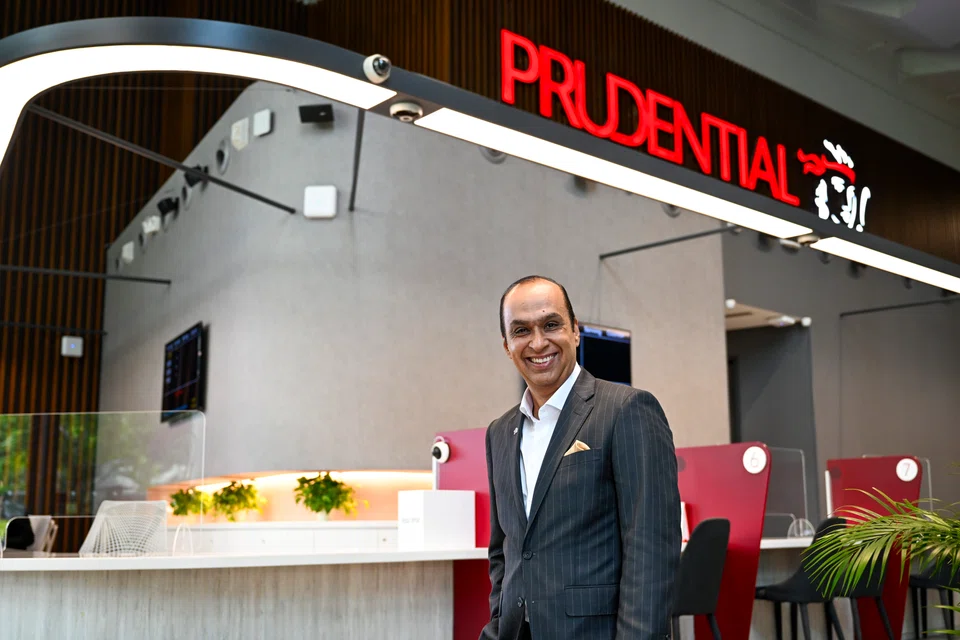
PRUDENTIAL chief executive officer Anil Wadhwani is on a mission to drive the insurance group through its next phase of growth.
The insurer plans to improve technology functions across the company, as part of its new strategic direction to boost customer and distributor experience.
“I believe that the strength of our strategy is in its simplicity,” said Wadhwani, who took over the reins at Prudential in February.
He noted that customers today are no longer only buying products and services. Instead, they are also buying experiences.
With this in mind, the insurer has set its sights on ranking in the top quartile in the net promoter score – not just within the insurance sector, but also benchmarked against others outside the industry.
The market research metric is based on a single survey question, asking respondents to rate the likelihood that they would recommend a company, product or service to a friend or colleague. It is used to measure the loyalty of a company’s customer base and customers’ experiences of a brand.
“Customers consume services from us, and they consume services from other players as well. To be (in the) top quartile, they will make those comparisons,” Wadhwani said. “If we are able to provide them with distinct experiences, they will rank us high.”
Technology to drive experience
To this end, Prudential is investing heavily in newer technologies that can lead to higher retention rates, customer acquisition and new distributed departments.
It previously said it would invest US$1 billion to grow customer experience, distribution and its health business, with a goal to grow its new business profit at a compound rate of 15 per cent to 20 per cent by 2027.
One of the key areas of focus is cutting down processing time.
Wadhwani cited some examples that the insurer is looking to scale up on, such as its artificial intelligence (AI) talkbot in Singapore, which reminds customers to make timely premium payments. Already, this has a customer response rate of 6.5 out of 10 times.
Its instant underwriting machine, which does not involve human intervention, also has an auto underwriting rate of close to 76 per cent.
“Imagine if we can replicate that across the different call centres that we have in our 24 markets, plus apply the same technology to different customer and distributor journeys,” he said.
The strategy update comes as the insurer shed its UK and US businesses in recent years, amid plans to focus on faster-growing markets.
Prudential now provides life and health insurance and asset management to 18 million customers across 24 markets in Asia and Africa.
Asia’s health and retirement theme
With the health and retirement theme expected to be a key growth driver in Asia, part of Wadhwani’s strategy is also to grow the insurer’s health insurance segment, and improve its wealth and investment capabilities.
Out-of-pocket health expenses reach as high as 50 per cent for some of the markets that Prudential operates in, Wadhwani said.
He noted that customer experience is not as seamless in many of its markets: “I believe that we can provide connected care for customers as they go through their health journeys.”
Furthermore, several of Prudential’s key markets have an ageing population. As life expectancy increases, customers will likely need savings for longer.
Meanwhile, the pandemic has amplified the needs of both health and retirement in the minds of its customers.
“I believe that we have a distinct role from not simply being a payer but also a partner with our customers, as they experience their healthcare journey,” Wadhwani said.
He also expects Prudential to better build products for retirement savings, given its in-house asset management capability.
The insurer owns asset manager Eastspring Investments, which Wadhwani said differentiates the insurer from its competitors, as it allows the Prudential to design products in-house and have a faster speed to market.
He said: “We are unique in a way where we have manufacturing capabilities on the insurance side, and also manufacturing capabilities on the asset management side.”
Looking ahead, Wadhwani hopes to build a mindset of constant improvement, to ensure that the insurer will stay at the top of the game.
“This is not a one-and-done (process),” he said. “We are constantly listening to customers and looking at areas where we can sharpen, improve and refine our processes to stay ahead of the curve.”
Position of strength
Wadhwani joined Prudential from Manulife Asia, where – as its president and CEO – he grew its multi-channel business and drove the modernisation of technology platforms in its markets in Asia.
The way Wadhwani describes it, Prudential has yet to realise its full potential.
In an earnings call accompanying Prudential’s first-half results, he said the insurer had lost market share due to its low speed of response and lack of differentiation in customer experiences, while its demerger had distracted it from building core capabilities.
He added that its technology investments have not strongly correlated with commercial outcomes, while its organisation model is not replicating success at scale and pace.
But Prudential is now approaching its strategy for change from a position of strength, Wadhwani said.
For H1 ended June 2023, Prudential posted net profit of US$947 million, swinging out of the red from a loss of US$1.5 billion a year earlier. This was boosted by a rebound in Chinese investors buying insurance products in its key revenue centre in Hong Kong.
New business profits – a measure of profitability for insurers – also rose 36 per cent to US$1.5 billion on an actual-exchange-rate basis.
Wadhwani noted that the 175-year-old insurer has a strong capital position to build its multi-market growth engine.
Prudential’s eligible group capital resources – in excess of prescribed capital requirements – stood at 302 per cent as at Dec 31, 2022.
Another advantage that the Prudential has, Wadhwani said, is that the insurer is a household brand in many of the markets it operates in. “We do not have to compromise growth in one market to grow the other,” he said.
TRENDING NOW

Once staunchly pro-China, Malaysian Chinese businesses are now distancing themselves from Beijing

Britain’s mansion tax shows the difficulty of targeting wealth

Three hats, one goal: How Ng Kian Swan runs sustainability at NUHS

COE review: The gap between luxury and mass-market cars isn’t the only one worth bridging

