

300 days into Ukraine war, what next?
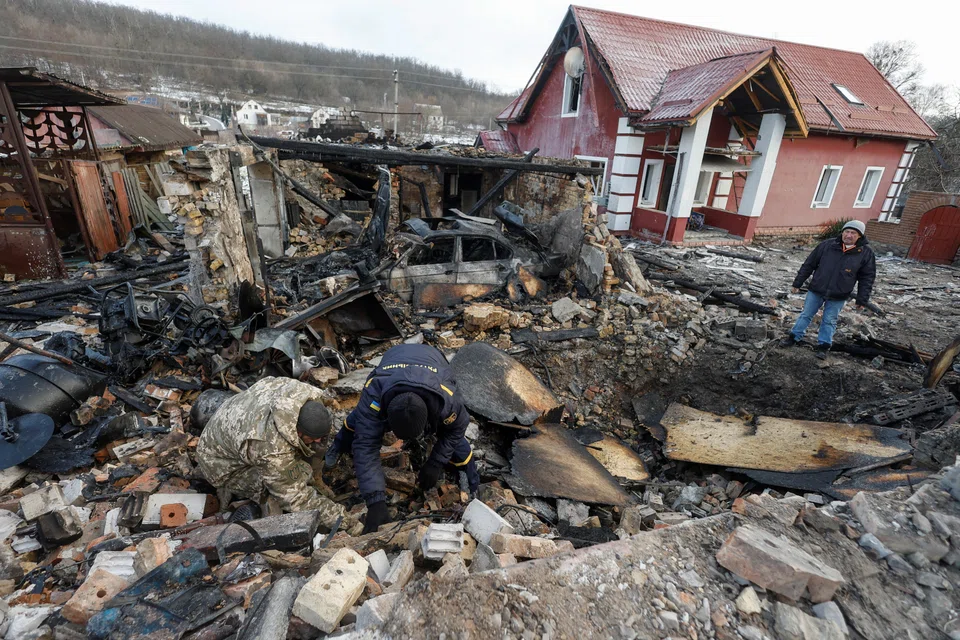
TUESDAY (Dec 20) marks the 300th day of the Ukraine war with as much uncertainty over the course of the conflict as there was during most of 2022.
Yet, while there remain many key unknowns, there are also fundamentals, too, that are most likely to continue to hold true during much of Q1 2023, before which time the war is likely to be conducted at a subdued level owing to the freezing weather on the battlefield. So these forces will shape the landscape in coming weeks, prior to what may be a full resumption of battlefield hostilities in spring 2023.
A first fundamental is that it seems neither side will win a decisive victory imminently. Historically, wars have tended to end in two ways: when one side imposes its will on the other on the battlefield, then at the negotiating table; or when both sides embrace a compromise they deem preferable to fighting. Unless something big changes in Q1 2023, neither of these outcomes is likely in Ukraine in coming weeks, especially as both sides are prepared to expend massive resources in the conflict.
The United States alone has already committed well over US$50 billion to Ukraine, larger than the entire annual Australian defence budget. Meanwhile, Western intelligence estimates that more than 100,000 Russian soldiers have already either died or been injured on the battlefield, illustrating the terrible human carnage that Russian President Vladimir Putin is prepared to unleash on his nation in pursuit of his war objectives.
What is largely unknown in the West is what the impact of this is in Russia in terms of the unpopularity of the conflict, and what this might mean for Putin and his strategy amid some speculation of a coup against the Russian president. One intriguing signal here came recently from Meduza, a website reporting Russian news from Latvia, which says it has obtained a recent confidential opinion survey conducted by the Federal Protection Service, which is in charge of guarding the Kremlin and providing security to top government officials.
The survey, apparently commissioned by the Kremlin, found that 55 per cent of respondents backed peace talks with Ukraine while 25 per cent wanted the war to go on. Levada Centre, a key Russian independent pollster, found in a similar survey carried out in November that 53 cent of respondents supported peace talks, 41 per cent spoke in favour of continuing the fight, and 6 per cent were undecided.
What this data appears to show is that, despite efforts of Russian authorities to enforce pervasive control of the information environment, the conflict has become increasingly tangible for many Russians, especially since the September 2022 partial mobilisation. Unless Russia achieves major battlefield successes in Q1 2023, maintaining even tacit approval of the war among the population may therefore be increasingly difficult for the Kremlin.
Nonetheless, the most likely scenario in coming weeks is still probably a continued “war of attrition”. Indeed, it is possible the conflict will last well into 2023 and potentially beyond, barring significant changes.
A second fundamental – even if the war continues at a subdued level during the cold winter months – is that the level and range of risks from the conflict remain exceptionally high, and this is why the outcome remains so unpredictable. In part, this is because Putin’s “exit strategy” remains unclear, and he may yet miscalculate, including the non-trivial possibility of chemical or nuclear weapons being used by pro-Russian forces if Ukraine continues to chalk up conventional battlefield wins.
Moreover, it is also important to highlight here that the announced strategy of the Western alliance led by the United States is to try to inflict a “defeat” on Russia. In the history of Nato in the post-war era, this is a very important difference from before and raises the stakes, if western resolve is maintained.
On that latter issue, while there will probably be further intra-Western tensions over strategy towards Russia in 2023, the most likely scenario is that the alliance will hang together over the difficult winter to come. In part, this is because of US leadership which will corral the partners together, including the disparate EU27.
US President Joe Biden’s Democratic Party defied US pollsters to retain in November the Senate and minimise losses in the House of Representatives. This means that Biden, while far from sure of re-election himself in 2024, has more political capital than expected in early 2023.
Thirdly, away from the battlefield, one other likely dynamic to continue in Q1 2023 is the continuing exodus of Western companies from Russia. Since Moscow’s invasion, over 1,000 major firms have now already cut (or reduced) business ties with Russia, by withdrawing (completely halting Russian engagements/exiting Russia); suspending (temporarily curtailing operations while keeping return options open); scaling back (reducing some business operations while continuing others); and/ or buying time (postponing future planned investment while continuing substantive business).
As Western sanctions grow, with the EU for instance recently formalising its ninth round of measures against Moscow, this economic decoupling is only likely to continue. Today, it is estimated that less than 230 major Western firms continue to operate in Russia.
One reason that there is likely to be a continuing outflow of Western businesses is the increasingly complex, difficult operating environment in Russia. Moscow is increasingly impatient, nationalistic and still reeling from what it considers to be illegal Western sanctions and expropriation of Russian assets overseas.
Pessimistic as this central scenario of a continued “war of attrition” into Q1 2023 may seem, with the human cost – including for millions of refugees – largest of all, it is not the worst-case outcome. That future is most likely to be realised if the conflict escalates beyond Ukraine to involve Nato countries, as remains a significant possibility.
While this still seems highly unlikely to many, it cannot be dismissed – such is the volatility of the situation. While Nato is doing what it can to support Ukraine without getting itself entangled in a direct military confrontation with Russia, miscalculation by one or both sides is a real concern.
Such miscalculation could be a genuine catastrophe for many, and use of nuclear or chemical weapons could not be ruled out. Moreover, not only would the regime of sanctions and counter sanctions grow, there would also be wider economic collapse, expediting the impulse towards de-globalisation.
Andrew Hammond is an associate at LSE IDEAS at the London School of Economics.
TRENDING NOW

Indonesia’s coal tycoon Low Tuck Kwong replaced as Bayan Resources president-director

OCBC names Ang Eng Siong as global corporate banking head in rejig of wholesale banking business

Consider lowering homeownership barriers for some non-resident foreigners

DBS opens flagship investment strategy to retail investors with new fund

