600 days into Ukraine conflict, Europe looks to ‘long war’
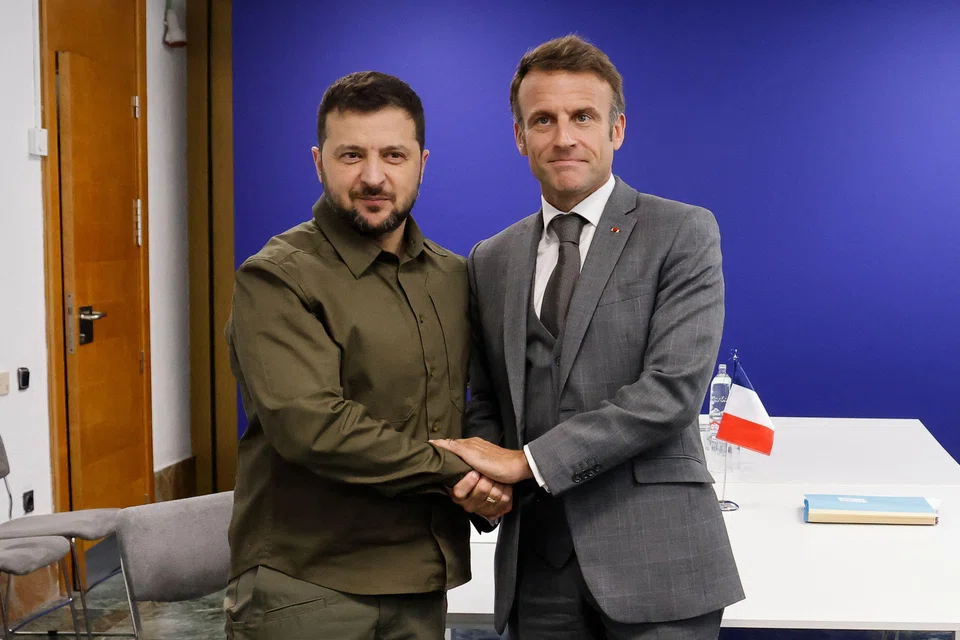
    • From left: Ukraine President Volodymyr Zelensky and French President Emmanuel Macron on the sides of the European Political Community summit at the Palacio de Congreso in Granada, southern Spain, on Oct 5, 2023.
    • From left: Ukraine President Volodymyr Zelensky and French President Emmanuel Macron on the sides of the European Political Community summit at the Palacio de Congreso in Granada, southern Spain, on Oct 5, 2023. PHOTO: AFP
    Published Tue, Oct 24, 2023 · 05:00 AM

    AS UKRAINE crosses 600 days of its grinding “war of attrition”, a potentially significant new dynamic is opening up.

    That is, the previously steadfast US support for Kyiv appears potentially now at risk from Washington’s political dysfunction. This may leave a critical gap that only Europe and its Western allies, including Japan, can try to at least – partially – fill.

    To be sure, the Biden administration remains strongly supportive of Ukraine. Yet, there are growing concerns over Washington’s ability to help finance Kyiv’s war effort in coming months because of a recent deal struck to avert a US federal government shutdown.

    While US President Joe Biden asked Congress on Oct 19 for over US$60 billion in new funding for Ukraine, he admitted earlier this month that amid gridlock in Washington it “does worry me” that US financial support for Kyiv might get derailed.

    This legislative drama would, of course, be only a foreshock of the political earthquake in Washington after the 2024 presidential election if a Republican sceptic of the Ukraine war wins. This especially so if former president Donald Trump were to emerge victorious given his apparent regard for Russian President Vladimir Putin, and disdain for Ukrainian counterpart Volodymyr Zelensky.

    So the current financial shenanigans in Washington may only be a foretaste of what is to come. It is in that context that Europe is considering how it can step up to the plate further to ensure Ukraine can fight from 2025 should the war still persists then.

    To be sure, there are real limits to the ability of the EU plus other European partners such as the United Kingdom to fill the big shoes of the United States. For instance, EU foreign policy chief Joseph Borrell has warned that the 27-member bloc will not be able to fully fill any funding gap left by Washington.

    What the Brussels-based club has done, however, is start to move forward with around half the previously promised EU aid to Ukraine – 50 billion euros (S$72.8 billion) over the next four years. This is to give Kyiv what Borrell called more “predictability and reliability” for its strained budget.

    This potentially significant change comes in a context whereby the “war of attrition” between Russia and Ukraine continues apace.

    Kyiv’s 2023 offensive has achieved some territorial gains, but the frontlines have remained stable for much of the year. In part, this is because of heavy Russian military mining, with Ukraine unearthing five mines for every square metre in some places, slowing advancement.

    The conflict has already resulted in over 20,000 civilian casualties, while well over five million people are internally displaced, and the number who have left Ukraine has crossed six million. Moreover, over 17.5 million people require humanitarian assistance, and Ukrainian economist Timofiy Mylovanov asserts that the nation’s workforce may be around a third smaller at the end of the war than it was before Russia’s incursion.

    To be sure, Ukraine has recaptured more than half of previously occupied territory, but Russia still holds around 20 per cent of the country. With both sides now digging in for the cold winter months ahead, making breakthroughs may become increasingly difficult, and the number of military casualties has now reached an estimated 500,000.

    So this looks increasingly likely to be a war that lasts into 2024, and potentially longer.

    It is in this context that renewed thinking is underway in Europe about how the 27-member bloc and non-EU allies such as the UK can best contribute to the resilience of Ukraine in the medium to longer term, including military assistance, security guarantees, and economic support such as access to the EU’s single market.

    A starting point for this forward commitment is the unprecedented support that Europe has provided Ukraine. The EU and member states, alone, have supplied economic assistance of over 76 billion euros, larger than that of the US, and Ukraine is moving towards starting accession talks to potentially join the EU too.

    However, as think tanks such as the European Council on Foreign Relations (ECFR) have asserted, even more will be needed to support Ukraine in any long war of years more to come. ECFR advocates for an urgent acceleration of European military assistance, necessitating a step change in Europe’s defence industrial capabilities, while bringing Ukraine not just into the EU but also the Nato club, as previous sceptics such as former US secretary of state Henry Kissinger now agree too.

    As part of this forward commitment, key EU leaders could also highlight to Ukraine that, during the Cold War, the Western alliance did not recognise Soviet control of the three Baltic states – Estonia, Latvia and Lithuania.

    Ultimately, these countries emerged free and democratic after the end of the Cold War. So there are potential parallels with those remaining parts of Ukraine now occupied by pro-Moscow forces, and this could be strengthened too with generous Western construction assistance, and security guarantees, for Kyiv.

    Beyond the war too, important commitments can be made on reconstruction. The rebuilding of Ukraine will resemble that of Western Europe after the Second World War, Eastern Europe after the Cold War, and the Western Balkans after the breakup of Yugoslavia. It will cost many hundreds of billions of euros, and be the most ambitious post-war reconstruction effort in the 21st century.

    Expensive as these commitments would be, ECFR asserts that they include upside opportunities for Europe to boost its longer-term military production capacities; enhance its geopolitical profile; and make it more fit for purpose for the 2030s by reconsidering its institutions and policies for a potentially significantly larger EU than the current 27 member states.

    Moreover, there could also be significant, wider benefits too from Ukraine being able to contest a long war with Russia, including a diminished future threat to wider European and global security from Moscow such as protection of economies and trade routes.

    Putin has shown that destabilising the international order, further, is a core element of his ambition which will be fuelled if he is perceived to win in Ukraine, and this might set a precedent encouraging states with similar, extraterritorial ambitions, including in Asia.

    Taken together, significant incentives exist for Europe to plan for scenarios whereby US support for Ukraine is diminished, before or after the 2024 US presidential election. While it is possible that Biden could win a second term, even this won’t guarantee continued US strong support for Ukraine in a context where political dysfunction in Washington may yet increase.

    The writer is an associate at LSE IDEAS at the London School of Economics