

900 days in, big change in Ukraine war narrative
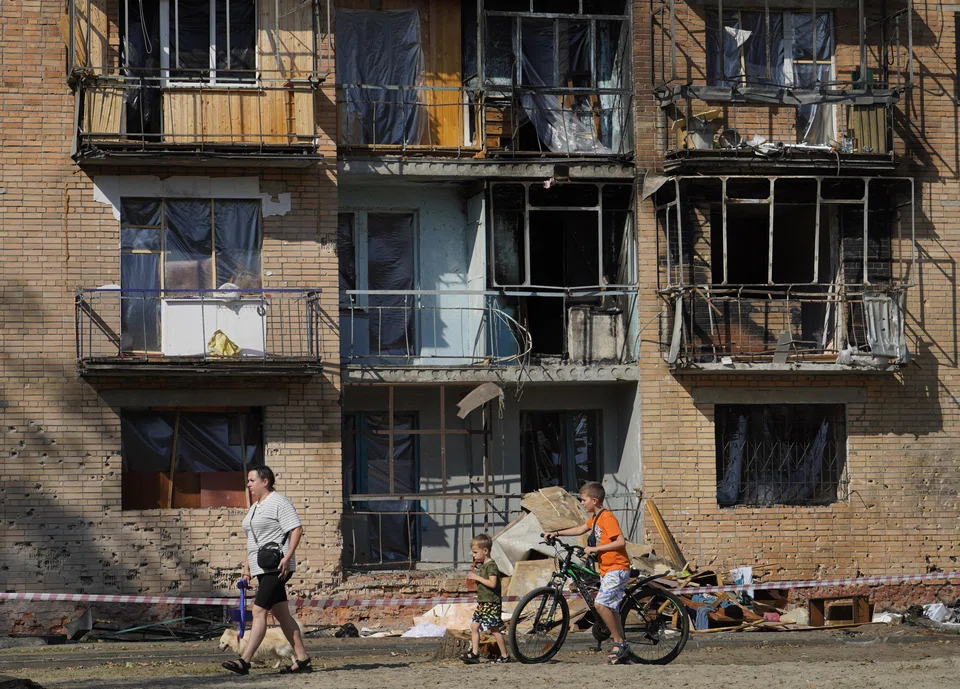
SOME 900 days into the Ukraine war, the most likely outcome in the coming months remains a continued war of attrition. However, August has seen a spectacular attempt to reframe the narrative of the campaign with Ukraine’s eye-catching incursion into Russia.
The surprise development has seen the greatest loss of western Russian territory since April 1944 during the Second World War. Ukraine asserts it has captured over 1,000 square kilometres (sq km) of territory, forcing tens of thousands of Russians from their homes, and capturing around 100 small-sized settlements.
This includes Sudzha which had a pre-war population of 5,000 people and contains infrastructure pumping Russian gas towards Europe. Ukraine has targeted this area, around 200 km north-west of the closest front line in Kharkiv, and 350 km from the main front line, because it is a weakly defended stretch of the border.
To put these gains into a wider perspective, it’s similar to the amount of Ukrainian land that Russia has managed to seize so far this year. However, it is much smaller than the 100,000 sq km (around 20 per cent of Ukraine’s total homeland) taken by Russia in recent years.
While Ukraine’s daring move may not ultimately turn out to be a “game changer” in the war, it has changed – at least temporarily – the story so far this year of steady Russian gains in Ukraine. This narrative has now been superseded by this recent operation.
Inevitably, the offensive has irritated Russian President Vladimir Putin who now has an even wider series of challenges to contemplate. This includes where Moscow should allocate its troop power.
Ukraine’s offensive deep into the Kursk region therefore adds to the challenges facing Moscow. After a troubled 30-month campaign, unverified estimates in recent days from the General Staff of Ukraine’s Armed Forces indicate that Moscow has lost around 600,000 troops.
Ukraine also asserts that Russia has lost some 8,500 tanks, 16,500 armoured fighting vehicles, 23,000 vehicles and fuel tanks, 17,000 artillery systems, 1,150 multiple-launch rocket systems, 900 air defence systems, 360 aircraft, 330 helicopters, almost 30 warships and boats, and one submarine. This underlines how, despite Moscow hoping for a quick victory within days, the war has not gone to plan.
Yet, multiple military experts are sceptical that Kyiv’s latest bold move will fundamentally change the course of the war, with Russian still on the offensive in Ukraine. Russia is estimated to have hundreds of thousands of troops on the front line; so diverting a few thousand soldiers may not have a large impact. This means Ukraine may not be able to hold its new Russian territory for the long term, as a potential bargaining chip in any future peace negotiations.
In this overall context, the most likely scenario therefore remains a continued war of attrition, potentially at least until the US presidential election in November. It is at that point when it will be clear if US support for Kyiv will remain steadfast under a Kamala Harris administration, or whether there will be a complete reversal under a second Trump presidency.
Under a President Harris, there is most likely to be broad-based continuity from the Biden administration’s policy. That is, the current pattern of avoiding escalation and providing military assistance only in small amounts to try to avoid direct confrontation with Russia will be maintained, and the war may become more protracted.
However, a big Donald Trump win could see him try to make good on his wholly unrealistic pledge to “end the (Ukraine) war in 24 hours”. This could see him seek to cut off support for Kyiv, a fear that has only grown since the selection of Senator JD Vance as his running mate, who has said that “I don’t really care what happens to Ukraine one way or another” and “the American people will not tolerate another endless war, and neither will I”.
It remains very unclear therefore what a Trump policy towards Ukraine would exactly look like. However, there is no question that it could be hugely different from that of President Joe Biden.
This is why there is so much Ukraine policy uncertainty emanating from the US presidential election. Hence, why Kyiv and its allies are undertaking much scenario-planning for 2025 and beyond.
Even in the event of a Harris presidency, there is every possibility that Ukraine will not achieve all of its strategic war objectives. If Republicans control one or more chambers of Congress, for instance, there could be significant attempts to frustrate the full policy ambition of Harris.
A growing number of Western experts therefore share the view of Peter Ricketts, a former UK national security adviser, who highlights the possibility of a Korea-style scenario. This would see Russia keeping control of perhaps around a fifth of pre-war Ukraine, the amount of territory it controls today, and the remainder moving in a pro-Western direction in the years to come.
However, a potential Trump presidency might see even this scenario become unrealistic. What US allies, especially in Europe, are particularly concerned to avoid is any result that is perceived as a big Russian victory which, it is feared, would only embolden Moscow and its allies across the world.
One measure of the stakes at play after a potential Russian “victory” is that Putin would move closer to controlling around a quarter of global wheat exports. At some future stage, this could see Moscow seeking to weaponise this key food stock in a way that it has sometimes done with energy before.
This is why US allies, especially Europe, are thinking through how they might be able to “buy Ukraine time” in 2025 under a potential second Trump presidency. What the European Union has done, already, is move forward with around half the previously promised aid to Ukraine – 50 billion euros (S$72.5 billion) over the next four years. This is to give Kyiv more predictability for its strained budget.
Beyond this, the Italian-chaired G7 is also looking at ways to seize US$300 billion in frozen Russian assets.
Brussels is also moving forward with accession talks for Ukraine to potentially join the EU. The West may at the same time put Kyiv on to a firmer pathway to possible Nato membership too.
Taken together, Ukraine’s eye-catching offensive may significantly change the narrative about the war, but is less likely to fundamentally impact the course of the conflict. More important, potentially, could be the result of November’s US presidential election, with possibly huge differences between a Trump and Harris administration, that could be a game changer for Kyiv.
The writer is an associate at LSE IDEAS at the London School of Economics
TRENDING NOW

Grab CEO’s wife Chloe Tong on life with Anthony Tan and finding her purpose
What role can Japan play in Asean’s future?

He built the Vingroup empire. Now South-east Asia’s richest man is handing some key roles to his sons
Asean’s challenge is to become resilient against global geopolitics: former Indonesia trade minister

