
ACFTA 3.0: Will it match the promises of RCEP and CPTPP?

ACFTA 3.0 aims to broaden the agreement’s scope to emerging areas such as digital and green economies
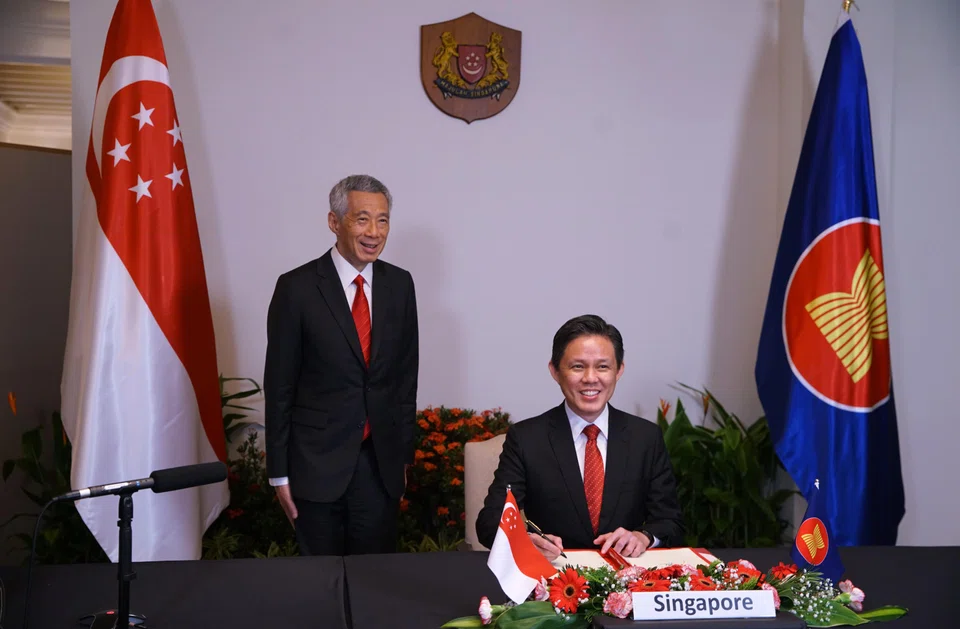
    • Chan Chun Sing (seated) signing the Regional Comprehensive Economic Partnership (RCEP) FTA on Nov 15, 2020. The RCEP represents the pinnacle of existing FTAs between Asean and China.
    • Chan Chun Sing (seated) signing the Regional Comprehensive Economic Partnership (RCEP) FTA on Nov 15, 2020. The RCEP represents the pinnacle of existing FTAs between Asean and China. PHOTO: MCI
    Published Thu, Jun 27, 2024 · 05:00 AM

    RECENT US tariff hikes on Chinese goods, including a quadrupling of duties on electric vehicles to 100 per cent, as well as markedly higher levies on various other products such as lithium-ion batteries, solar cells, and critical minerals have significantly shifted global trade dynamics. These new tariffs will not only push up US imports from South-east Asia but also nudge China closer towards Asean countries, emphasising the strategic need to revamp the Asean-China Free Trade Agreement (ACFTA).

    Since 2009, China has maintained its status as Asean’s largest trading partner, and likewise the region has, since 2020, emerged as China’s biggest trading partner. Asean has also reaped substantial benefits from the shift of supply chains from China to countries like Vietnam, Malaysia, Indonesia and the Philippines.

    Amid global challenges, China’s pivot towards becoming an innovation-driven economy, fuelled by advancements in technologies such as artificial intelligence, highlights South-east Asia’s critical role as a partner in fostering its technological self-reliance and expanding its market presence in digital infrastructure.

    Thus, the ACFTA, while a foundational agreement, needs to raise its game.

    From 1.0 to 2.0: Incremental progress, unmet potential

    Launched in 2003, ACFTA marked a significant milestone by eliminating tariffs on over 94 per cent of goods, creating one of the world’s largest free trade areas. The agreement’s step-by-step approach reflected a learning process for both Asean and China and laid a solid foundation for future upgrades.

    ACFTA 2.0, fully implemented in 2019, introduced several improvements, including streamlining rules of origin and certificate of origin procedures and broadening service commitments across sectors such as engineering and tourism. This boosted Asean-China services trade from US$21 billion in 2009 to around US$73 billion by 2021.

    However, ACFTA’s product-specific rules of origin remain old and stringent compared to advances in the Regional Comprehensive Economic Partnership (RCEP). Specifically, the drafting of the ACFTA protocol on rules of origin and the main general rules lacks clarity and transparency, leading to implementation challenges. Addressing these issues would require strong commitment by Asean members and coordinated efforts by its intergovernmental structures.

    ACFTA 3.0: Can it bridge the gap to RCEP standards?

    RCEP represents the pinnacle of existing free trade agreements between Asean and China, setting a high benchmark that the upgraded ACFTA must aspire to.

    RCEP’s streamlined customs procedures, such as faster release of perishable goods, application of information technology in customs clearance, and adoption of risk management checks, can serve as a more advanced model that ACFTA can benefit from adopting. These procedures are expected to bolster trade flows and lower trade costs and product prices more effectively than the WTO Trade Facilitation Agreement, upon which ACFTA upgrades are based.

    Similarly, RCEP’s provisions on investment offer a valuable blueprint for potential improvements in ACFTA. These include commitments to prohibit restrictive investment practices, such as mandating domestic content or technology transfer as conditions for market entry, expansion or operation in China. It also ensures that the relaxation of investment measures is locked in, thereby preventing backtracking on commitments. This framework is more progressive than the existing investment rules under ACFTA, which largely reflect earlier Asean agreements.

    Navigating new frontiers: digital and green economies

    ACFTA 3.0 aims to broaden the agreement’s scope to emerging areas such as digital and green economies to maintain relevance and effectiveness.

    Currently, ACFTA lacks significant commitments to the digital economy, with only a single article that calls for parties to cooperate on e-commerce promotion. In contrast, RCEP includes digital economy provisions, though they are broad and give member states considerable leeway in shaping their digital policies through exemptions for public policy goals, making them largely unenforceable. Despite covering essential areas such as digital trade, data flows and computing location, RCEP’s provisions do not substantially advance digital economic cooperation.

    Asean is addressing these gaps through negotiations for a Digital Economy Framework Agreement. Meanwhile, China’s interest in joining high-standard pacts on the digital economy, like the Comprehensive and Progressive Agreement for Trans-Pacific Partnership (CPTPP) and the Digital Economy Partnership Agreement, signals a move towards stronger digital rule commitments.

    With Brunei, Malaysia, Singapore and Vietnam already CPTPP members and others, including Indonesia, Philippines and Thailand, expressing interest in joining, digital rules and standards in the pact could serve as an excellent model for ACFTA 3.0. Given the strict commitments in the CPTPP and the gap in development within Asean, it would be prudent for ACFTA 3.0 to adopt a CPTPP-lite approach, maintaining flexibility for contentious issues while striving to meet higher standards.

    Additionally, unlike RCEP, which lacks an environmental focus, the CPTPP includes environmentally responsible trade and investment policies. The Singapore-Australia Green Economy Agreement further advances this approach, promoting interoperable green technology policies and sustainable finance, including a focus on environmental, social, and governance reporting and fintech solutions. This provides a potential roadmap for the evolution of the ACFTA.

    The complexity of crafting ACFTA 3.0

    Upgrading ACFTA to align with RCEP standards could mitigate the “noodle bowl” effect of existing FTAs among Asean countries and China. However, crafting an in-depth ACFTA 3.0 faces challenges due to the diverse interests and developmental stages of the 11 negotiating parties. This complexity could push negotiations towards pursuing the same old “lowest common denominator” provisions.

    Despite these hurdles, an upgraded ACFTA, focused on emerging trends, is crucial for enhancing economic resilience and fostering deeper regional integration. ACFTA 3.0 has the potential to set new benchmarks for regional trade agreements and contribute significantly to the broader regional framework, including RCEP in the future.

    The writers are researchers from the Asia Competitiveness Institute, Lee Kuan Yew School of Public Policy, National University of Singapore



