After the leeway provided in 2025, will 2026 be the time to tighten belts?
Government goodies and low inflation helped to support spending power this year. Next year does not promise the same

UNCERTAINTY has been the theme throughout 2025. Yet on several fronts, things have worked out better than expected for Singapore – or, at least, they could have been worse.
Much of the uncertainty, of course, began in January when US President Donald Trump threatened to levy tariffs on other countries.
In the ensuing months, the size, extent and timing of these tariffs continued to fluctuate. Uncertainties still linger over threatened sectoral duties on semiconductors.
Yet despite this, Singapore’s economic growth has come in better than expected. Granted, this was partly due to the early front-loading of exports – first, ahead of the April start date for tariffs, then continuing during a tariff pause. But the fall-off since then has not been as sharp as feared.
At the releases of both the second-quarter and third-quarter gross domestic product growth figures, the Ministry of Trade and Industry upgraded its forecast for full-year growth.
The labour market has also held up well. Nominal wage growth slowed to a rate of 5 per cent, down from 5.8 per cent the year before – but low inflation meant that real wage growth improved.
The preliminary estimate puts real wage growth for 2025 at 4.3 per cent, up from 3.4 per cent the year before.
Indeed, while the cost of living has been a worry in recent years – and was a hot topic in this May’s General Election – inflation this year fell to Covid-era lows.
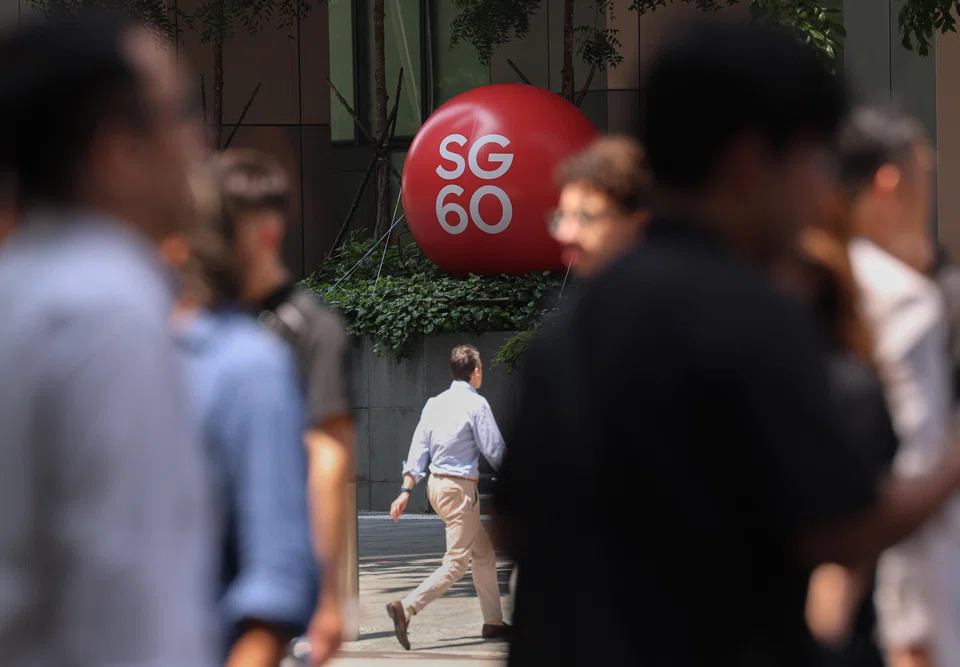
Meanwhile, the calendar has been full of government largesse, boosted not least by this year’s SG60 celebrations.
Apart from the usual U-Save vouchers and Service & Conservancy Charges rebates, there was a fresh S$500 in Community Development Council (CDC) Vouchers; SG60 Vouchers; the SG Culture Pass for local arts programmes; Climate Vouchers for energy efficiency; and an SG60 ActiveSG Credit top-up.
The Assurance Package was also enhanced, with payouts to come this December as well as in December 2026.
The party’s over
Yet that final tranche of Assurance Package payouts may be an outlier. Budget 2026 may be a more modest affair, resulting in a sparser calendar of handouts.
Most obviously, the SG60 celebratory goodies were a one-off. But Singaporeans should not necessarily count on the continuation of the CDC Voucher scheme.
The scheme, after all, was introduced during the Covid-19 pandemic to help Singaporeans through those tough times. While new tranches have continued to be launched, there is no guarantee that they will continue indefinitely.
Meanwhile, real income growth is likely to be squeezed from both directions in 2026.
Employers are reportedly less upbeat about wage increments and bonuses next year. This is in line not just with continued uncertainty, but also an expected slowdown in growth.
Full-year GDP growth is forecast to cool to a range of 1 to 3 per cent next year, down from around 4 per cent this year.
At the same time, inflation is expected to rise somewhat in the year ahead. The latest official forecast range puts headline inflation at 0.5 to 1.5 per cent in 2026, up from an expected 0.5 to 1 per cent this year.
Household spending power has benefited from many sources of support in 2025. With most of these being removed or weakening next year, it remains to be seen how well consumption will hold up.