THE BROAD VIEW

AI’s potential damage to economies

Worlds collide as artificial intelligence removes more and more goods and products from GDP calculations
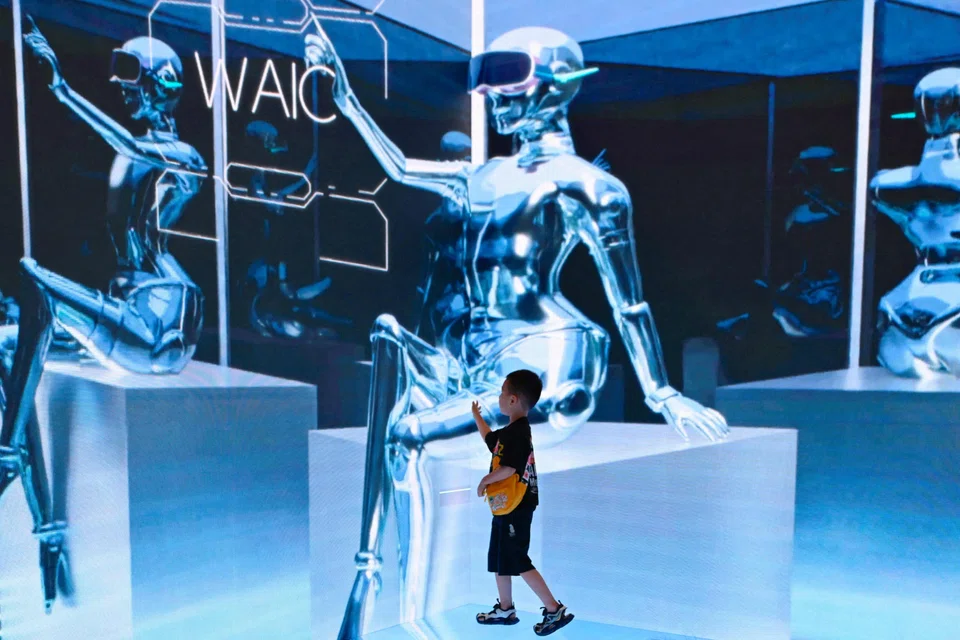
    • In this millennium, technology has been a massive deflationary force for anything that computers, programmable machinery and automation can do.
    • In this millennium, technology has been a massive deflationary force for anything that computers, programmable machinery and automation can do. PHOTO: AFP
    Published Sat, Sep 9, 2023 · 05:00 AM

    LIKE many people, I have been thinking about artificial intelligence (AI) a lot lately.

    I am not a computer engineer or an expert in large language models. Although my thoughts and opinions are often the amalgamation of other people’s ideas, I like to think that I can synthesise concepts from diverse sources – plus some of my own insights – to come up with a conceptual framework that could help investors make informed decisions.

    It is not news that as technology advances, we become more sedentary, more enveloped in our own digital world. We become more reliant on systems to deliver things not just to our local supermarket, but now right to our doorstep.

    But the trade-off has been that, over time, amid the march of technology, especially in this era of powerful digitalisation, we have lost touch with the “analogue” – the physical real world.

    It has made us forget how to do things that were once everyday basic tasks. Who among us knows how to plough a field or send a telegram (not the cloud-based messaging app but cables) today? For the group reading this, I’ll bet the answer is zero. With every task, chore or life skill that we forget how to do because technology does it better, we end up becoming more dependent on external sources to help us navigate through life.

    Most people have a hard time seeing paradigm shifts from within an existing paradigm.

    But now, the AI cat is out of the bag and more people understand it in a tangible way with the chatbots. Why did it go so viral? Because ChatGPT is more than a glorified Google search.

    Where are we heading towards? We could get to a point where, very soon, technology itself produces further technological advancements. This will be a major development. For medicine, agriculture, genomics, education – the possibilities are limitless.

    We must think exponentially. Moore’s Law suggests that computing power doubles every 18 months or so, and the exponential growth in computing power has stayed on track for decades.

    But people have a very hard time thinking exponentially: we did not evolve to do so.

    When you do, you start to realise that AI is going to dematerialise... everything. Not just products, but services as well.

    In this millennium, technology has been a massive deflationary force for anything that computers, programmable machinery and automation can do. TV sets, cars, clothing, mobile phone services – everything has become cheaper and cheaper as the marginal cost of production goes lower and lower. And productivity gains in these areas have benefitted us in the form of lower prices.

    On the other hand, goods and services that need human interaction, such as healthcare and childcare, have all gone up significantly.

    What AI has done is to introduce massive productivity gains into even human-centred industries, and areas we aren’t even thinking of yet.

    AI is therefore possibly the solution to elevated inflation. There is one major problem, though. And it cannot be allowed to happen. Because our whole economic system is predicated on debt – which rapidly becomes insolvent if the scenario materialises.

    Herein lies the problem.

    For instance, calculator sales used to be accounted for in gross domestic product (GDP) numbers. A company produced and made money from them and paid taxes on the profits.

    Now, the calculator is free on your smartphone. But “free” doesn’t generate tax dollars for the company. The same is true for all the photos you take and much of the media you consume on YouTube.

    As products “dematerialise”, they get removed from the GDP.

    If more products and services go the way of the calculator, what would happen to the GDP part of the debt-to-GDP ratio that economists are so concerned about?

    Well, the ratio explodes higher. And the massive debt – US$32 trillion and counting for the United States, no thanks to higher interest costs – rapidly becomes a serious problem.

    It will be quite a challenge for central banks and governments around the world as AI dematerialises more and more items out of GDP calculations. The whole edifice of the global financial order is built on the idea that governments borrow to fund themselves, and then slowly inflate that debt away to pay back less in real terms.

    AI is turning that economic concept on its head.

    Blue or white collar, your job will be at risk. Many of your daily tasks will be automated soon. What happens then?

    I think social unrest, especially in the West, will be a possible scenario. Okay, all this sounds terrible. With high unemployment, there will be social strife. And then we support the politicians who promise to restore order to protect us.

    To take care of us, they print more money – which causes inflation.

    And now you see the paradox.

    Everything should be getting cheaper. That’s what technology is about. But it is running up against a system that, in trying to stay solvent and stable, demands that prices keep rising to keep the accumulated debt bomb from blowing up and to keep the debt and GDP levels justifiable.

    Even if GDP goes up, it does not make your calculators more costly. It might just mean the unit you are measuring them in is worth less.

    But AI does not care. All it does is keep speeding at an inexorable pace. It dematerialises more goods and services as the marginal cost of production trends towards zero for everything.

    And if AI productivity gains continue to increase exponentially and destabilise the system, the eventual money printing to stem the next crisis will also be correspondingly bigger than anything we have witnessed.

    But if you try to regulate AI, you just concentrate all that awesome power in a few hands. And this is exactly what we are witnessing with the incredible outperformance of a few powerful companies’ stocks – how they are basically carrying the key market indices. Those companies will likely continue to do incredibly well, enriching the owners of these stocks.

    To summarise where I think we are heading:

    Worlds collide. On one hand, AI productivity gains drive down the cost of everything. On the other, debt-laden money-printing economies need prices to rise forever, just to keep up nominal GDP “growth” and tax revenues. This is untenable, and it will lead to an eventual crisis.

    If you adjust for the money-printing effect, the S&P 500 index still has a long way to go before we get even close to dot.com bubble territory.

    I do not at all believe that this is a dotcom-type bubble. To me, a technology that gives us all immediate access to the entire corpus of all human knowledge is anything but a bubble.

    The companies will thrive. It is the governments that I am worried about.

    The writer is vice-president active adviser in Geneva, Indosuez Wealth Management