

Allow flexibility on 10-year minimum occupation period for homeowners with sufficient deterrents
Needs and financial circumstances of owners of HDB Plus and Prime flats and new EC units can change

[SINGAPORE] Increasingly, homebuyers have to get comfortable committing to holding their units for at least 10 years.
For new and resale Housing & Development Board (HDB) Plus and Prime flats, which, according to HDB, are in “choicer and choicest locations”, respectively, the minimum occupation period (MOP) is 10 years.
The MOP for Standard and unclassified flats is five years. During the MOP, the owner cannot sell the flat or buy private residential property, among other rules.
Among recently announced new measures, buyers of new executive condominium (EC) units will need to fulfil an MOP of 10 years instead of five before they can rent out their whole unit, buy another home, or sell their unit to Singapore citizens and permanent residents.
The change applies to EC projects built on government land sale sites with tender closing dates from May 8.
Certainly, many buyers occupy their homes for well over 10 years. After all, numerous owner-occupiers develop a strong attachment to their homes and are loath to incur the costs and hassle of relocating.
Importantly, imposing a 10-year MOP on some homeowners sends an important signal that homes in land-scarce Singapore should primarily be bought for occupation and not investment.
Between 2021 and 2025, among EC units that were transacted on the open market, about 75 per cent were sold within five years after their five-year MOP – might such a figure be too high?
Onerous commitment
Sure, HDB Plus and Prime Build-To-Order flats generally draw healthy application rates. Nonetheless, applying a 10-year MOP on certain homebuyers can be onerous and potentially problematic.
Take a young couple who purchase an uncompleted EC home with a 10-year MOP and wait four years to collect the keys to their new home. Might things become messy should the couple’s relationship break down within a 14-year period?
Applying a 10-year MOP to homeowners can be extremely harmful to housing mobility.
For example, when a couple’s relationship sours, being able to quickly get out of jointly owning a home could help the partners in building new lives and improve their mental well-being.
Consider, too, how a household’s needs can change over time. Perhaps a four-room HDB Plus or Prime flat or a three-bedroom new EC of about 960 square feet may be too small when a couple grows from being a two-person household to a much larger household, because they have three or more children or become a three-generational household.
A family who bought a home with a 10-year MOP might also like to divest the said property sooner than planned – not for financial gains, but due to a change in financial circumstances.
Jobs could be increasingly insecure amid disruptions, whether due to the use of artificial intelligence or supply chain fragmentation, among others.
People might thus need to get out of servicing a large housing loan or free up funds by selling an owner-occupied home as they retrain for other job opportunities or invest to start a new business.
In short, there can be a myriad of reasons why homeowners may find a 10-year MOP harms their well-being.
Of course, there is sound rationale for applying tough conditions on buyers of HDB Plus and Prime flats as well as new EC homes.
For one, eligible buyers enjoy higher subsidies when buying a new HDB Plus or Prime unit versus purchasing a new Standard unit.
Meanwhile, imposing stricter conditions on buyers might help keep new EC prices more affordable for eligible first-time buyers. This includes those who bust the household income ceiling of S$14,000 a month to buy a new HDB flat, but meet the monthly household income ceiling of S$16,000 to buy an EC unit from a developer.
In turn, buying a new EC home offers a cost-effective way to achieve condo ownership, as new EC units might be priced 20 to 30 per cent below comparable new condo units.
Relax MOP with disincentives
Still, there may be room to go easier with applying a 10-year MOP on owners of HDB Plus and Prime flats and new EC homes.
Perhaps, allow the above owners to sell their homes after five years and before the end of the MOP, but apply disincentives.
Seller’s stamp duty (SSD) is payable on all residential properties and residential lands that are acquired on or after Feb 20, 2010, and disposed of within the holding period.
For homes purchased on and after Jul 4, 2025, the SSD rate ranges between 4 and 16 per cent, with no SSD payable for a holding period of over four years. The rate of 16 per cent applies to a holding period of up to one year, while the rate of 4 per cent applies to a holding period of over three years and up to four years.
SSD is computed by applying the requisite rate on the higher selling price or market value of the residential property.
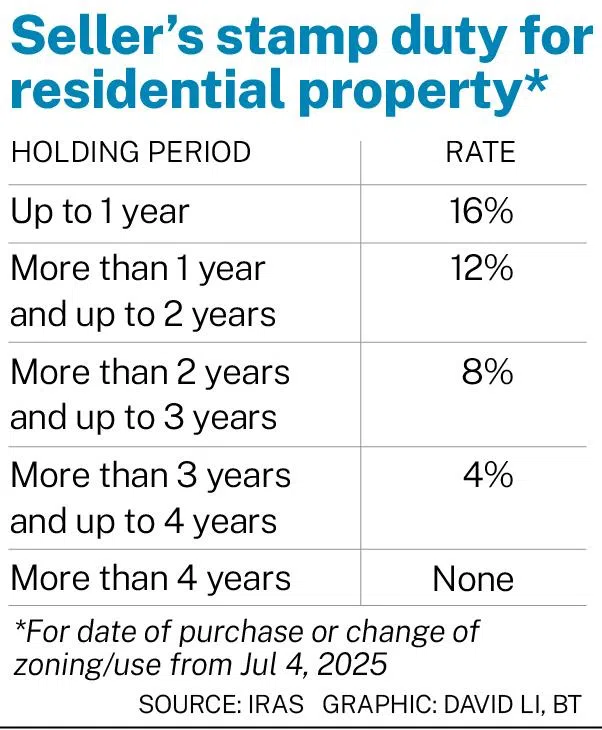
Perhaps levy stamp duty on a flat owner who is subject to a 10-year MOP when he sells his home after five years and before the end of 10 years. Consider applying different rates using a sliding scale based on an inverse relationship with the number of years of the MOP that the owner has fulfilled.
For example, allow an owner of a new HDB Plus or Prime flat to sell his home after occupying it for five years. But apply stamp duty of, say, between 4 and 20 per cent on the transaction price, in addition to levying subsidy recovery upon the resale of the flat when the unit is transacted after five years and before the end of 10 years.
The homeownership rate among Singapore residents is high, and homebuyers here have a range of choices.
Effective housing policies support the Republic’s successful housing system. However, said policies are a sensitive subject as they touch many lives. Correctly, policies are constantly refined to keep the housing system fair and prioritise the needs of first-time local owner-occupiers.
Much as HDB Plus and Prime flats and new EC homes can be attractive choices, buyers should think hard before committing to buying a home with a 10-year MOP.
While flipping of homes is rightly discouraged, housing mobility matters, too. With adequate deterrents in place, let’s consider giving more flexibility to flat owners who have trouble fulfilling a 10-year MOP.






