



Anwar’s unity government in jeopardy over ally Umno’s poor showing in state polls

Dennis Chan
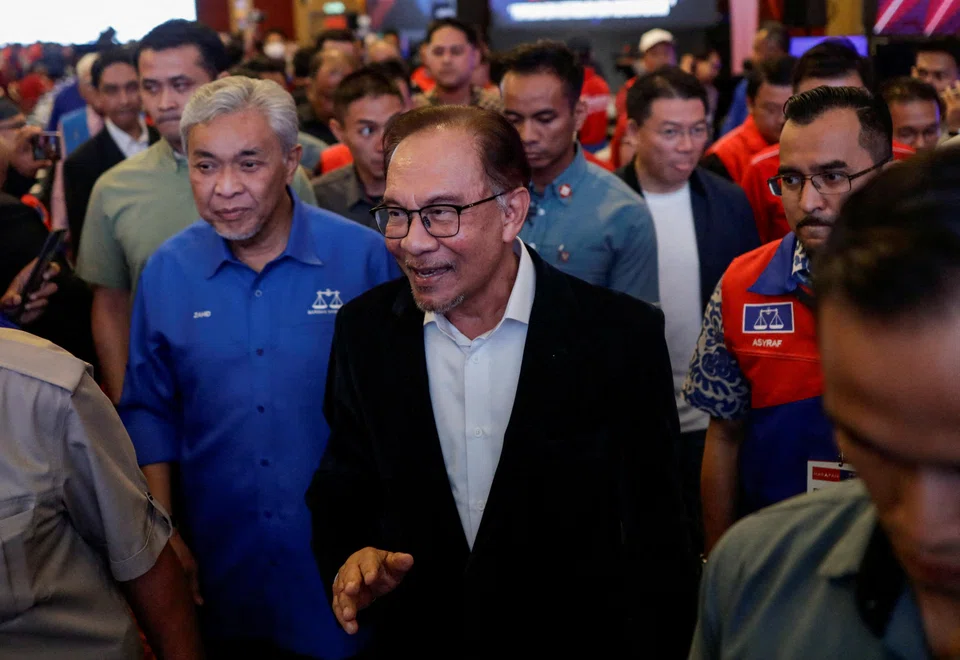
ON THE face of it, the outcome of elections in six Malaysian states last Saturday (Aug 12) was a 3-3 stalemate.
The ruling coalition of Pakatan Harapan (PH) and its ally Barisan Nasional (BN) retained control of the state legislature of Penang, Negeri Sembilan and Selangor, while the opposition Perikatan Nasional (PAS-Bersatu) alliance tightened their grip in Kedah, Kelantan and Terengganu. In any case, the PH-led government had been at pains during campaigning to point out that these state elections would have no bearing on the make-up of the Federal government.
This is true to a certain extent. This was not a general election (GE) and no parliamentary seat was at stake, save for one in a by-election in Terengganu. But the shifting alliances that is the hallmark of Malaysia politics mean that there is more at stake than simply local politics for the fragile Anwar Ibrahim government. The picture of the aftermath looks troublesome for Anwar.
Firstly, Umno – the lynchpin of BN – was drubbed, winning only 19 out of the 108 seats that it contested. The party of Tunku Abdul Rahman that ruled Malaysia for 60 years from 1957 to 2018 was wiped out in Kedah and Terengganu. It won one seat in Kelantan and two seats each in Penang and Selangor. It won big only in Negeri Sembilan, and that, too, by 14 seats out of 17 it contested with a lower vote share.
Secondly, Anwar’s own Parti Keadilan Rakyat (PKR) lost secure seats, including all three seats in the Permatang Pauh, seen as his homeground, given his family’s representation of the parliamentary constituency for nine terms until GE2022 when his daughter, Nurul Izzah, lost to a PAS candidate.
In Selangor and Negeri Sembilan, PN made unprecedented inroads, including breaking PH-BN’s two-third majority control of the Selangor legislature. And where PKR-BN won, it was mostly with a reduced majority.
Former Selangor chief minister Azmin Ali, who was one of the key protagonists in the infamous Sheraton Move that brought down the PH government in 2020, re-emerged from the cold on Saturday with a hard-fought win in the Hulu Kelang seat. These results underscored a continued erosion of support for Anwar and PKR – which is already seen as the weakest of all the significant Malay-dominated parties.
Thirdly, the Democratic Action Party’s (DAP’s) continued success at the polls is both a boon and bane to PH, of which it is a part. Ordinarily, any win by a coalition partner is welcome news to PH. Unfortunately, a DAP that is going from strength to strength coupled with a weakening of support for PKR-BN makes PH a bigger target for the opposition. Although multiracial in essence, DAP has long been regarded as a Chinese chauvinist party by Umno and other Malay parties. It used to compete against the Malaysian Chinese Association (MCA), Gerakan and Malaysian Indian Congress (MIC) for the non-Malay votes but these parties are in steep decline.
The maths is simple. Ethnic Chinese represent a mere 22.6 per cent of Malaysia’s population and Indians account for another 6.2 per cent, compared with the bumiputra’s (mostly ethnic Malays) share of 70.1 per cent.
Nonetheless, the near stranglehold the DAP has on Chinese and – to a certain extent, Indian – votes allows it to be a potent force while PKR, Umno, PAS and Bersatu have to compete among themselves for splintered Malay support.
This has led to accusations from many quarters – including former PM Mahathir Mohamad – that the DAP is calling the shots in government despite the party candidates not holding any key portfolio or senior ministerial position.
The DAP did not help its case when its then secretary-general Lim Guan Eng turned out to be extremely unpopular as Finance Minister following GE2018. His overzealousness in stemming rising government debts was seen as a hindrance to other ministries, and it is thought to be the main friction that caused a breakdown in relations between the DAP and the other PH coalition partners, leading to the collapse of the PH government in 2020.
The DAP’s relations with Umno in the current Anwar government remain fraught. Already in a postmortem on Sunday, an Umno Supreme Council member was reported to have said that its alliance with the DAP had cost it dearly in votes. His is by no means a lone voice. A swell of dissatisfaction among Umno members for the party to distance itself from the DAP could leave Anwar’s unity government in tatters.
Much will depend on whether Umno president Ahmad Zahid Hamidi, a close Anwar ally, can continue to fend off challenges from within the party. Facing corruption charges in court, Zahid’s position is weakened further following the state polls, although a few factors are in his favour to soldier on.
First, despite having only 26 seats in parliament, Zahid has managed to secure a disproportionately large number of Cabinet minister posts for Umno, including assuming the post of deputy prime minister.
Secondly, an Umno out of government will be in the wilderness in the foreseeable future. It’s hard to envisage PAS and Bersatu giving Umno more than junior partner status if they were to try to form an alternative Federal government.
When all is said and done, it will require all of Anwar’s ingenuity and ability to coalesce opposing forces to hold the unity government together. Although his government is barely eight months old, he will be acutely aware of how the last PH government was ousted after only 22 months in power when then coalition partners Bersatu and rebels from within his PKR switched allegiance.
Anwar’s handling of the situation will be watched closely by friends, foes and investors. Foreign investors typically seek political stability and Malaysia has been anything but in recent years. Since the Najib Razak administration was voted out in 2018, Malaysia has had four prime ministers. An untimely change at the helm again will prove to be disruptive, at a time when Malaysia is seeking new growth to combat low wages and fight inflation.
Anwar’s investor friendly stance is bringing big investments to Malaysia and it is probably best for the country if he gets sufficient time to do his job.






