

Are condo and car ownership getting harder for Singapore’s upper middle class?
Rise in private-home prices and car COE premiums outpaces income growth of 80th percentile of households

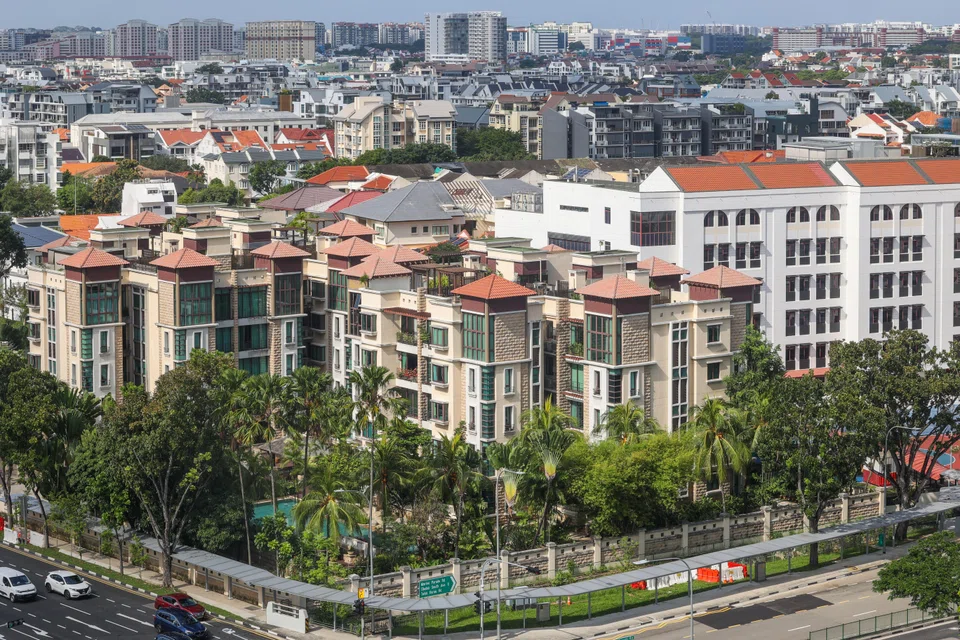
[SINGAPORE] A household with a monthly employment income of S$21,488, which amounts to an annual income of S$257,856, would have been at the 80th percentile of resident employed households in Singapore in 2024, or among the top 20 per cent of resident employed households by income.
Despite the Covid pandemic, an upper-middle-class household in the Republic has generally enjoyed decent income growth in recent years. Between 2015 and 2024, monthly household income among resident employed households, including employer Central Provident Fund (CPF) contributions, for the 80th percentile rose more than 31 per cent from S$16,385 to S$21,488, or at a compound annual growth rate (CAGR) of about 3.1 per cent.
A household earning S$21,488 a month earned 90 per cent more than the S$11,297 median monthly employment income, including CPF contributions, among resident employed households in 2024.
Nevertheless, might upper-middle-income households here be struggling? Chasing condominium and car-ownership dreams could be getting tougher for the 80th percentile of resident households.
Rising condo and car COE prices
Between the third quarter of 2015 and Q3 2025, the Urban Redevelopment Authority’s property price index of non-landed homes in the Outside Central Region or suburbs, climbed around 65 per cent from 159.4 to 263 or at a CAGR of about 5.1 per cent.
In short, suburban condo affordability may be worsening for upper-middle-income households.
In 2015, a household earning S$16,385 a month or S$196,620 annually could possibly buy a new suburban condo unit of around 1,000 square feet (sq ft) for S$1.2 million, or close to six times of its annual income.
Today, a household earning S$21,488 a month or S$257,856 annually that spends six times of its annual income may have to settle for a much smaller new condo unit. Alternatively, the said household might need to spend far more than six times of its annual income on its condo purchase.
Meanwhile, the price of a Certificate of Entitlement (COE) for cars, which confers the right to own and use a vehicle in Singapore for 10 years, has risen sharply.
In the bidding exercise early this month, the premium for the Category A COE, which applies to mainstream cars, was S$105,413. This is 85 per cent higher than the Category A COE premium of S$56,989 in the first bidding exercise in December 2015. Over the 10-year period, the Category A COE premium rose by a CAGR of about 6.5 per cent.
The premium for the Category B COE, which applies to larger and more powerful cars, in the latest bidding exercise was S$123,900, up 106 per cent from S$60,001 in December 2015’s first bidding exercise.
Nonetheless, there are sound reasons to be sanguine about the pace of increase in private-home prices and car COE premiums outstripping the growth in income of the 80th percentile of households.
Mitigations to higher condo prices
Housing-wise, while per-square-foot prices of suburban condos have jumped sharply in recent years, the increase in the absolute prices of condo homes may be more manageable.
One might get as much utility with a newer three-bedroom condo unit of around 800 sq ft as an older 1,000 sq ft three-bedroom flat due to the former’s better layout and efficiency.
Also, household sizes are generally shrinking, which implies many households may be fine with smaller living spaces today compared with the past. The average size of resident households living in condos and other apartments was 3.14 persons in 2024 versus 3.34 persons in 2015.
Indeed, more resident households live in condos today. In 2024, 17.7 per cent of resident households lived in condos and other apartments versus 13.9 per cent in 2015.
Furthermore, the recent trend of falling home-loan rates helps homebuyers. The three-month compounded Singapore Overnight Rate Average, or Sora, is down sharply from a year ago.
Importantly, an upper-middle-income local household has a good alternative to condos, namely a sought-after Housing & Development Board (HDB) resale flat. Typically, an HDB resale flat is much cheaper than a comparable condo unit that is located nearby, has a similar remaining land lease and is of around the same size.
With better transport connectivity and comprehensive amenities such as sheltered walkways, childcare centres, facilities for seniors, sports facilities and so forth across HDB towns, residents there enjoy an increasingly high-quality living experience.
Dropping car ownership
As for car ownership, the need to do so today may be considerably less versus 10 years ago.
The MRT network has expanded considerably. Today, many households can use the MRT and the public buses to commute affordably and efficiently to a wide range of destinations islandwide.
In fact, many households can use sheltered walkways to reach MRT stations and bus stops. Also, the MRT network is still expanding.
Given the good public transport system, easy access to ride-hailing services, availability of food-delivery services, strong suburban malls and online shopping, many households may easily dispense with owning a car in the city-state.
Nonetheless, while private-home and car ownership in the Republic are nice-to-haves rather than must-haves, many upper-middle-income households here still aspire to condo living and car ownership for lifestyle reasons.
Might such households, whose members may comprise professionals, managers and business persons, and who are often vital contributors to tax revenue, reconsider whether to be in Singapore should condo and car ownership get even harder?
Certainly, factors such as family and friends, public safety, social cohesion, quality of healthcare and ease of doing business matter in the choice by upper-middle-income households of where to sink roots. Other considerations may include career prospects, quality of education, clean air, cultural diversity, rule of law and so forth.
Market forces will largely drive private-home prices and car COE premiums in land-scarce Singapore. Dreams of condo and car ownership may get harder for upper-middle-income households to realise, even if such households enjoy steady income growth.
Hopefully, while an upper-middle-income household may struggle to own a condo home and a car here, sufficient pull factors exist to help anchor this key economic group to the Republic.
TRENDING NOW

LTA proposes combining car COE categories, adding rebate-surcharge system

StarHub to acquire MyRepublic’s mobile business amid ongoing telco consolidation

DBS, OCBC, UOB rout lops billions off STI as inflation, rate concerns spook investors

Grab CEO’s wife Chloe Tong on life with Anthony Tan and finding her purpose

