Asean summit signals Europe’s focus on Asia-Pacific
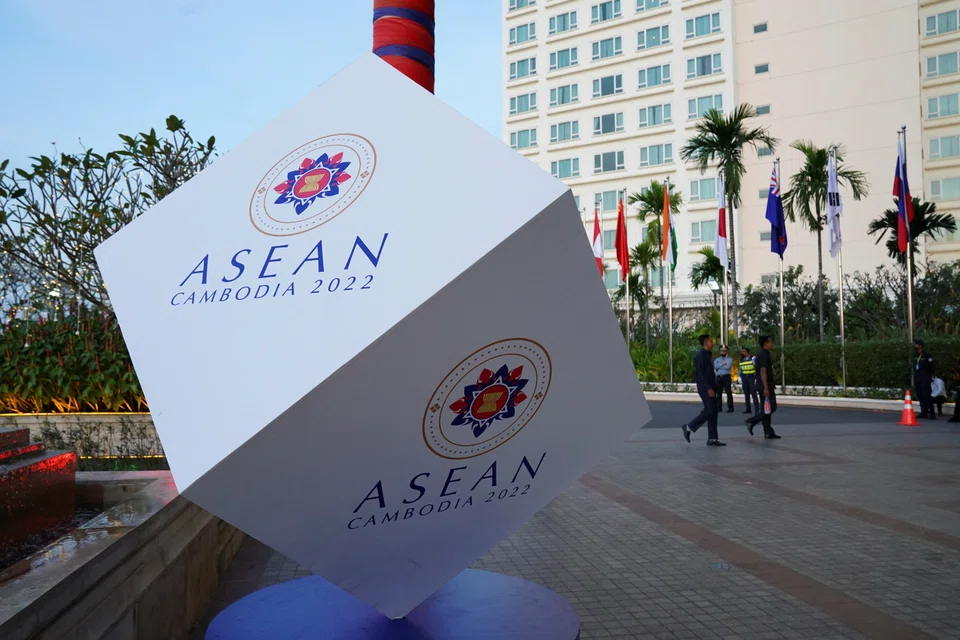
    • The European Union last year drew up a new Asia Pacific geo-economic strategy, with Asean at the heart of the plan.
    • The European Union last year drew up a new Asia Pacific geo-economic strategy, with Asean at the heart of the plan. PHOTO: REUTERS
    Published Thu, Dec 1, 2022 · 06:00 AM

    MANY 2022 headlines have been made by the intensified US focus on Asia-Pacific (Apac), including at the recent Apec summit in Thailand. Yet, the growing attention that the European Union is devoting to the world’s fastest growing economic region is often overlooked.

    The latest signal of intent from the Brussels-based club towards Asia-Pacific comes in December with the first ever summit of the EU and Asean which comprises Brunei, Cambodia, Indonesia, Laos, Malaysia, Myanmar, the Philippines, Singapore, Thailand and Vietnam. The EU and Asean have been dialogue partners since 1977, with shared values and principles of a rules-based international order, effective and sustainable multilateralism, as well as free and fair trade.

    Following the EU-Asean ministerial meeting on Dec 1, 2020, the two parties opened a new chapter in their longstanding relationship by becoming strategic partners. This has seen the bilateral relationship flourish across three main platforms: political and security cooperation; economic collaboration; and socio-cultural cooperation which includes higher education, health, disaster management and preparedness, biodiversity protection and the effective management of protected areas, sustainable urbanisation, and sustainable agriculture.


    Take the example of trade and investment relations which have grown considerably during the last decade. The EU is Asean’s third largest trading partner, accounting for just over 10 per cent of the region’s trade. Meanwhile, Asean is the EU’s third largest trading partner outside Europe with bilateral trade in goods and services reaching around 190 billion euros (S$269 billion) in 2020. Bilateral trade in services amounted to around 95 billion euros in 2019. The EU is also the biggest investor in Asean countries. In 2019, EU foreign direct investment (FDI) stocks into Asean accounted for over 310 billion euros.

    Sectorally too, much progress has been made. In June 2021, for instance, Asean and the EU concluded negotiations on the Asean-EU Comprehensive Air Transport Agreement. The pact is the world’s first bloc-to-bloc air transport agreement, bolstering connectivity and economic development among the Asean and EU member states. Underpinning this economic engagement, the EU has also become a major development cooperation partner of Asean, and is actively engaged in expanding confidence-building and preventive diplomacy in the region. It has also supported countries in the region in their fight against the pandemic with over 800 million euros in grants and loans.

    The upcoming inaugural summit will further lay down the framework for political and economic cooperation between the two regions based on mutual respect and equality. Collectively, the two mega regions have a collective population of well over one billion and their future engagement is underpinned by the EU and Asean Plan of Action for 2023 to 2027.

    Europe’s underlying goal of engagement with Asean, and indeed Asia-Pacific more generally, is to build competitive advantage vis-a-vis other world powers, including the United States. While states across Europe, including the United Kingdom, have ramped up engagement with Asia-Pacific partners in recent years, it is the 27-member EU at the vanguard of this.

    Last year, the Brussels-based club agreed on a new Asia-Pacific strategy, with Asean at the heart of this, to reinforce its strategic focus, presence and actions in this region of prime strategic importance. The aim is bolstering regional stability, security, prosperity and sustainable development, at a time of rising challenges and tensions in the region, in a bid to uphold democracy, human rights, the rule of law and respect for international law.

    The EU’s approach and engagement seeks to foster a rules-based international order, a level playing field, as well as an open and fair environment for trade and investment, reciprocity, the strengthening of resilience, tackling climate change and supporting connectivity with Europe. Outside of economics, free and open maritime supply routes in full compliance with international law are key too, and Europe intends to work increasingly closely with partners in security and defence, not just addressing maritime security, but also malicious cyber activities, terrorism, and organised crime.

    As well as the upcoming summit, European intent towards Asia-Pacific is manifest in the wider, growing number of EU annual conferences with key emerging market giants like India plus major industrialised nations like Japan. This is also already allowing the EU to make headway in the massive region.

    One example is India which with the EU-27, as a whole, are the world’s two largest democracies and keen to forge stronger ties. The Brussels-based club is already India’s largest single trade and investment partner, hence why a new bilateral trade deal under discussion is a key potential prize for both parties. There are wider reasons behind converging interests, including a growing need to develop shared defence forums such as maritime security in the Indian Ocean where two-fifths of bilateral trade passes.

    Yet, important as Europe’s relations are with emerging markets, industrialised nations are important too. With Japan, for instance, the EU enjoys a growing agenda with the two powers, for instance, stepping up in recent years their leadership on international trade and the rules-based economic order.

    Japan is one of Europe’s top export markets in Asia-Pacific. In the EU, it is estimated that some 600,000 jobs are now tied to bilateral trade, with an estimated 74,000 European firms exporting to Japan.

    This core economic agenda was given a fillip in 2019 when the EU-Japan free trade agreement entered into force, covering around a third of global GDP and almost 650 million people. The accord took years to come about, with the headlines captured by the scrapping of almost all duties of Japanese and European imports respectively.

    However, both sides have stressed that the trade treaty is also important because it rests on values and principles. This relates, in part, to the fact that the agreement is the first to be struck by the EU which includes language to support the 2015 Paris climate change treaty by declaring a “positive contribution” to reducing global warming by cutting greenhouse gas emissions.

    These examples showcase why Europe sees such a big opportunity in Asia-Pacific. The massive region is a growing priority for the EU trying to steal a march on others, including the US which is also pivoting there, to try to drive economic and political advantage in the 2020s and beyond.

    Andrew Hammond is an associate at LSE IDEAS at the London School of Economics