

Asia-Pacific economic focus for new UK government
A potentially significant reset of UK policy is underway towards Asia-Pacific that builds from the post-Brexit pivot to the region
KEIR Starmer has spent more time on foreign policy issues than perhaps any recent UK prime minister during the crucial first 100 days in office. Yet, much of his attention has so far focused on the Middle East and Europe, not least with the wars involving Israel and Ukraine.
However, recent days have seen Asia-Pacific rise to the fore, including the Association of Southeast Asian Nations and China. The new UK government sees the region as crucially important to UK foreign and economic policy, post-Brexit, and this has been showcased in recent days.
Starmer is making his first trip to the vast region, to Samoa, to attend the biennial Commonwealth Heads of Government Meeting (CHOGM) where he is joined by King Charles fresh from his visit to Australia. The first CHOGM was held in 1971 in Singapore, and this year’s is the 27th, reflecting the continuing robustness of the Commonwealth, despite many criticisms made about it.
The dozens of current member states of the Commonwealth straddle the Global South, from much of the Asia-Pacific to Africa and Latin America, including emerging market giant India. Industrialised nations include G20 states Australia and Canada.
The importance that Starmer attaches to the region, and the wider Commonwealth, is showcased in the fact that he is making his multi-day visit just a week before the government’s key budget statement on Oct 30. This may be the most important fiscal event of any UK government since at least the 2010 budget of then prime minister David Cameron’s team.
The starting point for the Labour government’s policy to the region is the acknowledgement that, with the possible exception of the Aukus alliance with Australia and the United States, the United Kingdom is not a strategically important nation that can – alone – significantly alter the military balance in Asia-Pacific. However, this does not mean the UK government has no key interests therein.
Post-Brexit pivot
On the economic front, for instance, the new UK government wants to build on the so-called post-Brexit UK pivot to the region, including to try to seize potential advantages that flow from its membership of the Comprehensive and Pacific Trans Pacific Partnership (CPTPP). That’s the trade zone that includes Australia, Brunei, Canada, Chile, Japan, Malaysia, Mexico, New Zealand, Peru, Singapore and Vietnam.
UK Foreign Secretary David Lammy engaged with several CPTPP member-countries in July at the Asean Foreign Ministers’ Meeting in Laos. With a combined population of almost 700 million people and the Asean economy set to be the fourth-largest in the world by 2030, Lammy stressed the UK’s foremost economic priority of cooperation with Asean member states.
The new UK foreign secretary also announced a £25 million (S$42.7 million) UK-Asean partnership to tackle the world’s most pressing global health challenges. This includes helping detect and prevent future diseases, plus boost health security within the region and also at home.
A UK-Asean Green Transition Fund worth up to £40 million was also announced to help boost green growth and leverage UK expertise to support countries at the forefront of the climate crisis. The funding will help unlock green growth for Asean businesses and in turn provide opportunities for green investments from the United Kingdom.
Outside of CPTPP, UK priorities in Asia are indicated by the travel priorities of Lammy so far. This includes his high profile visit to China in recent days, which was centred around a potential reset of relations as he became only the second UK foreign secretary to visit in six years.
Lammy met with his Chinese counterpart Wang Li, Chinese Vice-Premier Ding Xuexiang, responsible for science and technology, and other top Communist Party officials. He also met UK business leaders in Shanghai.
Relations between the United Kingdom and China had, even before the Covid-19 pandemic, cooled significantly under the last several UK Conservative governments. This includes following the political unrest in Hong Kong in recent years.
Today, even with a potential reset under the Starmer team, the mood music between Beijing and London remains a significant distance away from the “golden era” following President Xi Jinping’s UK visit in 2015. Lammy was keen last week to stress that, while a stronger partnership is possible with China, the new government will be a pragmatic but critical friend on issues including human rights. To this end, the UK government has commissioned a government-wide audit of the UK-China relationship and has said it will be “clear-eyed” with the relationship.
What the Starmer team is particularly interested in is better access to China’s huge economy. The United Kingdom has long received one of the largest amounts of Chinese foreign direct investment of any European country, and is one of Beijing’s top European trade partners. Meanwhile, China is one of the UK’s largest non-EU trade partners.
Economic ties with China
Going forward, the UK has deep aspirations to deepen economic ties with China, including infrastructure, and green finance and technological innovation. Take the example of UK energy and technology businesses which are eager to gain market opportunities in the massive Chinese market, and where the United Kingdom is well positioned as a leader in key sub-sectors, including energy management systems, offshore wind and tackling air pollution.
Following the China trip, Lammy attended on Sunday (Oct 20) the inauguration of Indonesian President Prabowo Subianto. As with Beijing, the UK goal is a “new chapter” in relations with Jakarta.
In July, Lammy also visited India, where he sought to push forward a trade agreement. India is a key emerging economic superpower, and the largest country in the world, with a population of about 1.4 billion.
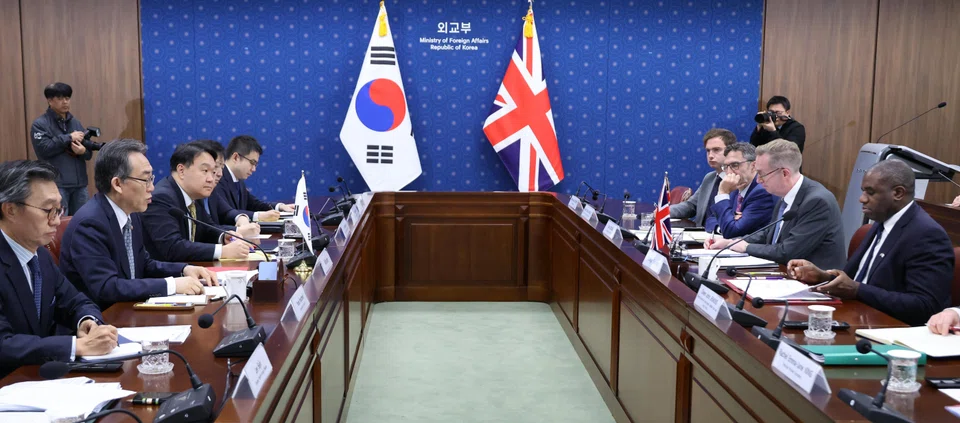
This week, Lammy also visited South Korea to tour the Korean Demilitarised Zone before launching the first UK and South Korea Foreign and Defence Ministerial 2+2 Dialogue. The visit comes amidst Ukrainian President Volodymyr Zelensky’s accusation that North Korea is sending around 10,000 troops to help Russia’s invasion of his country.
Lammy has said this “is a stark reminder of the interconnectedness of conflict, with North Korea supporting Russia and prolonging conflict on Europe’s borders whilst their illegal weapons of mass destruction programme threatens regional security. That is why it is so important for the United Kingdom to engage globally over conflict on our continent and security beyond it.”
Taken together, a potentially significant reset of UK policy is underway towards Asia-Pacific that builds from the post-Brexit pivot to the region. Economics is at the heart of this, with the CPTPP being one key opportunity the Starmer team hopes to seize.
The writer is an associate at LSE IDEAS at the London School of Economics
TRENDING NOW
High Court rules against Julius Baer’s Singapore trust arm in US$50 million family trust dispute

MSCI proposes standalone status for Indonesia; Jakarta stocks plunge 8%

Once staunchly pro-China, Malaysian Chinese businesses are now distancing themselves from Beijing
No chicken feed: How Malayan Flour Mills built an empire from flour to fowl

