Asia-Pacific Quad summit allows Biden to look to legacy
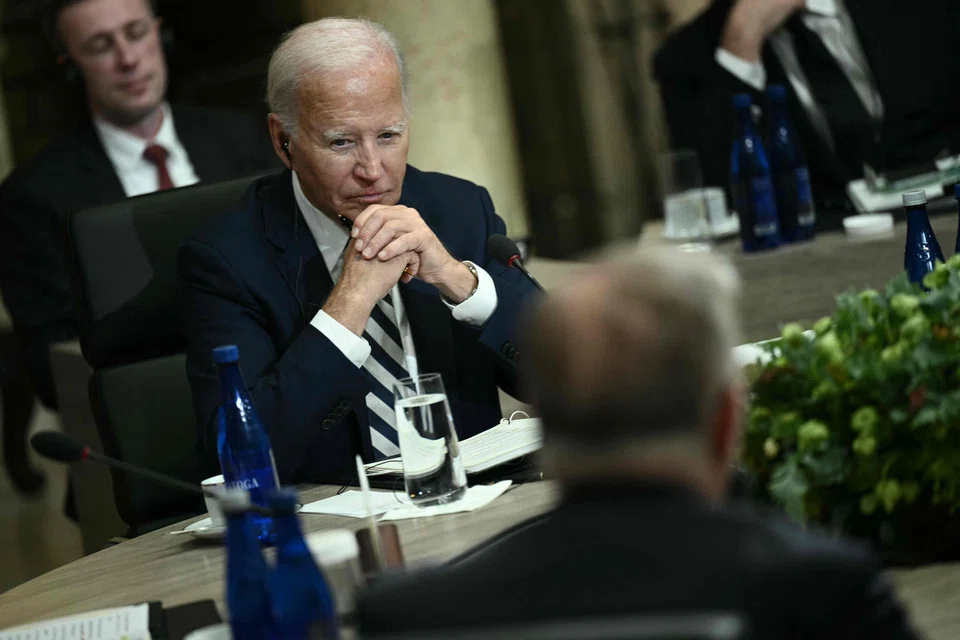
JOE Biden hosted the final “Quad” foreign policy meeting of his presidency with Asia-Pacific partners India, Japan and Australia in Wilmington, Delaware, on Saturday (Sep 21). As he enters the last four months of office, his mind is increasingly turning to consolidating his – contested – legacy after more than half a century in Washington politics.
On Saturday, Biden proclaimed that part of his international accomplishment is the deepening of the Quadrilateral Security Dialogue. He signalled that the group would outlast the current leadership of himself, Indian Prime Minister Narendra Modi, Japanese Prime Minister Fumio Kishida – who was making his last foreign trip in his role – and Australian Prime Minister Anthony Albanese, who faces a potentially very tough re-election battle next year.
Biden’s turn to legacy is, partly, a recognition that his presidency is nearly up.
One sign of this is that multiple foreign leaders attending this week’s United Nations General Assembly – including Ukrainian President Volodymyr Zelensky – will meet Democratic presidential nominee Kamala Harris or Republican nominee Donald Trump, as November’s election looms.
Like Biden, previous presidents have often seen foreign policy as a fundamental part of their legacy.
For instance, after the trauma of the 2001 terrorist attacks, then president George W Bush sought to spread his freedom agenda across the Middle East, with the toppling of Saddam Hussein’s Iraqi regime in 2003.
Bill Clinton was perhaps the last president to devote significant time to securing a comprehensive peace deal between the Israelis and Palestinians. And he came relatively close to a breakthrough agreement in 2000, but compromise ultimately proved elusive, a fact that has shaped the Middle East for the quarter-century since, including the current Gaza conflict.
A weaker position
The emphasis on foreign policy at the end of presidential office, with the incumbent in effect a “lame duck”, reflects the fact that office-holders in the post-war era have generally found it difficult to acquire momentum behind a significant new domestic agenda after the first two years in power.
In part, this is because the party of the incumbent president often holds a weaker position in Congress, as is the case now, with the Democrats having lost control of the House of Representatives in 2022. This dynamic means that domestic policy initiative in Washington – if it exists at all – can edge back to the legislature.
This overall political context means that Biden, like many of his predecessors, is now placing ever-increasing emphasis on foreign policy (which Congress has less latitude over). Saturday’s Quad summit exemplifies this.
In the coming weeks, Biden also has much wider international ambitions, including in the Middle East, to try to forge a sustainable ceasefire in Gaza. Moreover, he wants to attempt to cement the military position of Ukraine against Russia as he prepares to meet Zelensky in Washington, DC, on Thursday.
After his long career in Washington – he was first elected to the US Senate in 1972 – Biden has a bigger political time frame to draw on for his legacy than most presidents.
This includes his period as a ranking member and chair of the Senate Foreign Relations Committee from 1997; vice-president to Barack Obama from 2009 to 2017; and also as president since 2021.
It is particularly the period since 2009 that will be key to Biden’s foreign policy legacy. To be sure, some of this record is highly criticised, including the chaotic US withdrawal from Afghanistan in 2021.
Even some of Biden’s main achievements are wrapped in partisan controversy. This includes the 2015 Obama-Biden administration’s nuclear deal with Iran and the so-called P5+1 (the United States, China, Russia, the United Kingdom, France, plus Germany), which was viewed by some at the time as a victory for the US, albeit one from which Trump’s administration withdrew swiftly.
Although Biden has not returned to the deal under his presidency, he argued in 2015 that it had long-term potential not just to help forge a lasting rapprochement with Iran, but also ultimately to help transform the wider geopolitics of the Middle East, and help consolidate a traditional, pre-Trump era goal to enhance global nuclear security.
In this policy area, as well as pushing inter-state nuclear diplomacy, the Obama-Biden administration created the Nuclear Security Summit process to counter nuclear terrorism, which it described as the “most immediate and extreme threat to global security”.
Ukraine legacy
However, Biden will perhaps assert that Ukraine is his most important foreign policy legacy. Since Russia’s 2022 invasion, the battle in East Europe has become a defining feature of international relations.
More than 900 days into the conflict, the war has lasted much longer than many in Moscow had anticipated with President Vladimir Putin’s ambitions to deal an early knockout blow to Kyiv. At the time of writing, a “war of attrition” continues, with the next big moment in the conflict – barring a spectacular, unexpected “October surprise” – likely to come in November with the US presidential election, given the hugely divergent stances between Harris (broad-based continuity) versus Trump (potential complete U-turn in US policy).
The Ukraine example, like Iran earlier, highlights how much foreign policy can sometimes change from administration to administration. Yet another case study is Cuba, with which the Obama-Biden team sought to reset relations after revolutionary leader Fidel Castro died.
In 2014, the two countries announced they would restore diplomatic relations, announcing a new suite of measures that further eroded the bilateral sanctions regime introduced during the Cold War era, historic moves that were rolled back by Trump.
Taken overall, Biden’s legacy will therefore rest heavily on foreign affairs, given that it has been his major policy specialism over the last half century. While much of his presidential record rests in Ukraine, there is high possibility that this policy would get rolled back under any new Trump administration, mirroring what had happened with earlier key Obama-Biden team initiatives, including agreements with Iran and Cuba.
The writer is an associate at LSE IDEAS at the London School of Economics