

Australia deal shows EU is ‘open for business’
Affecting sectors from agriculture to critical minerals, the trade agreement marks a big win for both sides
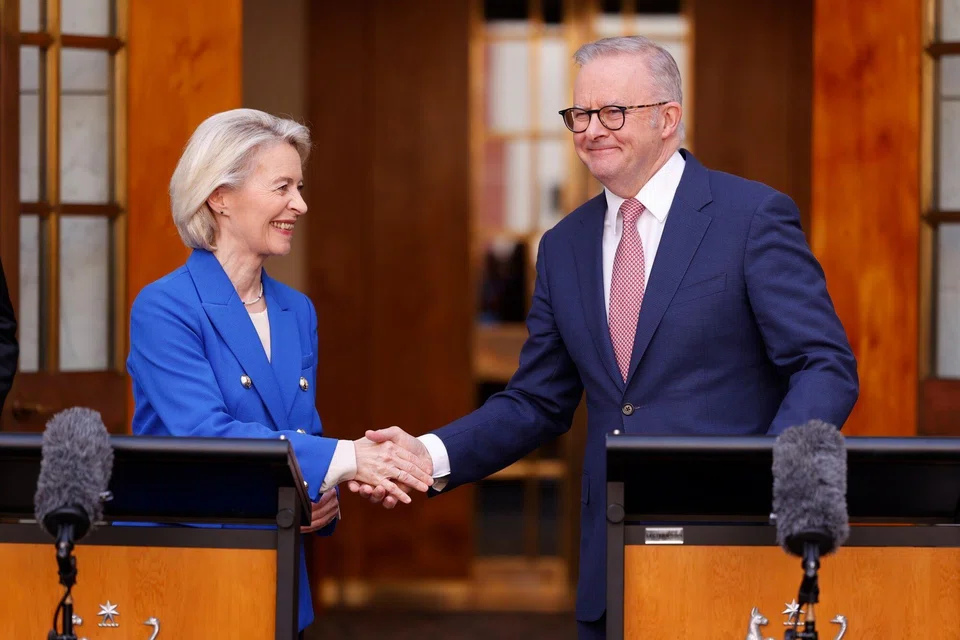
EUROPEAN Commission President Ursula von der Leyen wants her second term of office to be defined by a rise in the European Union’s economic competitiveness. While some of this agenda has proceeded slowly, her standout success has so far been with trade liberalisation.
Earlier this week, the EU secured a landmark agreement with Australia which the group’s top business lobby, BusinessEurope, called “a win for both sides, geopolitically and economically”.
The 27-member bloc had earlier agreed a trade deal with Mercosur in South America and India, and a Brexit reset deal with the UK.
Little wonder that Dr von der Leyen declared this week that “when it comes to trade, Europe is open for business”. Notably, the new deal will remove more than 99 per cent of tariffs on EU exports to Australia.
Of course, not everyone is happy with the deal which still needs to be ratified by both the Australian and European parliaments. The main criticism has come so far from agricultural lobbies, including the Australian National Farmers Federation.
The EU was Australia’s third-largest two-way trading partner in 2024 as well as the sixth-largest export destination. The bloc was also Australia’s second-largest source of foreign investment in 2024.
Moreover, Australia’s strategic value is rising fast for the EU. Not only does Australia possess the world’s third-largest reserve of rare earth elements, but it is also the top global producer of lithium, a keystone of battery production for electric vehicles (EVs).
In 2024, EU exports to Australia totalled around 37 billion euros (S$54.9 billion) in goods and 28 billion euros in services. By European Commission estimates, the new agreement could boost these exports by about a third in a decade, through tariff liberalisation on almost all EU goods and many services, potentially saving around one billion euros a year in duties.
The Australian government is also happy with the deal. It forecasts that it could add about A$7.8 billion (S$7 billion) to its gross domestic product by 2030.
Europe has long had some of the largest economic networks in the world. Prior to the recent deals of Dr von der Leyen’s second term, the EU benefited from more than 70 partners and over US$2 trillion in trade ties.
The region has also sought to strengthen its economic links with the rest of the world, including after Russia’s invasion of Ukraine.
The EU’s doubling down on trade is especially pronounced in the vast Asia-Pacific. There is growing recognition that many large new business opportunities lie in this region. Over the next five years, the global economy is forecast to increase by around US$40 trillion in size – a huge chunk of which will come from Apac, especially India.
Beyond Ukraine, wider new uncertainties that took the deal over the line include the policies of the Trump administration, especially on tariffs. Dr von der Leyen alluded to this, too, saying that “none of us is immune to the shocks, both geopolitical and economic, that the war in Iran brings to our populations”.
Given this geopolitical insecurity, the two sides also announced a new defence partnership. Australian Prime Minister Anthony Albanese said this will provide a framework for the EU and Australia to cooperate in agendas including defence industries, maritime security, cybersecurity, countering terrorism and combating hybrid threats such as disinformation.
Key elements of trade deal
The trade deal has implications in sectors ranging from agriculture to critical minerals. In the latter area, Europe seeks greater access to key Australian resources, including aluminium, lithium and manganese, with elimination of export duties on these critical minerals (as well as hydrogen) and a ban on export restrictions.
On investments, EU financiers will receive the most favourable treatment accorded to any foreign investor in Australia, and often be treated in the same way as Australian investors. Investors from both sides will be able to establish their firms and operate them freely in each other’s territories.
In the car sector, Australia will fully liberalise market access for all EU vehicles apart from a number of tariff lines on trucks, for which duties will be gradually removed over a short period. Canberra will also increase the current luxury car tax threshold for EVs, which will exempt 75 per cent of EU EVs from paying the tax.
In agriculture, tariffs will be removed on many Australian agricultural products, including barley, seafood, wine and most dairy products. Tariffs on EU cheese will drop to zero over three years.
Annual quotas for beef will rise over 10 years to 30,600 tonnes. Australian sheep meat, sugar, rice, wheat gluten, skimmed milk powder and butter will also get either new or expanded tariff rate quota volumes.
On protected European product names, Australia has agreed to fully protect 165 EU geographical indications (GIs) for agrifood products such as Comte cheese and 231 spirits GIs such as Irish whiskey. In some cases, including for Ouzo, there is a relatively short phasing-out period.
Taken together, the new trade deal is a significant win for both sides. Subject to ratification, it will provide not only an economic boost to both powers, but also a security one too at a time of growing geopolitical angst.
The writer is an associate at LSE IDEAS at the London School of Economics
TRENDING NOW

Stocks to watch: Clar, Seatrium, Sheng Siong, MPACT, NetLink NBN, Starhill Global Reit
Singapore government slaps loan curbs on individual private-hire car buyers

If Europe goes to war, the fallout will be felt in East Asia
DBS denies rumours of Indonesia unit merging with Bank Central Asia; analysts see sense in a deal

