

Azerbaijan attack stirs fears of new war in Europe’s backyard
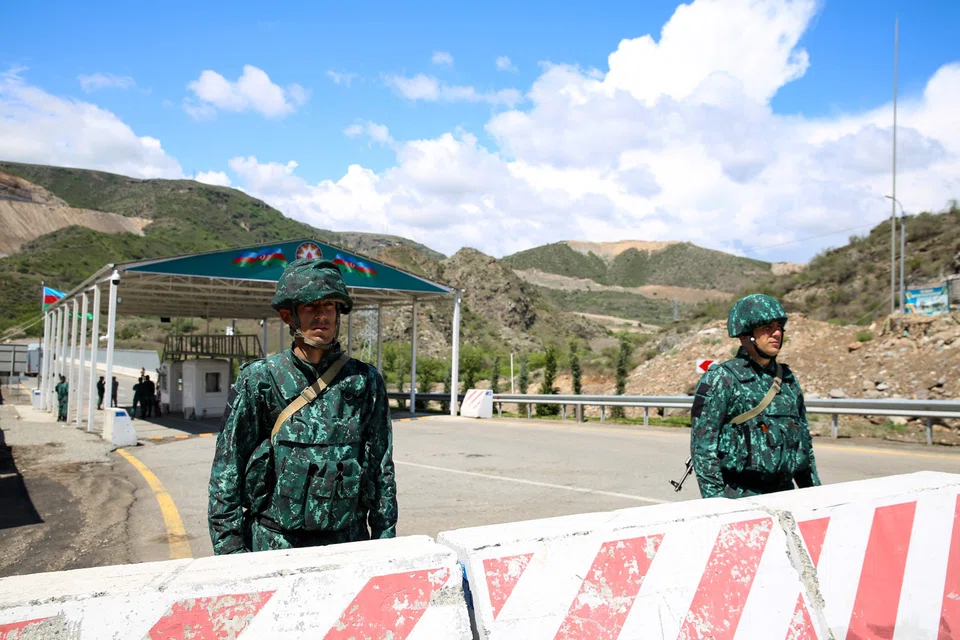
EUROPEAN politics has been convulsed in the last year and a half by the Ukraine conflict. Now, there are concerns of a second war in the European Union’s (EU) backyard, after Azerbaijan forces began a military offensive on Tuesday (Sep 19) against Armenian positions in the separatist region of Nagorno-Karabakh.
While a shaky ceasefire was agreed on Wednesday, the continued possibility of a new war in the Caucasus is a significant worry for the 27 EU member states – not least for their energy security policy after Russia’s invasion of Ukraine.
Last summer, European Commission President Ursula von der Leyen travelled to mineral-rich Azerbaijan to sign a memorandum of understanding on gas supplies with President Ilham Aliyev.
It is estimated that around two-thirds of Azerbaijan is rich in oil and natural gas. The country also produces a range of metals and industrial minerals, including aluminium, lead, iron and zinc.
Von der Leyen then called Azerbaijan a “reliable, trustworthy partner”, even as critics asserted that she was trading one energy autocracy – Russia – for another.
Although Azerbaijan regularly holds elections, these are reported to be marred by fraud and other unfair practices, and the country is sometimes characterised as an authoritarian regime.
Nevertheless, Azerbaijan was invited to be part of the new European Political Community organisation created last year. Since Russia’s invasion in early 2022, Brussels has stepped up its engagement, with von der Leyen’s visit being such an example.
Russia’s unknown role
Perhaps the biggest unknown factor in the region’s latest flare-up is what role, if any, Russia is playing. Moscow is the region’s traditional power broker, but some interpret Tuesday’s events as a further indication that Russian President Vladimir Putin is losing influence there after having started the Ukraine war.
Others even suggest that Putin may well have encouraged these developments, potentially to try to force a change of policy – or regime – in longstanding ally Armenia, which has recently moved closer to the West.
Armenian Prime Minister Nikol Pashinyan, who led huge anti-government protests in 2018 before coming to power, has asserted that his nation’s historical reliance on Russia as its single source of security was a “strategic error”.
Armenia is still a member of the Collective Security Treaty Organization, an alliance of former Soviet Union countries that mirrors the North Atlantic Treaty Organization (Nato), but has annoyed Moscow recently on several counts.
First, it undertook joint military exercises with US troops. Second, it has moved towards ratifying the Rome Statute establishing the International Criminal Court – which recently indicted Putin because of Russia’s invasion of Ukraine.
Another key uncertainty is whether Tuesday’s offensive was just a limited operation, possibly to try to coerce Armenians in Nagorno-Karabakh to flee to Armenia, or could yet lead to a real war.
Prior to Wednesday’s uncertain ceasefire, senior presidential aide Hikmet Hajiyev had already said that Azerbaijan had hit its main targets, and operations would continue in a “more limited format”.
Yet the backstory to Tuesday’s developments is the long, bloody tensions between the Azerbaijan and Armenian peoples, going back more than 100 years.
Nagorno-Karabakh is widely recognised as part of Azerbaijan, but its 120,000 or so inhabitants are predominantly ethnic Armenians and Christian. It has its own separatist government, which, while close to Armenia, is not officially recognised by it or indeed any other nation.
Armenians assert longstanding ties with the region. Azerbaijan, whose people are mainly Turkic Muslims, also claims deep relations to the area.
Under the Soviet Union, Nagorno-Karabakh assumed the status of an autonomous region within the republic of Azerbaijan. When that socialist political entity collapsed, Nato member Turkey became the first nation to recognise Azerbaijan’s independence in 1991, and has remained a strong supporter.
In recent decades, the region has already seen two wars. In the First Karabakh War from 1988 to 1994, around 30,000 people were estimated to have been killed and perhaps more than a million displaced. Most of the latter were Azeris, driven from their home when Armenia assumed control of Nagorno-Karabakh and several nearby areas.
The second war in 2020, however, culminated in a huge loss for the separatist, Armenia-backed Nagorno-Karabakh state. In just over a month, Azerbaijan won back large areas of land it had lost in the 1990s.
Turkish-made drones played a crucial role in the fighting in 2020, allowing Azerbaijan to make its territorial gains. Russia helped negotiate a ceasefire, including the assignment of around 2,000 peacekeepers to guard the so-called Lachin corridor – the only road connecting Nagorno-Karabakh to Armenia.
Ceasefire
Prior to Tuesday, tensions in the region had been smouldering for months, not least since Azerbaijani troops blockaded the Lachin corridor last December, preventing the import of food and medicines to the inhabitants of Nagorno-Karabakh.
Tuesday’s offensive came after weeks of negotiations – brokered by the EU, United States and Russia – to avoid a repeat of the 2020 war, and end the worsening famine. Armenian Prime Minister Pashinyan called for the United Nations Security Council to take “clear and unambiguous steps to end Azerbaijani aggression”.
Earlier this month, there had been optimism that tensions might be reduced when aid trucks operated by the International Committee of the Red Cross were allowed into Nagorno-Karabakh through the Lachin corridor and the Aghdam road from Azerbaijan. That hope was dashed on Tuesday.
Azerbaijan’s offensive, even if swiftly over, has much broader regional implications beyond Nagorno-Karabakh. Europe and the wider West will wait to see if the situation has truly stabilised in the coming days. That scenario is by no means certain, especially if Russia has decided it wants to try to upend the regional status quo.
The writer is an associate at LSE IDEAS at the London School of Economics
TRENDING NOW

Once staunchly pro-China, Malaysian Chinese businesses are now distancing themselves from Beijing

‘How many will survive?’: Bubble fears arise as China’s humanoid robotics face reality check

Philippine power giant First Gen rebuffs foreign offers, plans up to US$2.6 billion in expansion

Indonesia imposes US$116 million in fines over manipulation of Sinar Mas, Prajogo-linked stocks

