
HOCK LOCK SIEW

Barging blindly into Singapore’s construction boom could be a bust for some investors

Those dipping their toes in now are no longer buying the boom, but betting that these companies can manage their costs

Summarise
Jude Chan
Published Mon, Feb 16, 2026 · 03:50 PM
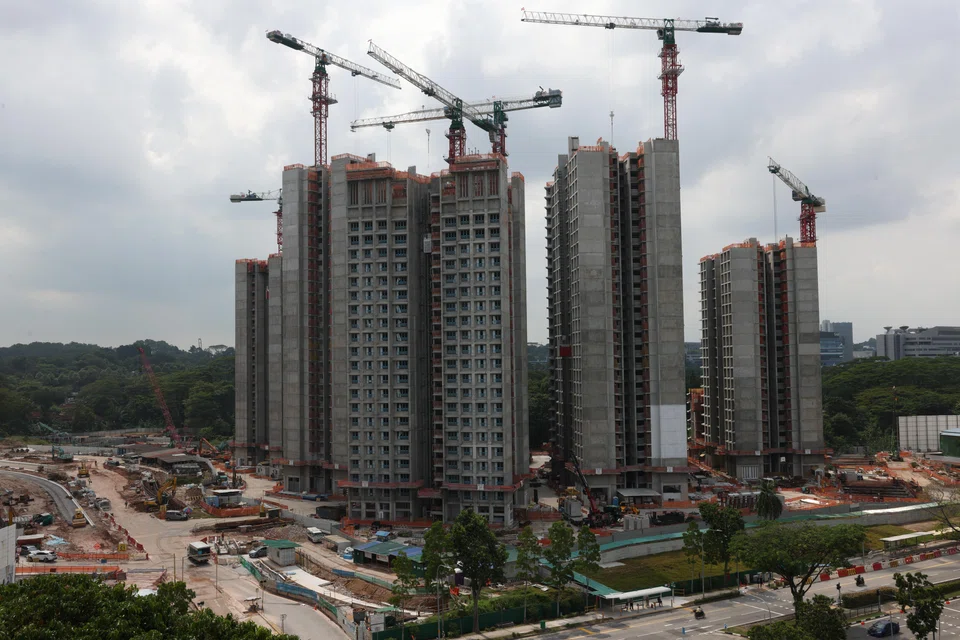
    • Analysts believe construction players such as Soilbuild will be key beneficiaries of Singapore's public housing mandate.
    • Analysts believe construction players such as Soilbuild will be key beneficiaries of Singapore's public housing mandate. PHOTO: TAY CHU YI, BT

    FOR years, Singapore’s construction sector was the proverbial “ugly duckling” of the local bourse – a messy, low-margin business plagued by labour crunches, fluctuating raw material costs, and the lingering hangover of pandemic-era delays.

    Investors, quite reasonably, preferred the steady dividends of the banks or the defensive allure of Singapore-listed real estate investment trusts (S-Reits).

    But look at the scoreboard now, and the narrative has shifted with the speed of a high-rise crane.

    Three construction-related companies ranked among the top 10 advancers in the Singapore market last year – with eye-watering returns that left the banks and S-Reits trailing far behind.

    The shares of leading Singapore-based builder Soilbuild Construction Group soared 344.7 per cent, while civil engineering services providers OKP and Huationg Global gained 290.8 per cent and 262.4 per cent, respectively.

    A bucketload of other construction and engineering-related firms also more than doubled their market values in 2025.These included Global Resource Construction (259.3 per cent), Hiap Seng Industries (214.3 per cent), Ever Glory United (178.6), Hor Kew Corporation (168.8 per cent), Hong Leong Asia (163.7 per cent), and Pan-United Corporation (109 per cent).

    For comparison, the benchmark Straits Times Index rose 22.7 per cent and the S-Reits gained 11 per cent.

    As we cross into February 2026, construction stocks have continued to romp, even as the STI has been busy flirting with its own all-time highs.

    This is not just a speculative “pump” by retail punters hunting for the next penny stock; it is a fundamental re-rating driven by a record S$53 billion contract pipeline and the sheer gravitational pull of Changi Airport Terminal 5 and the Marina Bay Sands expansion.

    However, as any site foreman will tell you, the higher you build, the more you have to worry about the wind. While the gains seen in some construction counters are intoxicating, the “easy money” has likely been made.

    Cementing the Gains

    Yet, market watchers believe there is still some room for gains to be made – with the right names.

    With steel and concrete prices stabilising and the government’s Equity Market Development Programme injecting fresh liquidity into the local market, analysts believe some stocks can become “alpha” generators for those willing to look beyond the Big Three banks.

    Take building materials supplier Hong Leong Asia and concrete manufacturer Pan-United Corp for example.

    After all, when the Building and Construction Authority (BCA) forecasts demand of up to S$53 billion, it is not just a number – it is a guaranteed order book for the concrete and aggregates that Hong Leong Asia and Pan-United churn out.

    Then there are the mid-cap “hidden gems” like Soilbuild Construction and reinforcement-steel solutions provider BRC Asia .

    The way analysts such as SAC Capital’s head of equities research Matthias Chan see it, Soilbuild – the share price of which already had a massive run-up last year – still has legs to run.

    For one, it stands to be a primary beneficiary of the aggressive public housing mandate, with the government’s commitment to launching 55,000 built-to-order (BTO) flats between 2025 and 2027.

    In 2026, HDB will launch about 19,600 BTO flats, of which around 4,000 units will entail shorter waiting times of under three years.

    This, Chan believes, “requires rapid, scalable construction methods” – that Soilbuild has an advantage in.

    “Soilbuild’s proprietary precast and prefabrication capabilities are essential for meeting these tighter deadlines and the ‘shorter waiting times’,” he said.

    “Furthermore, the forecast construction demand of S$47 billion to S$53 billion creates a high volume of tender opportunities for its main construction arm, particularly in the institutional and industrial segments where it has established expertise,” he added.

    Meanwhile, CGS International analyst Natalie Ong expects a re-rating for Soilbuild on the back of its strong order book.

    “Going forward, we expect further margin expansion from operating leverage as well as strong order wins from internal industrial projects and BTO precast to support double-digit earnings per share growth in FY2026 and FY2027,” she said.

    Soilbuild on Wednesday (Feb 11) reported that it had secured S$158 million in new contracts since the start of the year, bringing its total order book to S$1.07 billion.

    These new wins include the construction contract for an eight-storey factory in Seletar West, and precast and prefabrication contracts for the supply and delivery of precast components to an HDB project in Redhill and a dormitory project in Tuas.

    In a bourse filing, Soilbuild CEO Lim Han Ren said the group remains “focused on executing (its) ongoing projects efficiently”.

    Indeed, the market is now moving from a phase of anticipation to one of execution, and the focus must shift from pure growth to quality of earnings.

    For the savvy investor, the foundation is firm, but the valuation scaffolding is getting a bit high. It might be time to stop buying the rally and start watching the progress reports.

    Remember: If you’re buying in now, you are no longer buying the boom – you’re betting that these companies can manage their costs better than they have in the last two decades.



