

Be greedy when others are fearful, Warren Buffett said. Here’s why this is very hard to do
Evolutionary psychology and behavioural biases are common enemies of every stock portfolio. Despite well-established wisdom that you shouldn’t attempt to time the market, investors almost always jump in too late. Here’s how you can avoid making the same mistake.

Yong Jun Yuan

GOOGLE searches for the term “S&P 500” spiked in March 2020, roughly around the time the index was collapsing.
Whether Internet users were trying to calculate how much they had lost or figure out the best time to enter the market, it is impossible to tell. But there certainly was a rush to open stock trading accounts at the time, and anecdotal evidence shows plenty of investors made their first trades that year.
The excitement was understandable. From peak to trough, the S&P 500 fell 33.9 per cent in the first few months of 2020. A buying opportunity had emerged, unseen for more than a decade.
Fast-forward two years, however, and a similar buying opportunity is being greeted with a lot less enthusiasm. Since hitting a peak of 4793.54 in January this year, the S&P 500 is down 15 per cent. But search trends for the index are average, and trading activity has also fallen.
According to the financial statements of Nasdaq-listed Futu Holdings, owner of trading platform moomoo, trading volumes fell 19.7 per cent in the third quarter of this year. Over at UP Fintech, which owns Tiger Brokers, trading volumes are down 15.6 per cent.
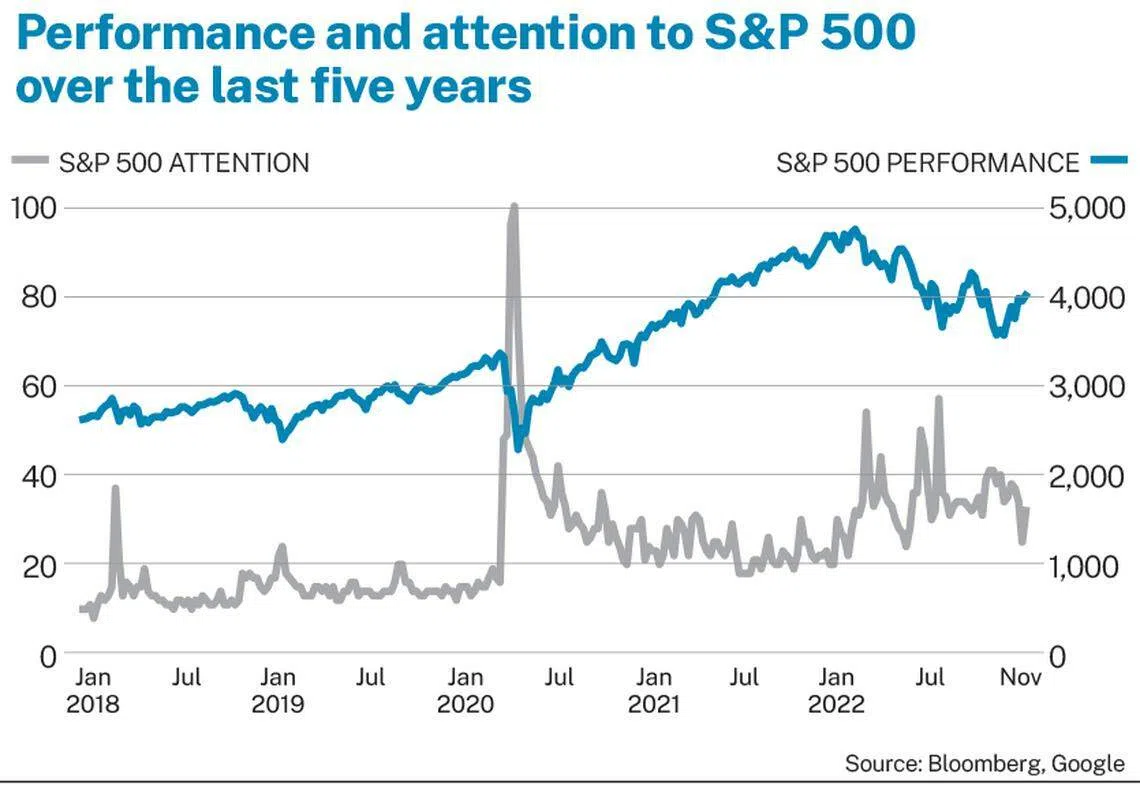
Trading circumstances are not that different now from what they were then: uncertainty abounds, but with a chance of recovery in sight. So why have investors stayed away from the markets this year?
Fund managers and psychologists say it is common for investors to be paralysed by fear when markets turn bearish.
Janus Henderson Investors’ head of Asia, Andrew Hendry, said retail investors may be doubly frightened by the falls in both fixed income and equity markets.
“The whole idea for the last 30 years is: If you have fixed income and equity, when equity is terrible, fixed income will save you...
“(But at the) end of March this year, you were down 20 per cent in equities, and you were down 15 per cent in fixed income. Everyone’s just like: ‘What the hell’s going on?’” he said.
In recent bear market history, central banks were in a position to lower interest rates and stimulate the economy. But the most recent sell-off has been triggered, at least in part, by the Federal Reserve’s interest rate hikes to tame inflation, which has put downward pressure on bond prices.
“If you look at your retail investor... what you’re still plagued by is uncertainty and paralysis because you don’t know what to do,” Hendry said.
But is that really what it is? Are investors reacting sensibly to a period of extreme uncertainty by shunning risk and pulling their money out of the markets? Or, could such behaviour end up sabotaging an investment portfolio in the longer run?
Investor psychology
Singapore Management University (SMU) assistant professor of finance and Lee Kong Chian fellow Li Weikai said investors may, at times, have irrational tendencies.
One is to hold to an expectation that trends will continue. Rising markets are expected to keep rising, and falling markets, to keep falling.
There is also a well-documented correlation between investors’ risk aversion and their wealth. As wealth declines, investors’ appetite for risk falls as well.
“When you have become more conservative, what people usually do is they try to sell their risky assets, which in this case is stocks, and put their remaining wealth in safer assets like money market funds or deposits,” Prof Li said.
The result is usually a self-perpetuating cycle in the market. Although the recent initial selldown in equities started out rationally, as investors adjusted their valuations for companies in accordance with higher interest rates, Prof Li noted that continued declines may be exacerbated by investors’ overly bearish sentiment.
This may not be the most rational thing to do, he said, as the broad-based S&P 500 is now below its average historical price-to-earnings ratio. The S&P 500 now trades at 19 times its historical earnings, down from an average of about 22 over the past 40 years.
Prof Li said the root of this irrationality could lie in the fact that for most of human history, risk aversion has been prized as a favourable trait. Those earliest to spot danger, and who rely on instinct to run first and think later, are more likely to survive.
In addition, although a market crash in a single day may be viewed as an outlier, a bear market lasting over some period of time would also lead investors to be more conservative, he said.
“In the current environment, we have seen a correction for several months. So, more people... may not be able to stick to their original plan, which is to continue to buy when the market actually becomes cheaper,” he said.
Retail investors are also easily swayed by the news, and not always in the right direction.
TD Ameritrade head trading strategist Shawn Cruz said a lot of the rallies he has observed this year have not made a lot of sense.
“If you hear about how they justify the rally, they usually say that it’s because they think the (US Federal Reserve) is going to moderate its hawkish policy, or slow down, or pivot...
“That doesn’t make sense, because the Fed has been very consistent in saying that it is going to be pumping the brakes on monetary policy for the foreseeable future,” he said.
Rothschild chaired professor of banking and professor of finance at Insead Massimo Massa said investors tend to overreact to positive news due to the hot-hand fallacy, which describes the tendency for people to believe that successful streaks will lead to further success.
An example of this could have been when markets rallied in October after the United States posted an inflation rate of 7.7 per cent – down from 8.2 per cent in the previous month. On the day the news was released, the S&P 500 index rose 5.6 per cent.
“This suggests that there is quite a lot of money on the side and investors are actually using any type of information in order to basically extrapolate to the future,” Prof Massa said.
He added that investors also invest based on attention, rather than information. This means they may react to information at the time their attention is drawn to it, even if that information is stale. In fact, this bias has been well documented and leveraged by hedge funds to trade against retail flows.
Studies also show confidence can lead to excessive trading, which can in turn disadvantage investors.
He Tai-Sen, assistant professor at the Nanyang Technological University (NTU)‘s School of Social Sciences, pointed to studies correlating trading frequency with performance.
Men tend to be more overconfident than women, he said. “The implication in the financial markets is that (males) get tricked too much and in the long run, they are going to have lower returns than females.”
A study published by University of California, Davis professors Brad Barber and Terrance Odean in 2001 found men traded 45 per cent more than women. It also found that trading reduced men’s and women’s net returns by 2.7 percentage points and 1.7 percentage points, respectively.
NTU associate professor of economics Bao Te said disposition bias may also be prevalent among investors. The bias leads people to sell assets which have gained in value and keep assets that have lost value.
He believes that most of the time, investors are reluctant to sell their loss-making assets because they do not want to realise any losses, even if market fundamentals have changed.
“I would bet that many people are just going to do nothing, and they’re going to wait,” he said.
Making rational decisions
To counter biases, experts recommend investors take a long-term view of their investments, invest consistently and diversify – for instance, by investing regularly into exchange-traded funds (ETFs) that track broad-based indices.
SMU’s Prof Li reminded investors that history shows markets grow consistently over the long run. The same, however, cannot be said for companies.
“A company can change its business model or change its main product, so it may not be the same company (in the long term)...
“But from a market perspective, the market is still... based on entrepreneurship and innovation. The fundamental ways to generate profit and growth are still unchanged,” Prof Li said.
Janus Henderson’s Hendry said investors should ideally look to make decisions about their risk appetite and portfolio objectives in calmer times. If investors have a clearer view of their long-term underperformance if they left markets, they could be more clear-headed about the decisions they make.
“You believe in your past self, that you did a good job three years ago; if nothing’s changed with yourself and your health and such, then you leave (your investments) alone,” he said.
TD Ameritrade’s Cruz added that investors who take a more active role in portfolio construction should look to keep their portfolios balanced.
If a hypothetical investor wants to keep 15 per cent of his holdings in tech and 10 per cent in financials, that balance might get tipped towards technology when the sector outperforms. Such an investor should then sell his tech stocks and buy more financials to rebalance the portfolio.
“What you’re actually doing while you’re re-balancing is you’re selling high, and you’re actually buying low,” he said, adding that investors should also pay attention to the fundamentals of these sectors to see if anything has changed significantly, and review such allocations regularly at the portfolio management level.
Insead’s Prof Massa said it is also important for investors to understand the two major risks to markets: volatility and black swan events.
Black swan events are rare, but cause large shocks to markets due to a confluence of factors. Volatility, however, is normal and rises when there is very little information for investors to trade on.
“Volatility is a sign that people are trying to learn as well, they are testing the market... so there are rational reasons why there should be volatility,” he said, adding that the Russia-Ukraine crisis and China’s zero-Covid strategy are rational catalysts for increased volatility.
Still, he believes retail investors should manage both in the same way: leave their money invested in markets.
“The moment you try to time the market... that’s the dimension along which asset managers and retail are the worst at. People may know how to pick a stock, but it’s very difficult to predict the market,” Prof Massa said.
He added that long-term investors should also eschew investment products such as options, whose prices are entirely due to volatility.
“You’re putting a bet on volatility, which is exactly where you don’t have information.”






