

Beating the heat: Singapore tackles business risks of warmer weather
Productivity loss, project delays, higher costs are some of the challenges that lie ahead

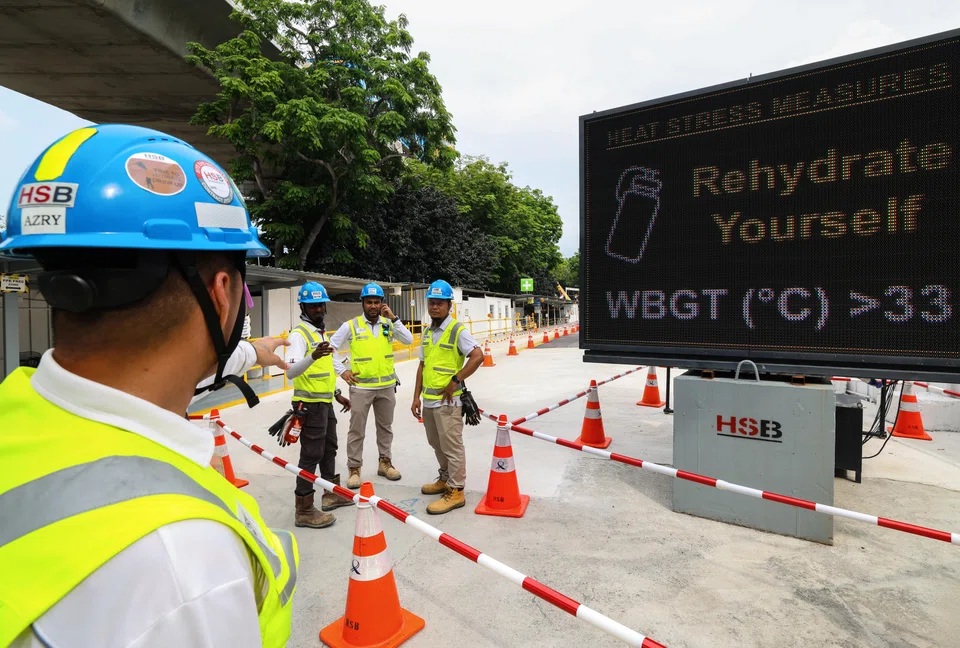
[SINGAPORE] Water sprinklers, an outdoor shower tent, large industrial fans, and insulation beneath a shelter’s metal roof – these may not be common sights at construction sites in Singapore.
But construction company Hwa Seng Builder went beyond the Ministry of Manpower’s (MOM) mandatory heat stress measures for outdoor work and took these extra steps, some in response to workers’ feedback.
“You treat it as an investment rather than expenditure,” says Alan Nah, the company’s executive director of projects. “We have to take their feedback seriously… because they actually know where the pain points are.”
“It’s a fraction of the contract sum,” he adds.
Beyond safeguarding workers’ well-being, these measures aim to maintain current levels of work productivity – which may suffer as the climate warms.
A study on chronic humid heat’s impact on labour in 2018, with projections for 2028 and 2035, was recently published in academic journal Climatic Change.
It found that in 2018, Singapore’s construction sector had one of the largest effective working-time losses due to heat: 17 per cent lower than it would have been otherwise. This is projected to increase to 20.7 per cent in 2035.
Businesses that rely on outdoor work are particularly affected, due to their workers’ greater exposure. But losses may extend beyond specific sectors.
Dr Natalia Borzino, the study’s lead author and postdoctoral researcher at the Singapore-ETH Centre, says: “Singapore’s economic structure amplifies these effects.”
When sectors such as construction, logistics and utilities face heat-related labour-capacity constraints, the impact may flow to other firms through “delayed inputs, reduced throughput and infrastructure dependence”, she adds.
“The economic risk beyond 2035 is therefore not simply that more outdoor workers will face hotter conditions. It is (also) that repeated heat-related constraints in critical sectors could increasingly affect the reliability and performance of the wider economy.”
Feeling the heat
Data from the Meteorological Service Singapore shows a clear trend: Temperatures have risen in recent decades and are projected to climb further.
This is true even under the most optimistic climate scenario, which assumes that warming will be no greater than 2 degrees Celsius above pre-industrial levels by 2100.
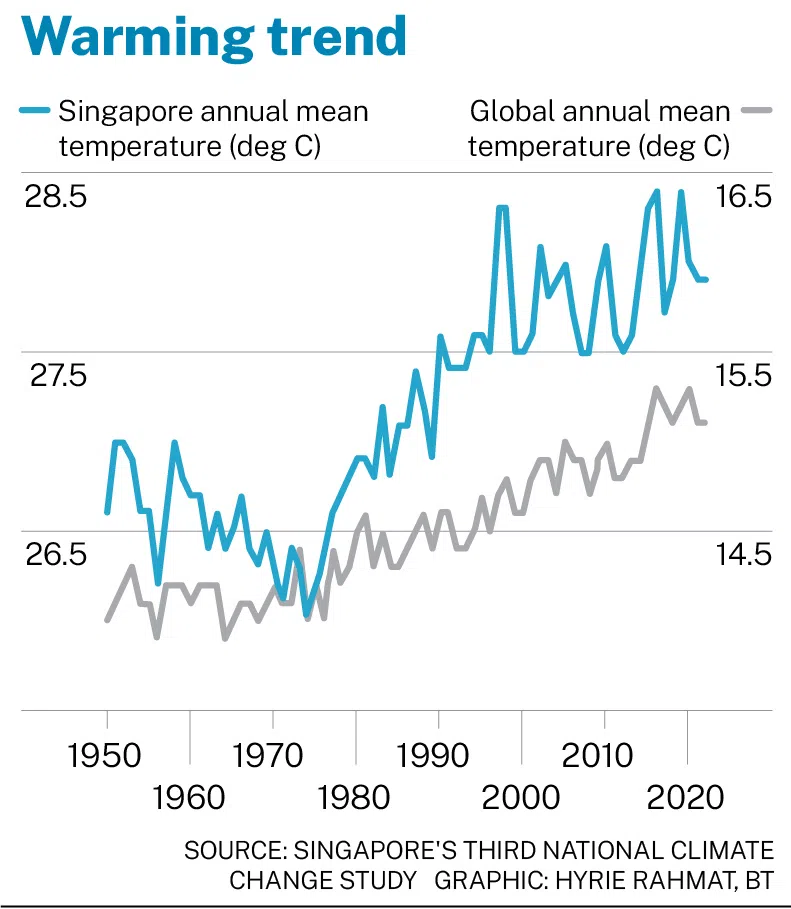
What might this mean for Singapore’s economy? A 2024 study, Project HeatSafe, sought to quantify this.
It projects that in 2035, heat could make the city-state’s total productive working time 14 per cent lower on average than it would have been otherwise. This means a potential economy-wide output loss of S$2.22 billion.
This is 88 per cent greater than the loss of S$1.18 billion in 2018, when productive work hours fell 11.3 per cent on average.
This does not mean Singapore’s economy will contract by S$2.22 billion in 2035, clarifies Dr Borzino, who led the economic research for Project HeatSafe.
Rather, it shows how a substantial volume of economic activity could be at risk in a single year if rising heat constrains labour capacity faster than workplaces, infrastructure and supply chains can adapt.
The toll on productivity
Some companies are already feeling the heat.
Between hotter conditions and MOM’s tighter foreign labour policy, landscaping company Mao Sheng Quanji Construction is finding it increasingly hard to meet project objectives, says executive director Choo Jun Wei.
Workers are less productive because they need more frequent breaks. Having noticed workers requesting more painkillers at certain times of the year, Choo says: “I think (the heat) gave them headaches.”
He adds: “Right now, we do encourage them to take more short breaks, more water breaks, just to break the heat accumulation.”
It is also harder to keep projects on schedule, because hotter weather requires that newly planted areas be watered more frequently – which takes up workers’ time and may delay other tasks.
To minimise the risk of delays, the company takes measures such as deploying industrial fans or asking property owners of job sites to provide water if possible. It is also testing solutions such as cooling vests.
Expecting rising temperatures to further erode productivity, Choo worries that his business may not stay competitive.
Staff at building maintenance company ISOTeam, meanwhile, are now more prone to mistakes and minor accidents than they were a few years ago, observes executive chairman David Ng.
He attributes this to rising temperatures. “Dehydration sets in easily, and you have headache, dizziness, which means more errors and sick days... Heat is like a tax on productivity.”
Nonetheless, like most companies to which The Business Times spoke, ISOTeam has continued to complete projects on schedule and has not had significant productivity losses.
This is despite workers clocking fewer productive hours, partly due to firms having to comply with MOM’s mandatory heat stress measures.
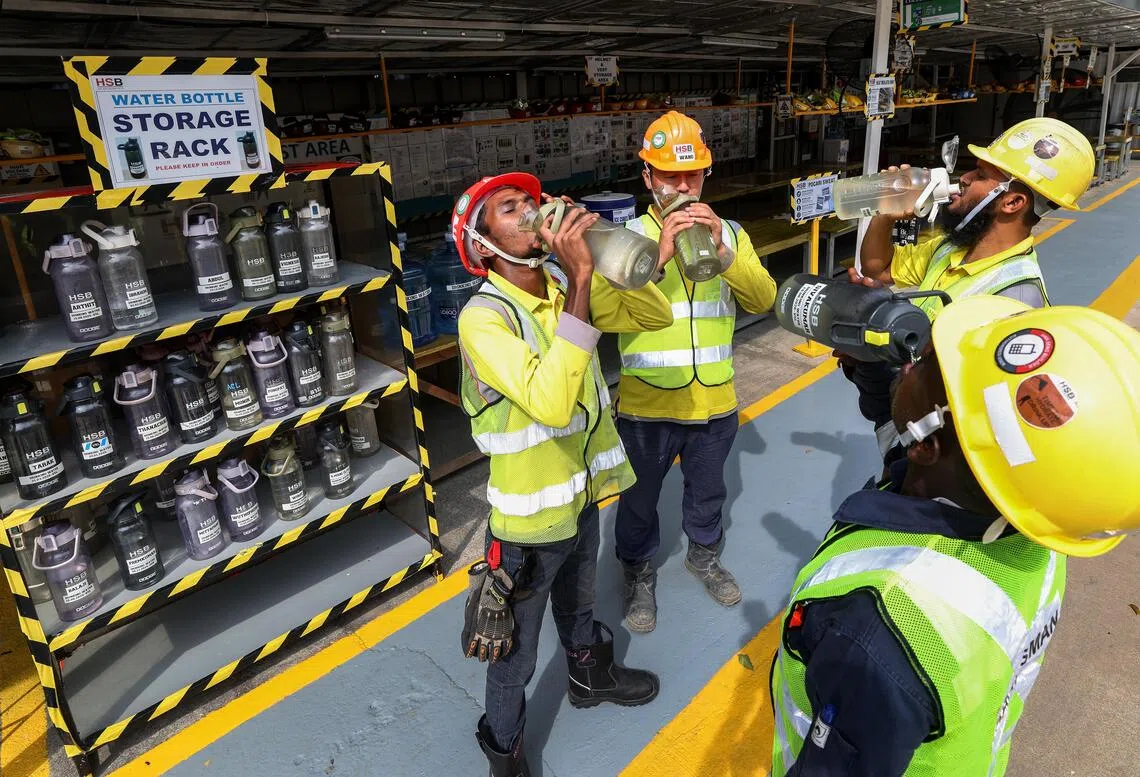
When the Wet Bulb Globe Temperature (WBGT) – a heat stress index incorporating air temperature, humidity, wind and solar radiation – hits 32 deg C, employers must ensure workers hydrate themselves and take a 10-minute break every hour.
When the WBGT crosses 33 deg C, the required break time is extended to 15 minutes.
One reason that overall productivity has not fallen may be that breaks are relatively brief, says Allan Low, who chairs the sub-committee for heat resilience at the Singapore Contractors Association Ltd (Scal).
The breaks may even help workers sustain productivity by preventing heat fatigue, he adds.
Companies also strive to minimise the impact of fewer productive hours by redesigning processes, automating tasks and using cooling infrastructure.
ISOTeam has adapted schedules to minimise workers’ exposure to heat. Outdoor tasks, such as hacking a basketball court, are done in the cooler hours of the morning or late afternoon; indoor activities, such as painting, are done during the hottest part of the day.
Scal’s Low notes that construction companies are increasingly doing the same, by sequencing work according to the weather.
It helps that the sector has moved towards precast construction, where structural components are made off-site and assembled on-site, and lighter building materials that are easier and quicker to install.
This shift started years ago as a response to tighter foreign manpower policy, but now has the added benefit of reducing the time that workers spend outdoors.
Similarly, aluminium shipbuilder Penguin International is automating parts of its hull fabrication process to reduce the time workers spend exposed to the elements.
Managing director James Tham notes that most of the shipbuilding work is already done in sheltered spaces.
Then there is cooling infrastructure. Penguin is considering air-conditioning for its workers’ dormitory that was completed this April. Although fans have been installed, workers have told the company that the dormitory remains uncomfortable.
Steel shipbuilder Marco Polo Marine is constructing two large shelters over its slipway. While this was prompted by heavy rainfall that disrupted production at its Batam shipyard, the new structures will also protect workers from unpredictable weather in general, including heat, says chief executive officer Sean Lee.
The company has also built two sheltered workshops and is installing industrial fans in them.
“Even modest investments can become economical when applied across a large workforce and many hot days.”
Prof Winston Chow from Singapore Management University
Academics suggest a portfolio approach to managing heat stress, whereby measures are tailored to work sites.
These range from low-cost moves such as heat-risk training for workers and having extra capacity during hotter periods, to capital-intensive interventions such as redesigning worksites for airflow and shade, and having centralised or district cooling systems, says Professor of Urban Climate Winston Chow from Singapore Management University.
He suggests that companies start with low-cost controls, measure the results, then prioritise engineering investments in areas where heat exposure and productivity losses remain high.
“The business case should compare life-cycle adaptation expenditure against avoided losses from slower production, absenteeism, errors, injuries, employee turnover and delayed contracts,” he says.
“Even modest investments can become economical when applied across a large workforce and many hot days.”
Mind the gap
Even as companies recognise the importance of mitigating heat-related risks, their focus remains on day-to-day operational challenges.
Rising costs and foreign manpower policy are pressing issues that usually take precedence, says Choo. “Things like climate, you have it at the back of your head, but you also cannot overthink (it) because you don’t have the solutions.”
Yet, it is critical for businesses to start adapting to heat now, as the impact of climate change is already intensifying, notes a government spokesperson in response to queries from BT.
“Taking action early can help businesses maintain operational resilience, reduce long-term operational costs, and help position companies favourably with increasingly climate-conscious stakeholders,” adds the spokesperson.
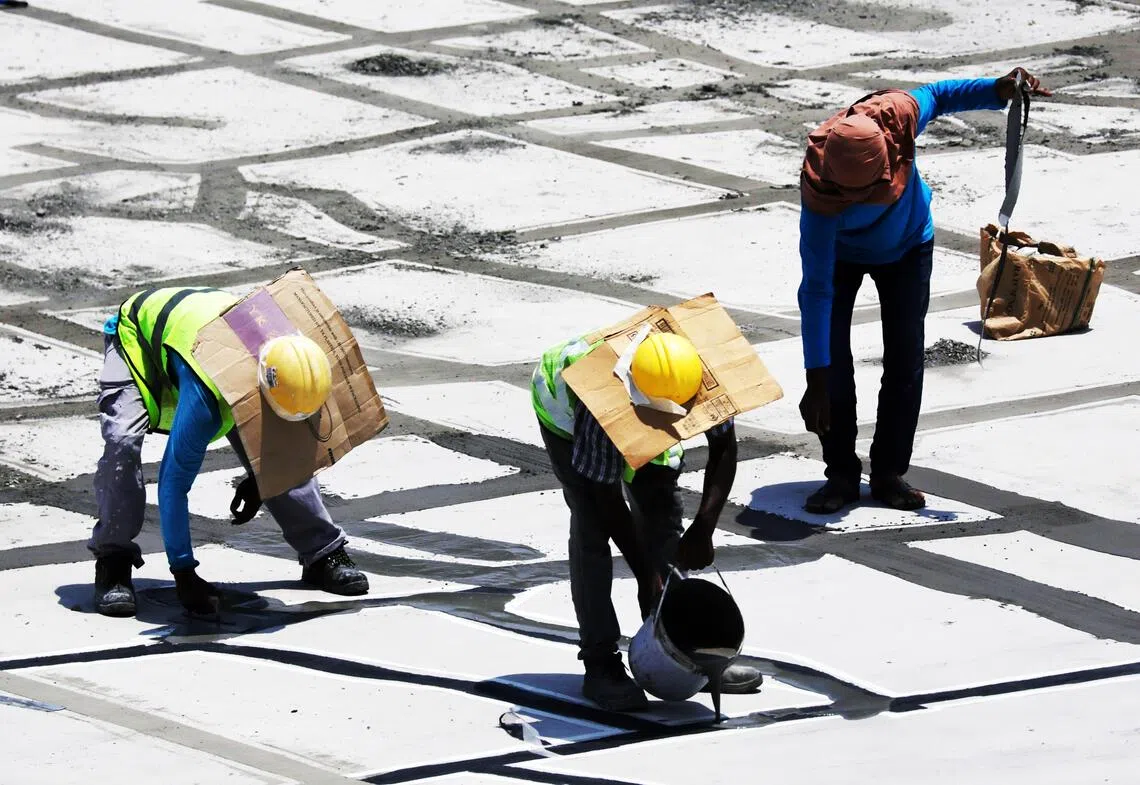
Businesses’ failure to take necessary action may be due to underestimating the costs of heat, according to a Project HeatSafe finding.
Only about 30 per cent of the 214 employers surveyed saw productivity loss as a significant problem, even while estimating that workers lost an average of 32 per cent of their productivity on a hot day.
Says Dr Borzino: “This points to a perception-and-accounting gap: Firms may observe slower work, more breaks or reduced pace without aggregating those effects across workers, shifts, projects and months into a total business cost.”
Related losses may not be seen as “heat cost” per se, and instead show up in the form of slower task completion, unplanned stoppages and project delays.
Heat experts say heat indicators and workers’ symptoms should be tracked alongside operational metrics such as productivity losses, so that the risk of heat stress is measurable.
Such records could also help in, for instance, requesting an extension when a project is delayed due to heat-induced productivity losses.
There is an established practice for construction companies to make such requests when there is more rain than forecast during the contract period, notes Yheng Yee Foon, vice-chair of Scal’s workplace safety and health committee. But such a mechanism does not exist for intense heat days.
Something to sweat over
Besides the impact on individual companies, heat stress could dampen Singapore’s long-term economic competitiveness.
Business costs may rise if companies have to hire more workers, spend more on cooling measures and manage longer project timelines, says Prof Chow.
But the city-state can continue to be competitive if it has high adaptive capacity.
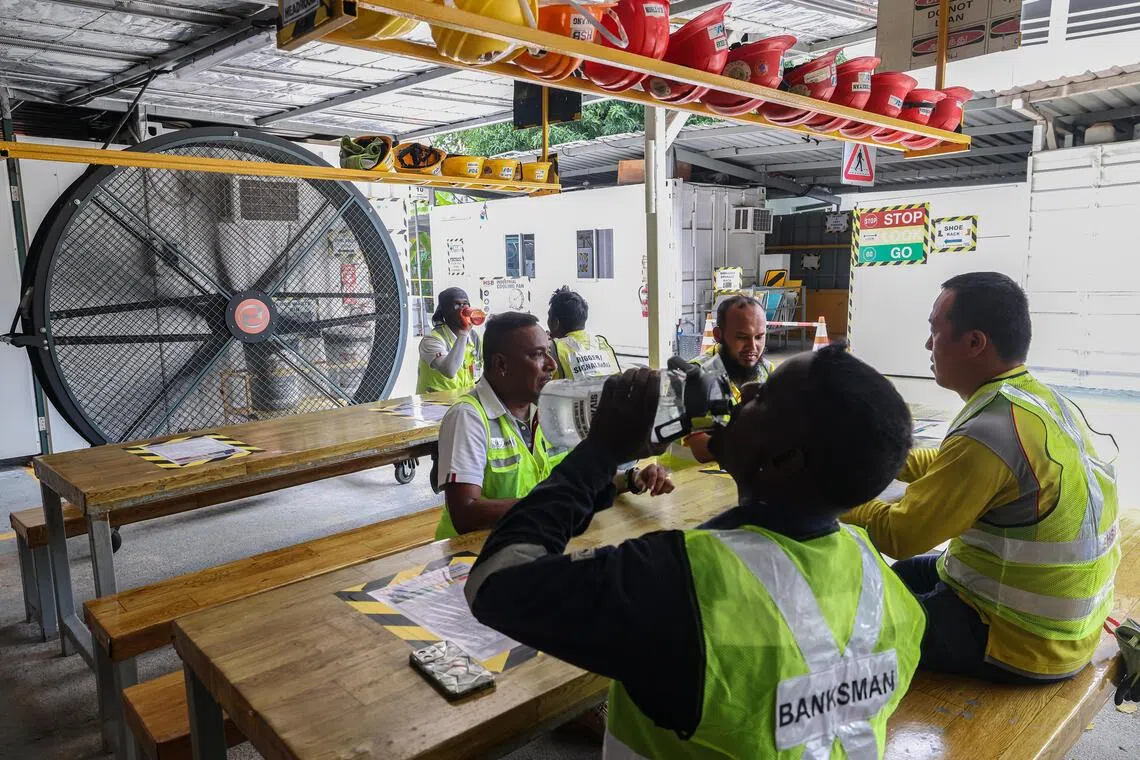
There will be rising demand for solutions that protect workers without sacrificing productivity and energy efficiency, say Dr Borzino and Professor Jason Lee, the lead principal investigator of Project HeatSafe.
Singapore can be a test bed for such solutions, which can then be sold elsewhere too.
“The strategic issue is therefore not only how much the climate warms, but (also) how effectively Singapore adapts,” they add.
“Firms and economies that treat heat resilience as part of productivity infrastructure and business continuity strategy – not only as a compliance obligation – will be better positioned in a warming region.”
A hotter future
As temperatures rise, heat stress regulations may have to evolve.
MOM will continue to monitor developments in climate science and the evolving understanding of heat-adaptation measures, says a government spokesperson.
This includes short and long-term acclimatisation, as well as emerging heat-mitigation solutions.
The spokesperson adds: “We will review and enhance measures in consultation with industry stakeholders and tripartite partners, to ensure that outdoor workers are adequately protected from both immediate and long-term environmental risks at workplaces.”
Updated heat stress measures should go beyond isolated periods of extreme exposure, note Dr Borzino and Prof Lee.
Heat should be treated not only as an exceptional workplace hazard, but also a recurring operational constraint, they add.
This could entail having “stronger protections for heavier work, longer exposure and more vulnerable workers rather than relying solely on one universal cut-off”.
Prof Chow says that simply adjusting heat-relief measures for higher temperature thresholds is not sustainable, as that would mean that normal work is still being carried out under hotter conditions.
“Raising an action threshold could normalise more dangerous exposure,” he notes. “Instead, future rules may need more detailed and progressively stricter controls above 33 deg C.”
Possibilities include higher work-rest ratios for heat tiers above 33 deg C; different rules based on workload, protective clothing and radiant heat; and ways to manage cumulative exposure over a shift or inadequate recovery during warm nights.
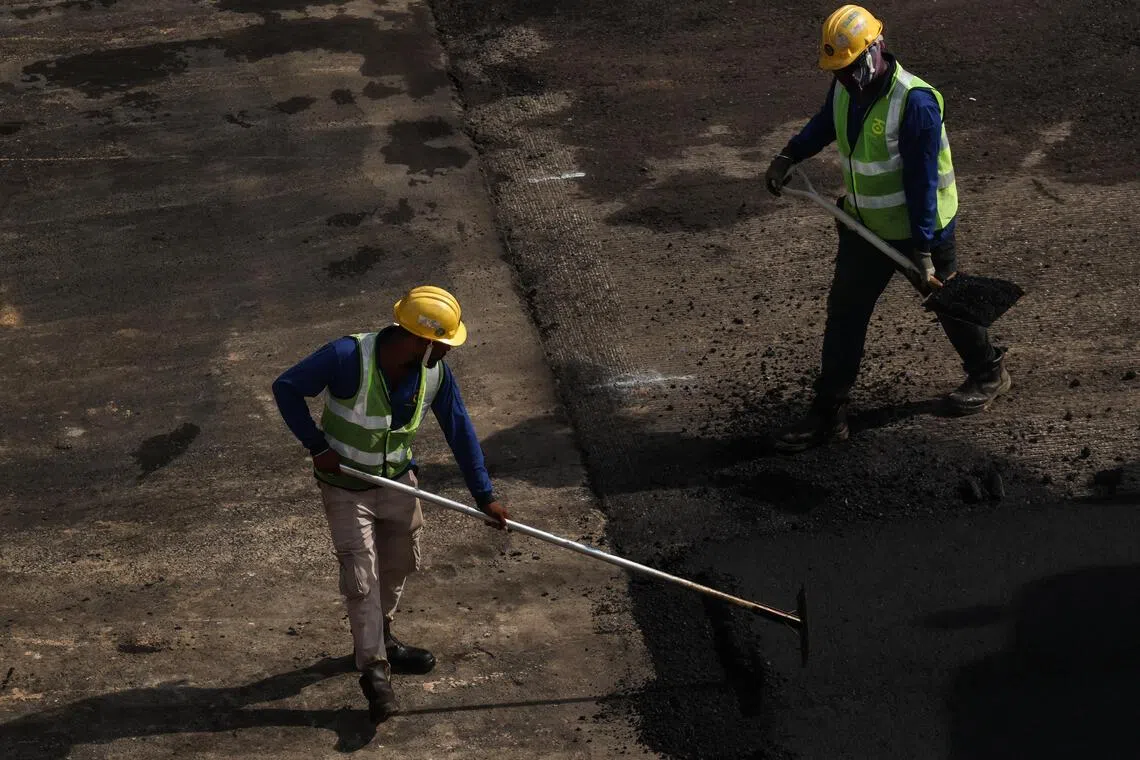
Companies should view heat stress management as an integral part of workplace safety and business continuity planning, rather than as a compliance exercise, says the government spokesperson.
“A good starting point is to conduct a risk assessment of the workers’ heat stress exposure, taking into account factors such as the nature of work, duration of outdoor exposure and physical demands.”
Companies can then take action based on that, drawing on MOM’s heat stress framework and guidelines, adds the spokesperson.
Prof Chow suggests that companies should develop procedures where action must be taken once the WBGT crosses certain thresholds.
An example is stopping work without having to seek the approval of a supervisor. Such requirements should also be extended to sub-contractors, adds Prof Chow.
A longer-term response is also necessary, say Dr Borzino and Prof Lee. “Firms cannot depend only on measures activated after a threshold is crossed.”
“Heat resilience should be incorporated into work design, staffing, scheduling, facilities planning, procurement and business-continuity systems,” they add.
For companies, adapting to heat is not just a regulatory challenge, but also a financial one.
Hwa Seng’s Nah notes that tasks will take longer to complete, either because workers become less productive or because working hours will be shorter if processes are made more heat-resilient.
“A three-year project probably may drag on for another half a year,” he says. “I think society, as a whole, (has) to recognise that the cost of construction is going to go up, the labour cost is going to go up. It’s something we have to deal with.”
This also means that project owners must accommodate longer timelines where necessary, points out Lim Eng Boon, Hwa Seng’s director of projects.
Developers and infrastructure players in both the public and private sectors need to recognise the risks that rising heat poses to construction work, he adds.
“Heat should be treated not only as an exceptional workplace hazard, but also a recurring operational constraint.”
Dr Natalia Borzino and Prof Jason Lee
Mao Sheng Quanji’s Choo says that even though heat stress has been discussed in the industry for the past decade, its economic implications are not getting enough attention.
“People know it’s getting hotter. But how does it affect overall cost? I think this part – the economics of heat – needs more effort.”
In countries such as China and some Middle Eastern states, outdoor work is halted during the hottest parts of summer days when temperatures approach 40 deg C, he notes. “Maybe this could be our future.”






