Beijing now wants the world to live with the virus
Ravaged by the virus, China is hitting out at the very countries that could have provided a model for how to exit Covid-zero.
IN CHINA’S binary view of the pandemic, there can be only zeros and ones – that is, Covid-zero or Covid for everyone.
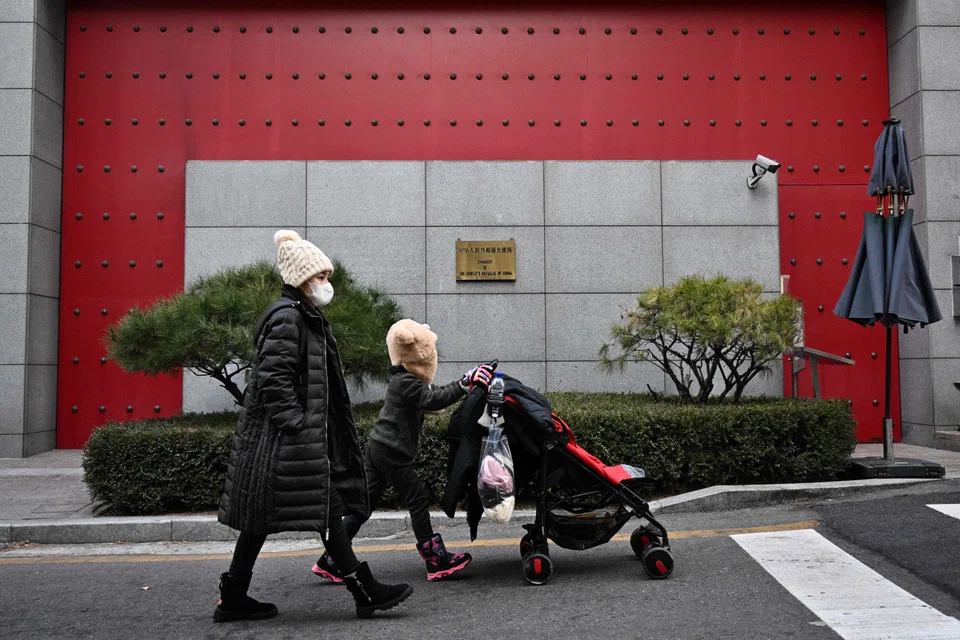
Having scrapped its pandemic policy in an abrupt about-face that it failed to warn the international community was coming, Beijing has now decided that attempts to limit the spread of the virus are unacceptable – even those over which it has no control. President Xi Jinping’s administration has now stopped issuing visas for South Korean and Japanese travellers, after those countries (among others) put in place new curbs when infections started surging through China. With Lunar New Year fast approaching and Chinese citizens able to leave their country for the first time in years, its neighbours have imposed testing requirements on travellers, with Seoul also halting the issuance of some short-term visas, and Japan looking to limit flights.
This comes even as China still requires visitors from all nations, including South Korea and Japan, to submit a negative polymerase chain reaction test before boarding a flight to the country. The double standards from Beijing are a throwback to 2020, when it decried any action from other nations that sought to limit the spread of the virus by targeting Chinese travellers, even as the country locked down domestically.
What’s most depressing is that the two countries that Beijing has lashed out at – which pre-pandemic sent more people each year to China than any other nation – are those from which it has the most to learn as it exits from Covid-zero.
From the early days of the outbreak, South Korea and Japan took a third approach – one that neither sought lockdowns to eliminate Covid, nor let the virus loose in a bid for herd immunity. In many ways, the two were pioneers of “living with the virus”, a phrase that the late Shinzo Abe, then Japanese prime minister, used as early as May 2020 to describe his country’s approach.
Without resorting to police on the streets, much less the lockdown excesses epitomised by Shanghai’s 2022 approach, both nations sought to keep their economies ticking over, tamping down the worst of the virus while rejecting the idea of eliminating it entirely. Although their approaches were different, with South Korea emphasising mass testing and high-tech logging and Japan pursuing public health messaging that helped people avoid infection alongside contact tracing to suppress infections, results were similar. Both had radically lower levels of restrictions and deaths compared to most major economies.
The upshot was that routine medical screenings and treatment continued, as did much of normal life. Factories and education were largely unaffected. The global economy did not, as a result of uncontrolled infections, run short of the parts both countries supply. Both also utilised vaccinations with world-leading mRNA shots, and boast impressive booster take-up, along with some of the lowest deaths of any major country. Where China lies on that list is no longer certain, with its data on Covid fatalities no longer trustworthy, if indeed it ever was.
That lack of certitude is one reason governments want to be seen doing something as China becomes swamped with infections. At any one time in recent days, there may have been more people with Covid in China than the populations of South Korea and Japan combined. Both have seen runs on medication and painkillers in pharmacies, seemingly from Chinese travellers or those sending supplies back home.
While China’s decision to end Covid-zero was overdue and welcome, shifting overnight from full suppression to a let-it-rip approach was bewildering and illogical. Communication has shifted to downplaying the dangers of the virus, now claimed to be no more harmful than influenza. That may be technically true in terms of fatality rates, but it ignores that Covid can transmit orders of magnitude faster than even a bad flu season, quickly clogging hospitals – which have already become overwhelmed in China. With the surprise move also coming as winter begins to bite, both neighbours are concerned not just about Covid’s impact on their stretched medical systems, but that of the flu, also. They have little room to spare.
Tuesday (Jan 10)’s visa pushback has already punctured the theory that China is looking to soften its approach to international relations, after shifting “wolf warrior” diplomat Zhao Lijian to another role. Indeed, it came the same day that China’s ambassador to Australia launched a bizarre attack, repeating the canard that Japan hasn’t apologised to Canberra for its actions in the World War II, and suggesting Tokyo, not Beijing, represents the biggest threat in the region.
Thankfully, few are swayed by such arguments these days. The memories of China’s retaliations for supposed offences are more recent – from imposing de facto economic sanctions on Seoul for deploying the Thaad defence system to letting protesters run riot against Japanese businesses in 2012 over disputed islands. Sony Group appears to be the latest foreign brand that may be forced to apologise for some perceived online slight.
What Beijing seemingly can’t accept is that, particularly when it comes to Covid, it has done nothing to deserve trust. This is the regime that insisted the virus wasn’t transmitting between people, even as it hoarded supplies of swabs and masks; or to this day continues to hinder efforts to learn more about the pandemic’s origins. While Beijing’s proxies were able to garner sympathy back in 2020 thanks to the presence of the divisive Donald Trump in the White House, it has no such inadvertent ally today.
While China says Covid has peaked in many parts of the country, Lunar New Year travel likely means the virus will continue to circulate into more rural parts of the country. At least for now, Seoul and Tokyo should ignore Beijing’s admonitions and stick to their guns. BLOOMBERG