The best port in a storm: why tech businesses are flocking to Singapore
FOR almost its entire history, Singapore has been a place where connections are made. As early as the 1300s, Malay, Indian and Chinese traders exchanged goods in the region. Europeans followed a few centuries later, in pursuit of commodities like cloth, spices and gold. Singapore became a free port in 1819, which helped it become a thriving strategic centre on the Maritime Silk Road.
From a cosmopolitan port city under colonial administration, an independent Singapore emerged, determined to press its advantages – and to use the lessons it learned from its mercantile past to transform its economy into a leader. Instinctively, Singapore’s leaders understood the value of being a place where connections are made; not just where traders meet each other, but where entrepreneurs can find investors, where multinational corporations can find a workforce, where foreign investors can find new customers.
Singapore is still the best place to make those connections, especially for the newest crop of tech disruptors who are revolutionising the global economy and changing the way we live.
At present, the global economic and geopolitical environments are challenging, and investors are harder for tech companies to find. The upside is that the tech companies that can weather this storm are likely to have staying power. And there’s no better place for them to steady the ship and chart a course towards future growth than Singapore.
Much as Singapore’s founders sought to build on the city-state’s strengths by expanding into manufacturing, finance and then tech, its current leaders see the value of investing in disruptive and innovative businesses. Singapore is doubling down on tech leaders.
Today, nearly half of South-east Asia’s unicorns are based in Singapore, and about 80 of the top 100 global tech firms also have a presence here. But at the Infocomm Media Development Authority (IMDA), we’re more interested in the more than 4,200 startups that are following in their footsteps with innovative technology and new business models. These businesses come from as far as China, Japan, Israel and the US. And they could succeed anywhere – but they choose Singapore.
Our four-pronged approach – involving partnership, access, people and global perspective – leans on the very best of Singaporean culture to attract the world’s most disruptive companies. Along with the opening of the world after a global pandemic, these four pillars offer us a moment-in-time opportunity that could be hugely lucrative for Singapore.
Using true trader hustle, we are seeking out and partnering with the best startup ecosystem organisations around the world. From Japan to Australia, Israel to the Nordics and the UK to Spain – we have teamed up with them to focus on the added value of Singapore in helping “disruptive” startups from both ecosystems to test and learn, to build enterprise scale or to help meet their vision to address some of the biggest challenges in the world via technology.
The IMDA accreditation programme is the vehicle that helps these promising companies establish credentials and position themselves as qualified contenders to government and large enterprise buyers around the world. It doesn’t include direct financial incentives, but there are still huge benefits for partners and their portfolio companies in progressing through accreditation.

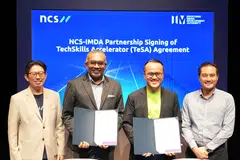
For example, in China we partner with TusStar, the largest startup and innovation network in China with over 170 centres covering all major cities in China, and part of Tsinghua University’s ecosystem. The signing of the first IMDA-TusStar memorandum of intent (MOI) in October 2019 led to the creation and co-curation of four joint events. From these tie-ups, 88 promising Chinese deep-tech startups were identified, after which four of them landed in Singapore within six months.
But why would these world-class disruptive companies choose to come to Singapore? For construction software firm viAct, it was about access and IMDA’s ability to quickly facilitate introductions and access to strategic government projects. For many companies, accessing, scaling and succeeding within Singapore’s world-class infrastructure (with its strengths in law, IP protection, financial systems, et cetera) is a huge advantage. Singapore’s ability to identify fit-for-purpose projects, while evaluating and safely integrating innovative technology into a broader enterprise architecture, sets it apart from other countries, where public service opportunities and technology integration might be slower or harder to achieve.
For Virspatial Technologies, a spatial computing company, it was about the unique added value of Singapore’s people and processes. Its managing director Gavin Gui said: “Singapore’s political stability and world-class talent are top considerations for our business outside of China.”
Singapore’s talent pool and an ecosystem where disruptive startups mingle and grow is an incredibly strong selling point for groundbreaking businesses looking for a global or regional hub. Vinnie Lauria, managing partner of Golden Gate Ventures, told Startup Genome: “Singapore and Silicon Valley share a unique quality, they are magnets for talent across the globe. Magic is sparked when people from different backgrounds come together to solve a problem.”
Last but certainly not least, Singapore’s global perspective makes its landing programme hugely attractive for disruptive technology companies. For such startups, Singapore is supercharging their global opportunity, given its global hub status across key sectors such as transport, logistics and financial services, and with IMDA’s ability to deliver successful local proof-of-concept solutions, integrating local infrastructure into regional and global standards and systems. Like the traders of old, we are taking their raw products and adding a uniquely Singaporean flavour and value, which makes the finished product more attractive and palatable for the rest of the world.
So that’s great for disruptive tech firms from around the world, but what’s in it for Singapore? S&P Global notes that “the weight of the Asia-Pacific region in world gross domestic product has risen from 27 per cent (US$9.5 trillion) in 2000 to 37 per cent by 2021, with a further increase to 42 per cent projected by 2040”. Much of that is likely to come from digital innovation leaders.
The benefits range from hiring and developing local talent, to providing first-mover advantage in adopting innovative technology to having Singapore lead in the adoption of technology to address major societal challenges. Sourcing and wooing disruptive technology firms will continue to build Singapore’s reputation of being world-leading, as it becomes the world’s first digital metropolis.
Finally, as global economic headwinds start to bite, disruptive technology can play a key role in helping minimise the impact. As the dotcom bust and global financial crisis demonstrated, slowdowns are a great time to identify and support the next Amazon, Grab or Alibaba. If a company is still building and forging forward during a downturn, it shows its mettle and commitment. Therefore, IMDA believes there’s no better time to support startups from around the world – and we are committed to scouring the globe to find and attract the best businesses here, to build our future.
The writer is assistant CEO of the Infocomm Media Development Authority.
Decoding Asia newsletter: your guide to navigating Asia in a new global order. Sign up here to get Decoding Asia newsletter. Delivered to your inbox. Free.
Share with us your feedback on BT's products and services