

Big agenda for Europe’s two most powerful politicians
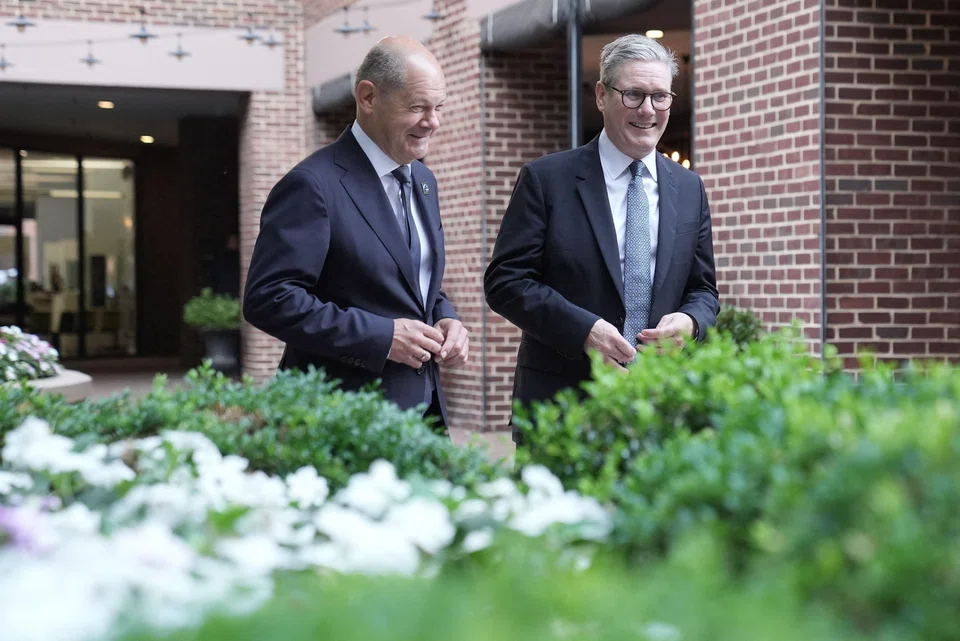
GERMAN Chancellor Olaf Scholz and UK Prime Minister Keir Starmer are sometimes criticised as technocratic, uncharismatic politicians of the centre-left. Yet, even some of their fiercest opponents acknowledge that they are perhaps the most powerful national leaders in Europe at the moment.
Scholz heads the European Union’s largest economy, and it remains possible he could win a second term in 2025. Meanwhile, Starmer will likely be UK prime minister till at least 2028 or 2029, after Labour’s landslide election victory in July.
This is why the first major meeting of Starmer and Scholz on Wednesday (Aug 28) matters. Europe is facing a critical period, ranging from the future of the Ukraine war to the next steps regarding the transatlantic alliance with the United States, and also the future of ties with China. With the term-limited Emmanuel Macron’s presidential power draining away in France, it will be Scholz and Starmer who will have an outsized influence in shaping issues facing the region in the coming months from their vantage points within and outside the EU, respectively.
The key issue underpinning all these challenges is UK-EU cooperation, post-Brexit. While the new UK government has ruled out rejoining the EU, it has vowed to rebuild trust with European allies after a damaging last decade, before and after the 2016 Brexit referendum.
The fact that this EU-related agenda is important to Starmer is showcased in his early visit to Berlin on Wednesday, less than two months into office. By comparison, his Conservative predecessor Rishi Sunak was in power for 18 months as prime minister before making a first trip to Germany.
At July’s European Political Community summit in England, Starmer told European leaders that his government would be a “friend and partner”. He asserted that “we want to work with all of you to reset relationships, rediscover our common interest and renew the bonds of trust and friendship that brighten the fabric of European life”.
Prior to the 2016 referendum, Starmer was a strong advocate of the United Kingdom remaining in the EU, and served as Labour’s shadow Brexit secretary for some of the period after. As prime minister, he has ruled out rejoining not only the EU, but also the European single market and Customs union.
Part of the reason for this is that the UK government wants to utilise new, post-Brexit powers to pursue an enhanced international trade strategy. This includes potential new trade deals with Asian nations such as India and South Korea, plus others across the world, from the Gulf Cooperation Council and Turkey to Latin American nations.
Nevertheless, the new UK government has an ambitious agenda with Europe too, short of EU membership, including a potential new UK-EU security pact, plus an improved trading deal. That this agenda is important for London is indicated by the fact that new Foreign Secretary David Lammy chose Germany for his first trip abroad just two days after election day, proposing a “reset” in relations with the EU. Moreover, Defence Secretary John Healey has also visited Berlin, signing a joint declaration with German counterpart Boris Pistorius.
The political “window of opportunity” for Starmer to move forward on this agenda comes in 2025 when the UK’s Brexit deal is formally up for renegotiation. He has vowed to change what he described as former prime minister Boris Johnson’s “botched” agreement.
However, this will require political will in the EU too, to get any significant changes agreed that might move towards a deeper trading relationship and security pact. This is especially so in Germany, in an election year. On the trade side, one key focal point for the UK government is a so-called veterinary deal which has the potential to significantly reduce friction on agricultural commerce.
Since 2021, the EU-27 nations have applied comprehensive border controls on UK agri-food imports, which were reciprocated by the UK on the EU in 2024. These necessitate full checks and a veterinarian signature to ensure compliance with respective EU and UK standards.
The UK government has estimated that the checks on animal and plant imports are costing businesses almost 400 million euros (S$582 million) a year. However, some industry estimates put this figure at higher than three billion euros every 12 months.
While both sides recognise the futility of the current approach, negotiations could fail over the potential EU demand that the UK align with key single-market regulations on agri-food in the future. This could mean London accepting a role for the much-maligned European Court of Justice, a hugely politically controversial institution among UK Conservatives.
On the security front, there is now a real opportunity for a UK-EU pact that would formalise much of the current cooperation, with the potential to move beyond this, including tackling illegal migration. This deal might be especially likely to be agreed if Donald Trump wins a second presidential term.
Taken together, much of Starmer’s trade and security agenda with the EU will be fiercely opposed by Conservatives who generally want to diverge more from Europe, including in areas such as taxation, to seek competitive advantage for the UK. However, public opinion may favour the government’s stance after the perceived failures of Brexit under prime ministers Johnson, Liz Truss and Sunak.
To win support for its agenda, the Labour government is likely to continue to try to reshape the centre of debate away from “Brexit versus Remain” towards how best to make Brexit work in practice. The goal is forging a clear new settlement that includes potentially taking advantage of new freedoms, such as the ability to cut tax on energy bills that the Conservatives failed to deliver on.
Politically, this agenda is important for Starmer given his top goal of rejuvenating UK’s economic growth. Johnson’s Brexit deal created structural impediments to trade that aren’t improving, as highlighted by business groups such as the British Chambers of Commerce, which has made proposals for smoothing out the many rough edges of the 2020 agreement.
The EU got much of what it wanted from that agreement, including a zero-tariff, zero-quota deal for goods, by which it runs a surplus with the UK. Meanwhile, Brussels gave away little on services which is the UK’s strength. The longer the agreement remains unchanged, the more likely that economic activity will migrate, given that the UK was disadvantaged vis-a-vis competitors inside the EU single market.
The stakes at play are therefore huge and historic for both the UK and EU. A new, more constructive EU-UK partnership can potentially bring much benefit for both at a time of significant geopolitical flux.
The writer is an associate at LSE IDEAS at the London School of Economics
TRENDING NOW

Grab CEO’s wife Chloe Tong on life with Anthony Tan and finding her purpose
What role can Japan play in Asean’s future?

He built the Vingroup empire. Now South-east Asia’s richest man is handing some key roles to his sons
Asean’s challenge is to become resilient against global geopolitics: former Indonesia trade minister

