

The big ambitions of China’s private space industry
Chinese firms race to catch up with SpaceX
AROUND a decade ago, Chinese President Xi Jinping said he dreamed of making China a “space power”. Since then, the country has put a rover on Mars and built one of the two operational space stations orbiting Earth. Now, its private space industry aims to make an even bigger impact.
China’s companies may, for the first time in their histories, successfully recover the first stage of a rocket – a vital step for slashing launch costs – opening a galaxy of opportunity. Meanwhile, new private launch pads will be completed, new satellite factories will ramp up production, and a new government department will funnel more state resources into the industry.
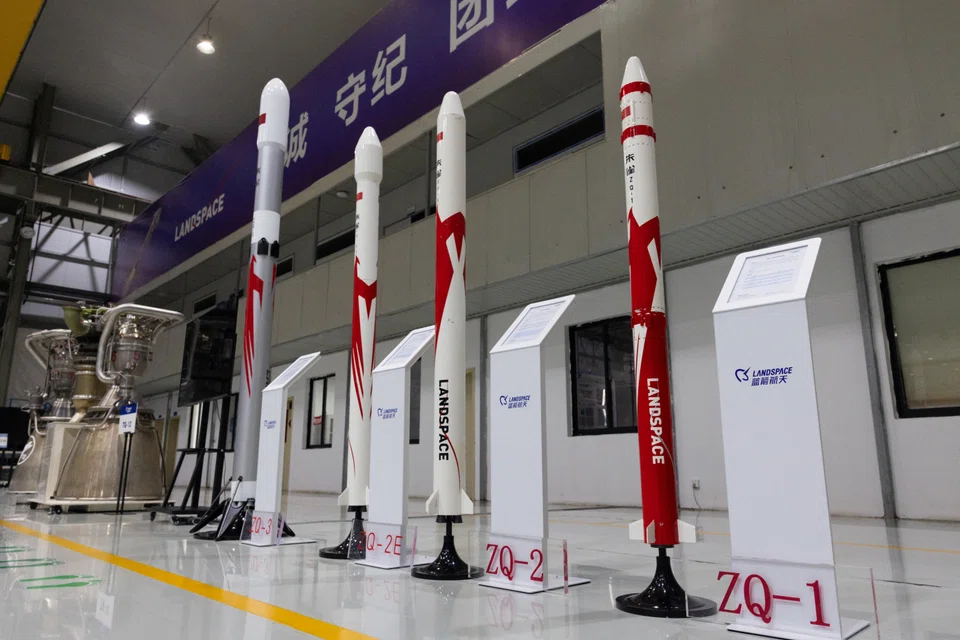
China’s space firms still lag rivals abroad. None of the 600 companies in the sector towers over it like Elon Musk’s SpaceX does in America, though a clutch of entrepreneurs has emerged who hope to. Among the most prominent are Zhang Changwu, a former financier, and Kang Yonglai, an engineer, who founded launch companies LandSpace and Space Pioneer, respectively.
China conducted nearly 100 orbital launches in 2025, but its private firms were responsible for only 16 of these. (America, meanwhile, conducted 180 launches, of which SpaceX managed over 160.)
The global space economy – which grew from US$300 billion to about US$600 billion over the past decade and is projected to further triple by 2035 – is still dominated by America, even as China makes gains in a host of other high-tech industries.
Still, China’s commercial space sector shares advantages with other high-tech sectors: many engineers, ambitious entrepreneurs and a supportive government that deem it a strategic necessity. So it is probably a matter of when, not if, China will catch up.
Despite heady ambition, almost all of China’s launches still rely on the “Long March” series of rockets built by the state-owned China Aerospace Science and Technology Corporation (CASC). They are reliable workhorses. But, much of CASC’s capacity is taken up serving the needs of China’s civil and military space programmes. And, as a government-run body, it is risk-averse and so has less incentive to bring costs down.
On average, a customer would have to pay about 60,000 yuan (S$11,066) to get a kilogram of cargo from a Chinese spaceport to low-earth orbit (LEO), which is easier to reach than higher orbits and a good spot for commercial satellites because, being closer to Earth, they can provide data faster.
The Falcon 9, SpaceX’s standard rocket, can get a kilogram to LEO for around a third of that price. It is both large, and its booster can be captured after use, refilled with fuel and fired up again.
SpaceX got the hang of launching such rockets back in 2017, and is now testing a vast new space vehicle called Starship, which could get many more – or much bigger – satellites into orbit with every launch. Chinese companies have so far built only one-time-use rockets, which are more expensive.
But that is changing.
In December 2025, both CASC and LandSpace test-launched reusable rockets (named the Long March 12A and the Zhuque-3, respectively). In both cases, the reusable booster stage exploded before being recaptured, but the non-reusable second stage still reached orbit successfully.
In 2026, Space Pioneer is expected to test its reusable Tianlong-3 vehicle, and reusable rockets from several other companies are probably also going to try their luck. “Making rockets is still very complicated,” dryly noted Jiang Luye, the chief technology officer at Arktech, a rocket company based in Beijing.
Cheaper reusable rockets would hugely increase China’s capabilities in space. Chinese firms could quickly build large constellations of satellites in LEO. So-called “megaconstellations” are needed to provide global satellite internet coverage.
China has two in the works: Guowang, which is projected to use 13,000 satellites, and the “Thousand Sails”, which will use 15,000. Currently, both still just have around 100 satellites apiece (Musk’s Starlink constellation has over 9,000). But more are on the way.
Finding consumers for the services of all these satellites may be a challenge.
Starlink said it has eight million subscribers worldwide, with around a third in America, where there are plenty of rural areas with poor ground-based Internet coverage. But it is more complicated for China. Most of the country already gets cheap zippy Internet from domestic telecom providers, while those who live in more remote areas probably cannot afford satellite Internet.
Western countries are wary of getting their Internet beamed in from Chinese platforms; potential customers in developing ones might find the service too costly.
All this creates a “chicken-and-egg” problem, said Blaine Curcio, an industry consultant. Without lots of demand for satellites in orbit, it is difficult to justify the big investments in rocket launches which could bring down the costs of getting them up there.
“Only when the data and information generated by satellites can be truly used on a large scale... will subsequent links in commercial spaceflight (including rockets, engines and launch pads, et cetera) see faster development,” said a spokesperson at Orienspace, a rocket company in Shandong province in eastern China.
Still, there are a few signs that demand might be heating up.
In December, Airbus, a European plane manufacturer, signed a deal for China’s Thousand Sails to give its passengers Internet during flights. Geely, a Chinese auto giant, is launching a constellation of several dozen satellites to help its cars navigate. Chinese tech firms Huawei and Xiaomi have started including satellite call functions into their smartphones.
China is hoping its firms move into more speculative businesses, too, such as space tourism and space-based biomanufacturing (cells behave differently in microgravity, which might help with developing drugs). On Dec 13, AZSpace, a private launch company, sent a spacecraft into orbit carrying cargo including yeast, plants and probiotics for scientific experiments.
No matter successful Chinese space companies may become, there is no chance China will allow one to amass the power enjoyed by the largest American ones (Nasa now relies entirely on SpaceX and other private firms for launches).
But China does want to better integrate private firms into government plans. In November 2025, the China National Space Administration set up a new department to oversee commercial space and released a two-year plan to support the sector.
The plan calls for opening state facilities (like rocket-test stations) to private companies and creating a national fund to invest in commercial space. It will also allow private companies to bid for projects under China’s civil space programme.
When China’s space firms do take off, they may bring more than just economic benefits. Many of the technologies they are trying to master have military uses, too: from providing communications to quickly replenishing damaged constellations to removing unwanted satellites.
In December, Chinese officials claimed Starlink and other foreign constellations present “pronounced safety and security challenges”. On Dec 13, Starlink claimed that a recently launched Chinese satellite came “dangerously close” to one of its own.
Some day, a Chinese satellite Internet provider might help China’s armed forces coordinate an invasion of Taiwan, reckons Steven Feldstein of the Carnegie Endowment for International Peace, an American think tank.
©2026 The Economist Newspaper Limited. All rights reserved






