

Birth of luxury post-partum confinement services
Centres offering these facilities are on the rise in Singapore, fuelled by rising demand from parents, even if the cost is twice their combined monthly income

Yong Hui Ting
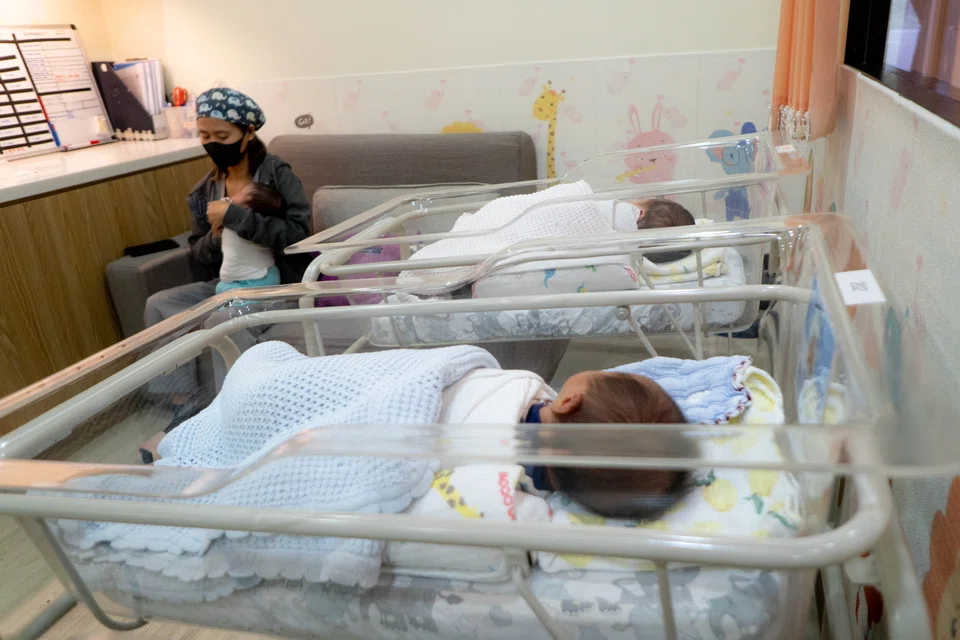
BIRTH rates have fallen steadily to record lows in Singapore. In spite – or perhaps, because – of this, demand for post-partum confinement services has shot through the roof.
The traditional practice of seclusion or special treatment following childbirth can be traced as far back as biblical times, and varies across cultures. For example, it is known as “zuo yue zi” (or “sitting the month”) in China – and the timeline for it could range from 30 to 100 days.
In parts of India, some follow a 40-day confinement and recuperation period also known as “jaappa” in Hindi.
In Singapore, the typical practice has been for new mothers to be accompanied by a confinement nanny, or taken care of by their parents or in-laws. Recently, however, post-partum confinement facilities – where parents check themselves into luxury hotels or serviced apartments that provide round-the-clock care for newborns and their mothers – have become all the rage.
Market watchers say these centres have risen in popularity for several reasons including smaller spaces at home, changing cultural norms and growing affluence among the working class.
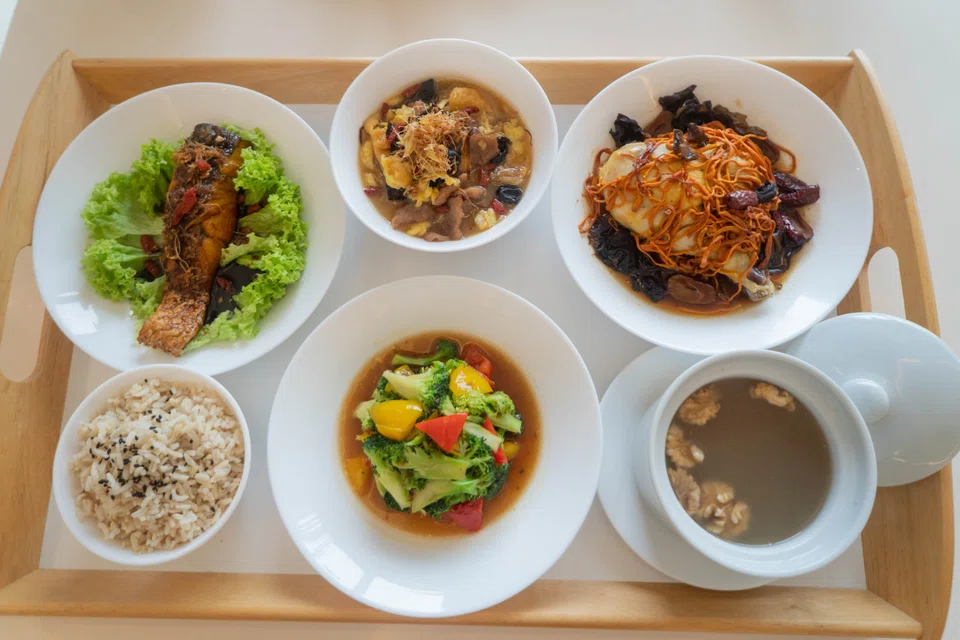
These places also whip up nourishing meals for new mothers and engage lactation experts to dish out breastfeeding advice, among services – and operators here have been quick to cash in on opportunities in the market.
While there is stiffening competition among post-partum confinement centres, demand for such services is expected to rise this year, as the Year of the Dragon is believed to be an auspicious time to have children.
What’s the appeal?
“I think, from a father’s point of view, it’s more worry-free for me,” says Chow Zheng Da, an investment manager and father to a four-month-old girl, Charlotte.
“I’m very assured that they can take care of my baby and wife well so that I don’t need to worry about them during work time.”
Chow and his wife stayed at Momley Loft for the confinement period after the couple welcomed their firstborn in late September 2023. They initially considered hiring a stay-in nanny but were not able to accommodate one as their home was under renovation.
Instead, they paid about S$20,000 for a 28-day stay at the facility, situated in Aranda Country Club in Pasir Ris.
Haysy Oh, mother to a two-month-old girl, similarly opted for a stay at a confinement centre. In total, she paid S$38,000 for a 42-day stay at My Queen in Sentosa.
Oh says she decided on this option as she preferred the centre’s more “structured” way of caring for her child, guided by experts who were professionally trained – and after hearing multiple horror stories surrounding the disputes in childcare methods between families and employed nannies.
“My husband has a sister who is 12 years younger. He watched (what) his mother went through with the confinement nanny (after his sister was born), and he did not want me to go through the same (experience),” she says.
Higher quality of care
The cost of such facilities is at least four times higher than hiring a stay-in confinement nanny – who typically charges between S$3,000 and S$5,000 a month, excluding the cost of meals.
Despite this, more couples are choosing confinement centres for the perceived higher quality of care.
These places also come with a whole suite of extra services, including post-partum massages, yoga classes and spa sessions, on top of the basic round-the-clock care for both mother and baby.
Parents whom The Business Times interviewed say they are likely to stay at confinement centres again for subsequent births. This is despite the price of such services sometimes costing more than double their combined monthly income.
Operators of such facilities say a combination of rising affluence and having fewer children has helped to increase their appeal.
Danny Xiang, founder of Saint Bella, a maternity and baby-care brand which operates Bella Villa Maternity and Baby Care Centre in Sentosa, points out that Chinese family units – which were typically larger in the past – are now much smaller.
““Now, if you look at the millennials… their parents are not living with them. By the time they marry and have kids, their parents are still working.””
Danny Xiang, founder, Saint Bella
He notes that some 10 years ago, young parents – after having children – were likely to stay with their own parents. Childcare and confinement duties could then be taken care of within the household.
In Singapore, the average household size has fallen steadily over the years. The number of households with at least four members and above has declined over the last decade, while those with three or fewer members have increased over the same period. In 2022, the average household size was 3.09, down from 3.53 in 2012.
“Now, if you look at the millennials… their parents are not living with them. By the time they marry and have kids, their parents are still working,” says Xiang.
Joey Zhang, founder of Singjoy, a confinement centre, says younger couples are also more willing to spend on such a service.
This is probably because the average fertility rate in Singapore fell to an all-time low of 1.05 in 2022, as more women delay having children and choose to have fewer children. At the same time, income levels are higher than ever. Households with at least one employed person made an average of S$13,124 in 2022, according to Singstat data.
And of course, the rising propensity to spend in this market has not gone unnoticed.
Rich opportunities
Xiang’s Bella Villa, for example, was set up to capture the wealthier segment of Singapore’s population.
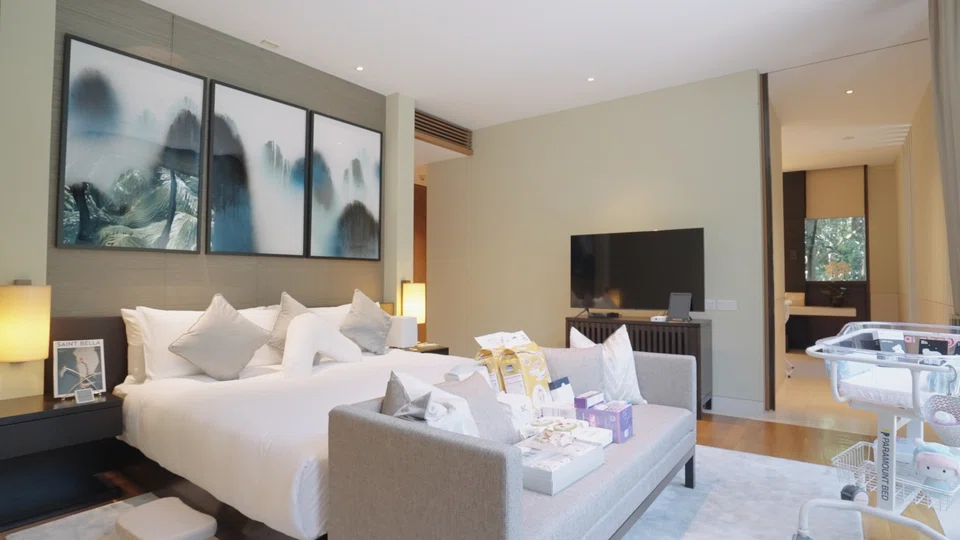
A 28-day package at the centre – housed within a luxury hotel in Sentosa – starts from S$68,000 and can go as high as S$168,000.
While some may baulk at the jaw-dropping fees, there has been no lack of interest.
Xiang says the company had to turn away some guests when the facility held its soft launch in October last year, as some of its staff were still undergoing onsite training.
“We’re even seeing families that are potentially travelling from Indonesia and the US,” says Lillian Tseng, director of global expansion for Saint Bella. “The majority of them (come) because their parents actually reside here in Singapore.”
“These wealthy families want to pay for their kids to deliver here in Singapore so they can be close to the family as well,” she adds.
Saint Bella’s facility is among the few that allow even grandparents of the newborn baby to stay at the centre. Its smallest room type, a two-bedroom apartment, spans 170 square metres (or 1,830 square feet).
Other operators have also been exploring ways to enter the market catered to the rich.
For example, Joel Tan, co-founder of confinement nanny service provider Nannymoon, says he had been in talks with the upscale St Regis hotel to explore opening a confinement centre housed within its premises.
Rising supply, limited land
There has been a spike in the number of applications to the Urban Redevelopment Authority (URA) to use existing commercial properties to run confinement facilities.
A total of six applications were recorded in 2022, compared to one each in 2020 and 2021.
In 2018, the Singapore Land Authority (SLA) awarded a tender at 26 Dunearn Road for use as a pre and post-natal care centre. Since then, no other plots have been awarded for such use.
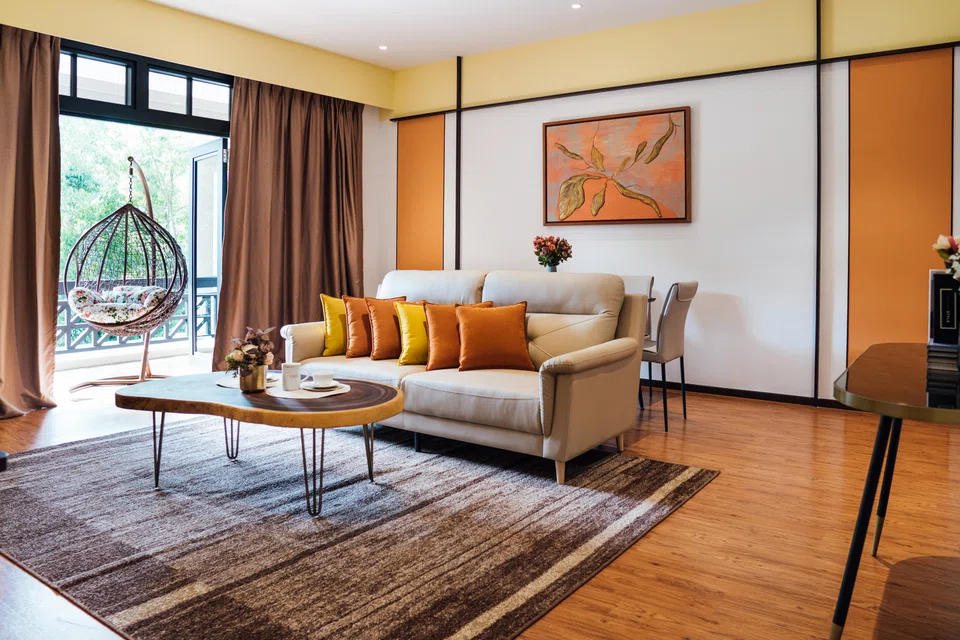
To overcome the land constraint, operators have instead set up in hotels and serviced apartments, turning ordinary rooms into multi-use spaces – for tourists and short-stay guests during peak seasons, and for mothers in confinement when they are not occupied.
Post-partum care centre My Queen is one such example. Housed within Oasia Resort in Sentosa, the centre leases rooms from the hotel and converts them into rooms for confinement stay on a need-to basis. Rates for its 28-day package start at S$19,888.
Guests at My Queen can also take advantage of the hotel’s facilities, including the pool, spa and gym.
Momley Loft confinement centre operates similarly, converting ordinary suites into rooms for confinement stays. The facility spans the whole third floor of Aranda Country Club in Pasir Ris, with parts of it facing the Wild Wild Wet water theme park.
Its deluxe suites are available at S$20,888 for 28 days, while premier suites will set guests back S$23,888 for the same duration.
Similar to My Queen’s arrangement, guests at Momley Loft get access to the country club’s facilities, as well as post-partum massages, herbal baths, and a suite of baby products and necessities.
This relatively new business model has quickly caught on. At least five confinement centres here are currently operating out of existing hotels or serviced apartments.
For the operators, this also helps to reduce renovation costs.
Singjoy’s Zhang says she did not have to spend on renovations when the company opened its Havelock branch in July 2023, as the place was already spruced up by the hotel operator before the confinement business moved in.
The brand also operates another branch housed within Shangri-la apartments, priced at S$25,000 for 28 days. The Shangri-La branch is fully booked till April 2024.
Zhang says that the two outlets cater to different segments, as its Havelock branch prices its service slightly lower – at S$19,800 for 28 days.
Expansion plans
Others have even gone as far as to set up centres in neighbouring Malaysia to capture opportunities there.
One such business, Muzi Confinement Centre, was founded by Singaporean Ong Pang Yang and his business partner Anne Chng in Johor Bahru in April 2019.
The duo picked Malaysia for its lower costs of operation and close vicinity to Singapore’s borders – the centre is just a 30-minute drive from Woodlands Checkpoint.
Ong says setting up in the country has also allowed him to price the centre’s services competitively. Rates at his confinement facility range from RM14,000 (S$3,988) to RM18,000.
With 10 rooms available, the centre is so popular that it has been booked out till July 2024. On average, about a fifth of its guests come from Singapore, while the remainder are from Malaysia.
Ong and many other confinement centre operators in Singapore are already hunting for their next plot of gold.
A cursory Internet search shows there are at least 14 such businesses in the city-state, and more are expected to spring up.
Already, many of the operators that spoke to BT say they have plans to expand within the country.
“I’m always interested (to look for spaces),” says Teo Meiling, founder of My Queen.
But given Singapore’s land scarcity, Teo says she hopes more help can come from the government in allocating spaces for such centres amid rising demand.
Crowding out fears?
Despite rising competition in the industry, operators remain optimistic about the prospects within the space, even as Singapore’s birth rate continues to fall.
“It’s not about competition, but about making the industry bigger and better together,” says Singjoy’s Zhang. “It’s a very niche market, and I don’t think it will be affected by the birth rate falling.”
Momley Loft’s general manager Ian Tan also believes that the price tag of S$20,000 and up is no longer considered “expensive”, given the rising income levels today.
“If you think about it, S$20,000 for a dual income family… Go on one less trip, buy one less bag, one less watch – (and it’s) settled,” he says.
TRENDING NOW

Despite the de-dollarisation debate, demand for dollar liquidity in Asia is growing
URA to review guidelines on floor space to give developers more design flexibility: Chee Hong Tat

He built the Vingroup empire. Now South-east Asia’s richest man is handing some key roles to his sons
Can a first-time homebuyer couple earning S$18,000 a month afford a new EC unit?

