Budget wishes for housing: Raise income ceiling and drop mortgage servicing ratio for executive condos
Affordability of new ECs can be challenging based on monthly income of S$16,000

YOUNG Singaporeans can consider themselves fortunate – buying a subsidised Housing and Development Board (HDB) flat gives them a good home to live in that will appreciate in value.
The HDB will supply about 19,600 Build-To-Order (BTO) flats across three sales exercises in 2025. Together with over 5,500 Sale of Balance Flats, the HDB will launch over 25,000 new flats this year.
Among the BTO flats to be launched this year, 3,800 will have a waiting time of under three years, up from 2,876 such flats offered in 2024.
Meanwhile, the BTO application rates have fallen. In 2024, the average application rate for first-time homebuyers across all flat types excluding Community Care Apartments was 2.1, lower than the pre-pandemic rate of 3.7 in 2019.
However, not all local couples can purchase new HDB homes. Those who bust the monthly household income ceiling of S$14,000 will have to look at other options, such as a new executive condominium (EC) unit. Among other criteria, a couple’s monthly household income must not exceed S$16,000 to qualify to buy an EC home from a developer.
The EC is a hybrid of public and private housing. Built and sold by private developers, ECs typically sit on 99-year leasehold land and offer condo features.
New EC homebuyers are subject to a minimum occupation period (MOP) of five years from project completion, during which the home cannot be sold or rented out whole. After five years, the EC home can be sold to Singapore citizens or permanent residents (PRs), or rented out whole. After 10 years, the EC unit can be sold to anyone – including non-PR foreigners – just like a private condo.
Buying a new EC home enables locals to meet their aspiration for condo living cost effectively as new EC homes may be over 20 per cent cheaper than comparable new condo homes. And historically, many who bought EC homes from developers made sizeable financial gains.
With Singapore marking 60 years of independence and holding a general election this year, the upcoming Budget, to be unveiled on Feb 18, could be packed with goodies for Singapore citizens.
Perhaps, while no major moves on the housing front are expected in Budget 2025, changes can be made to expand the pool of new EC homebuyers and ease the financing of new EC home purchases.
Income ceiling
One, consider raising the income ceiling so that more locals can buy new EC homes.
In 2019, the monthly household income ceiling for buying ECs from developers was revised from S$14,000 to S$16,000.
Since 2019, new EC home prices have climbed significantly. In 2019, one could buy a new EC home of about 1,000 square feet for around S$1.1 million. Today, one might pay around S$1.6 million for a new similarly-sized EC home.
Hoi Hup Realty-Sunway Development’s Novo Place EC in Tengah sold about 57 per cent of its 504 units at an average price of S$1,654 per square foot during its launch weekend in November 2024.
As a new EC home costing S$1.6 million works out to about 8.3 times the annualised monthly income of S$16,000, affordability might be stretched.
Developers typically secure EC sites by bidding the highest at state land tenders. With higher land and construction costs, new EC home prices have risen. Adjusting the income ceiling for a couple to buy a new EC home can help account for the higher prices of new ECs and the growing difficulty that couples earning over S$16,000 per month face in buying new condo homes.
Mortgage servicing ratio
Two, consider dropping the mortgage servicing ratio (MSR) for those borrowing to buy EC homes. This could be especially helpful to potential homebuyers with no other loan commitments.
Currently, MSR applies only to those taking up loans to buy an HDB flat or EC unit where the EC’s MOP has not expired.
MSR refers to the portion of a borrower’s gross monthly income that goes to repaying all property loans, including the loan being applied for. It is capped at 30 per cent of a borrower’s gross monthly income.
Doing away with applying the MSR for those borrowing to buy EC homes will not undermine the ensuring of financial prudence among homebuyers. Financial institutions extending mortgages have to adhere to total debt serving ratio (TDSR) limits, which help ensure borrowers are not over-leveraged. Exceptions can be granted, subject to enhanced credit evaluation.
The TDSR threshold for property loans is set at a maximum of 55 per cent of the borrower’s monthly income. TDSR is computed by first dividing the borrower’s total monthly debt obligations by the borrower’s gross monthly income, then multiplying by 100 per cent.
In addition, there are loan tenure and loan-to-value limits. Factors such as the borrower’s age, the loan duration and the property type, and whether a borrower has existing home loans help determine the maximum housing loan borrowers can take.
In short, strict rules govern how much a new EC home buyer can borrow even without the MSR requirement.
Indeed, applying the MSR to new EC homebuyers may inadvertently favour young couples who can access financial help from family to buy a home, and hence do not need to borrow as much, over those who do not have such help.
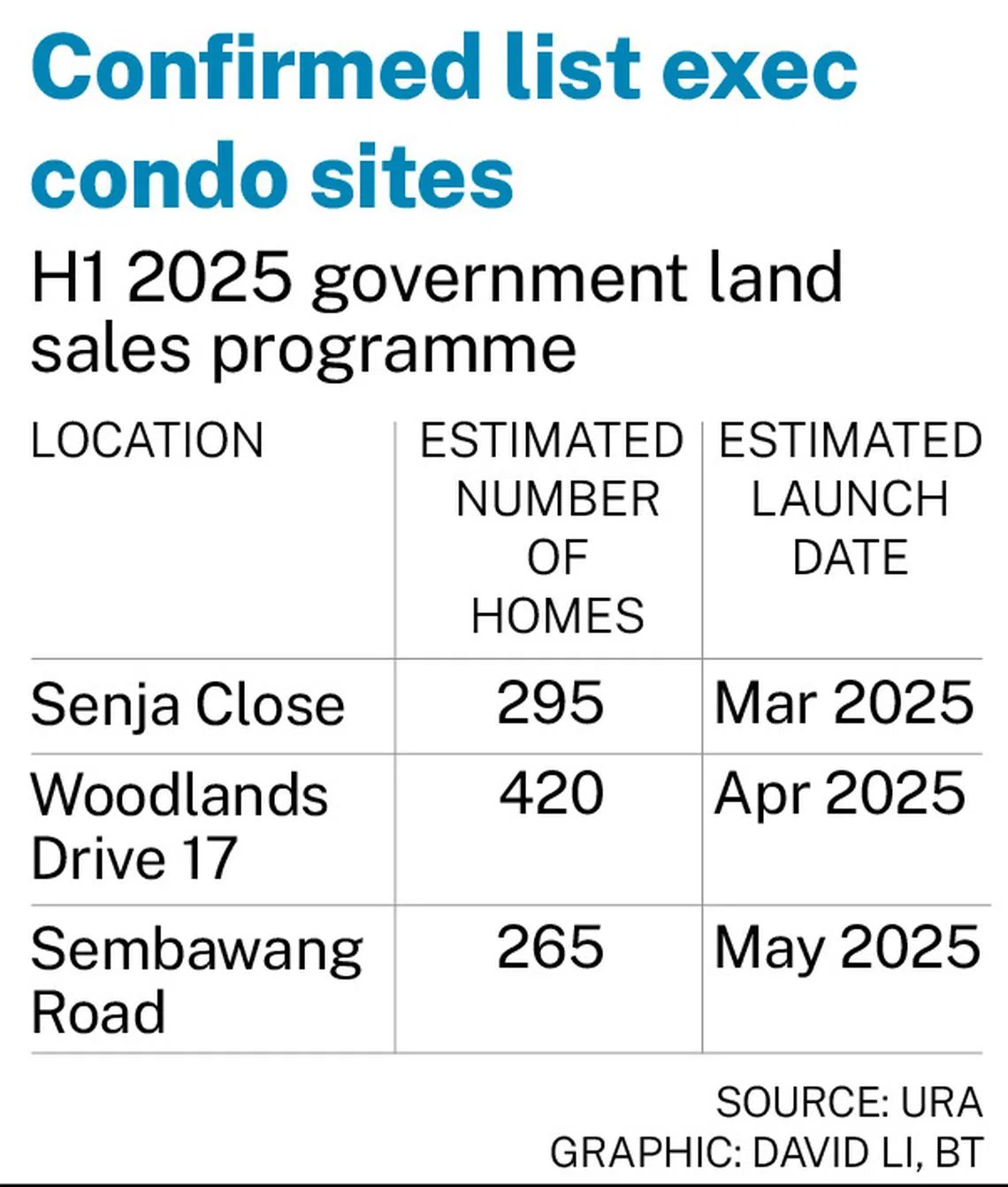
Should demand for EC homes rise due to the changes suggested above, supply of EC sites can be ramped up further. There are three EC sites – in Bukit Panjang, Sembawang and Woodlands – in the confirmed list of the H1 2025 government land sales programme that may yield an estimated 980 homes in total.
Perhaps, young Singaporeans are spoiled by the extensive aid given to help them become homeowners. Still, anchoring young locals to home and helping them create wealth matters. Hopefully, too, many young couples who are homeowners will be more inclined to have children.
May Budget 2025 see EC home-buying rules relaxed to help more young locals buy a new EC home.