COMMENTARY

BYD or Toyota: Who will top Singapore car registrations in 2025 and beyond?

BYD’s remarkable momentum looks set to continue, but further ahead the playing field could be more level if EV rebates reduce

Summarise
Derryn Wong
Published Mon, Feb 3, 2025 · 05:00 AM
    • Factoring in parallel imports, Toyota was the top selling car brand in Singapore in 2024, but BYD was number one in authorised dealer sales.
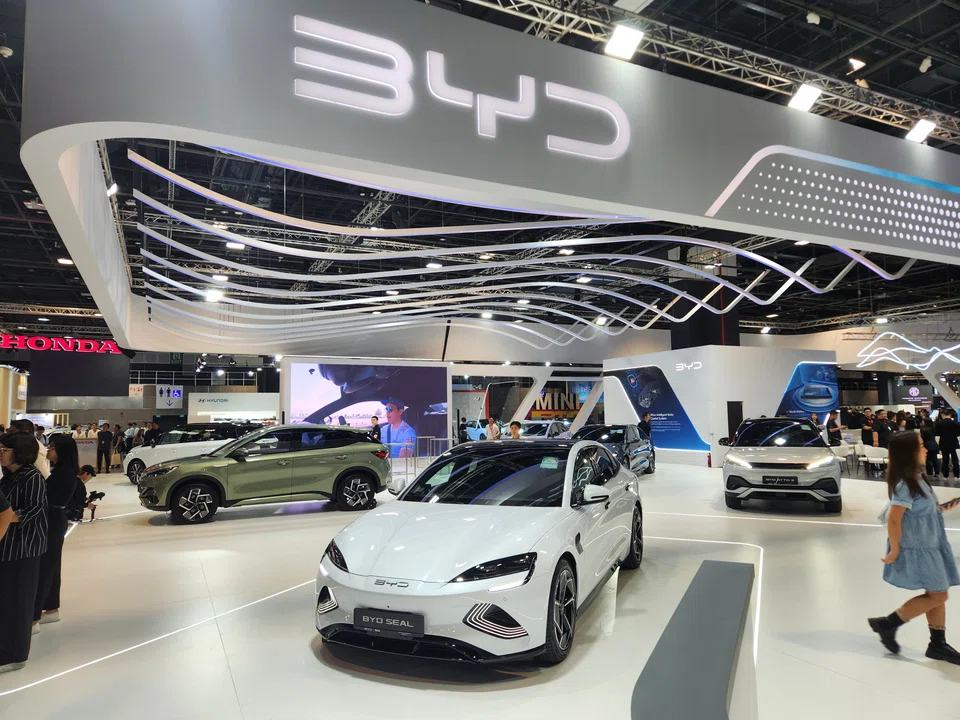
    • Factoring in parallel imports, Toyota was the top selling car brand in Singapore in 2024, but BYD was number one in authorised dealer sales. PHOTO: DERRYN WONG, BT

    CHINESE carmaker BYD had an extraordinary 2024, selling around 4.2 million vehicles worldwide, of which around 1.8 million were electric vehicles (EVs).

    That puts it on track to be ahead of Ford and Honda, though still far from industry leader Toyota, which had already sold more than nine million vehicles by November 2024.

    Yet in Singapore, BYD is now Toyota’s closest competitor, with a very real chance of eclipsing the Japanese automaker in new sales this year.


    According to Land Transport Authority data on both authorised dealer and parallel import new car registrations, Toyota remained on top with 7,876 in 2024.

    But BYD has risen to second place with 6,191, putting it ahead of Mercedes-Benz (5,101) and BMW (5,071). It was in sixth place in 2023.

    The China carmaker has cracked the Singapore market by capitalising on EV incentives, signing multiple dealers to boost sales and offering a range of attractive and cost-effective models.

    Now is the time

    If BYD wants to unseat Toyota in Singapore, 2025 will be the year to do so.

    This is because a large part of its success has hinged on Singapore’s EV incentives, which could be reduced after 2025.

    In Singapore, BYD offers only EVs. All but one are eligible for the maximum EV rebates of S$40,000, with the exception – the Denza D9 Grandeur – still getting a S$17,500 rebate.

    These rebates have made BYD’s cars very cost effective, which is why it has been able to gain market share so quickly. Its most popular model, the Atto 3 sport utility vehicle, starts at around S$163,000 with a Certificate of Entitlement (COE), compared to Toyota’s similarly sized Corolla Cross at around S$213,000 with COE.

    In contrast, Toyota has been slow to offer EVs in the Asia-Pacific, and has yet to bring one for official sale in Singapore.

    This EV edge, however, may not last long. Singapore’s EV rebates were recently extended until Dec 31, 2025. The automotive industry’s expectation is that they will be reduced after that, with the emphasis moving to increased penalties for more pollutive vehicles.

    A similar scheme for light commercial vehicles has already taken that approach. Introduced in April 2021, the Commercial Vehicle Emissions Scheme began with a S$30,000 rebate for electric commercial vehicles.

    Yet, in 2023, this rebate was halved and penalties for more pollutive vehicles were hiked instead, to S$15,000 from S$10,000 before. In 2025, the rebate remained, while the penalty increased to S$20,000.

    The hybrid path

    To continue on the road to supremacy, BYD will also need to play catch-up in business-to-business (B2B) sales, including private hire and rental car fleets.

    Industry sources estimate that B2B sales make up around 15 per cent of Toyota’s sales, compared to around 10 per cent for BYD.

    One boost for BYD will be its partnership with Grab announced last month, where it will provide up to 50,000 EVs to the operator in South-east Asia.

    But so far, BYD has had less success in B2B sales as such cars are used for ride-hailing, meaning that range and charging downtime are more of a concern.

    Fleet companies still favour petrol-electric hybrid cars – which have a longer range and do not need to be charged – where Toyota is dominant. Hybrids formed 80 per cent of Toyota’s 2024 sales.

    In Singapore, sales of hybrids have not grown as quickly as those of EVs. But hybrids still form a larger share of new car registrations: 48 per cent in 2024, up from 37.6 per cent in 2022. EVs formed 33.6 per cent in 2024, up from 11.7 per cent.

    Importantly, when EV rebates are reduced – as they might be in 2026 – it is hybrids that benefit as buyers pivot.

    Germany’s experience bears this out. After EV subsidies were scrapped in 2024, EV sales fell 27.4 per cent, while hybrids sales rose 12.7 per cent.

    In that country, Toyota’s sales rose 27 per cent while BYD’s fell 30.2 per cent.

    In Singapore, BYD could enter a new segment by introducing hybrids: specifically, plug-in hybrid electric vehicles (PHEVs). Globally, these formed 58 per cent of its 2024 sales.

    Unlike hybrids, which run only on petrol, PHEVs have slightly larger batteries that can be charged from an external source. In combination with petrol power, they can cover more than 1,000 km.

    While BYD has not introduced PHEVs to Singapore yet, mainstream brands Jaecoo and Mazda both launched PHEV models at the Singapore Motorshow in January. These are the first mainstream PHEVs to be sold here in around a decade.

    Who’s really on top?

    By another measure, BYD is already on top.

    Counting only authorised dealer figures and leaving out parallel imports, BYD is in first place with 6,191 registrations in 2024, followed by Toyota (5,736), BMW (5,042) and Mercedes-Benz (4,887).

    Another question is whether to include group-owned or sub-brands.

    Toyota’s registration figures include its subsidiary luxury brand Lexus, which typically sells around 800 to 1,000 cars a year, according to industry sources. BYD’s 2024 results include its premium sub-brand Denza, which registered around 200 cars.

    If these other brands are left out, Toyota lags BYD by a fair number in authorised sales.

    But there is no doubting Toyota’s brand strength. Toyota has taken pole position in seven of the past 10 years, including each of the past five.

    Its authorised dealer, Borneo Motors, has also improved its share of Toyota sales to 72.8 per cent in 2024, up from around 55 per cent in 2023. Sources attribute that to Toyota’s shortened delivery times and closing off of parallel import avenues.

    Toyota could also pull a surprise and bring an EV to Singapore within the next two years. Globally, it is forecast to have produced 140,000 EVs in 2024, ramping up to one million in 2026.

    Last December, it announced the Urban Cruiser EV on the global stage, which could be a strong competitor to the BYD Atto 3.

    Toyota’s reputation for reliability and quality in a mainstream EV – that benefits from rebates – is exactly what it needs to take BYD head on, not just in Singapore, but everywhere else too.