Can Biden and Sunak spark ‘special relationship’?
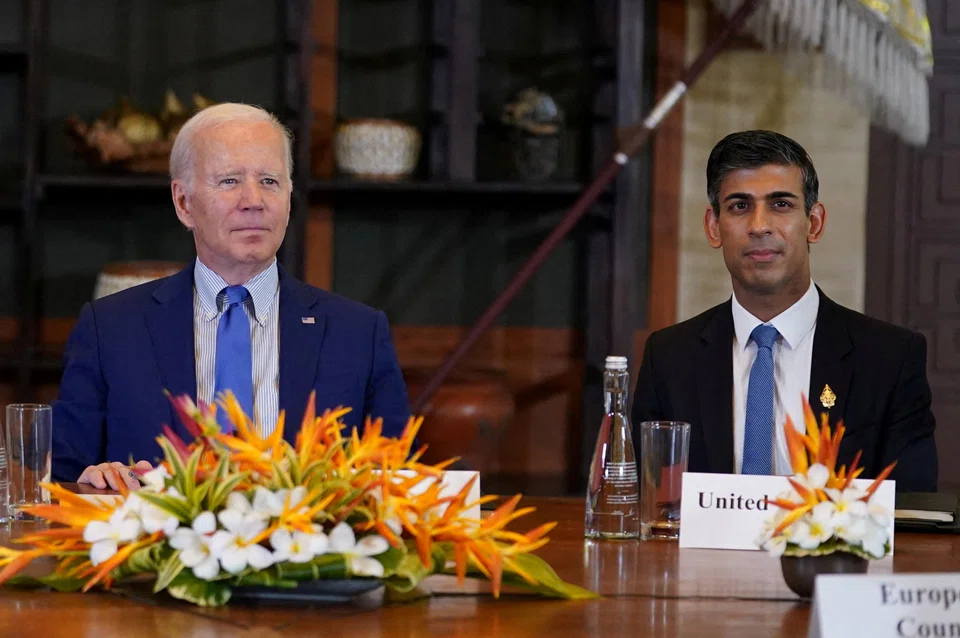
JOE Biden and Rishi Sunak have different political personas and philosophies, yet they are both hoping that they could spark the special US-UK relationship after years in the deep freeze.
Whereas Biden was first elected to the US Congress in 1972 and is a left-of-centre Democrat, Sunak is a Conservative former banker who became a UK Member of Parliament only in 2015. Add to this the fact that Biden is around twice Sunak’s age.
Indeed, one of the main commonalities between the two is that they both face big election battles in 2024. Sunak is seeking an unprecedented fifth term for the Conservatives against a resurgent Labour Party, while Biden may face off against Donald Trump next year in a 2020 presidential rematch.
Yet, despite their significant contrasts, there is an outside possibility that Biden and Sunak could have the most constructive meeting this week of any two UK and US leaders since Barack Obama’s presidency. Sunak wants to forge better relations with the US after they were strained by the UK’s departure from the European Union (EU) in 2020. Biden was one of many anti-Brexit Democrats. And the two leaders’ initial meetings, including at the Group of Seven summit in Japan in May, have been cordial.
This is not to have sky-high expectations of the meeting, but more that the bar was set so low by Sunak’s predecessors in Downing Street – Boris Johnson and Liz Truss, both of whom Biden was sceptical – that the US president is willing to work as constructively as possible with the prime minister given the ongoing emergency of the Ukraine war, and the need to reunify the Western alliance. For instance, Biden has noted that Sunak is a Stanford University graduate, and has joked about getting an invitation to the home Sunak still owns in Santa Monica.
The UK prime minister also knows he needs to try to rebuild relations with Washington. For all the president’s perceived shortcomings, Sunak knows Biden has often been a defender of UK interests. He was, for instance, a staunch supporter of London during the Falklands War, which divided the Reagan administration despite the then-president’s deep admiration of Margaret Thatcher.
The two leaders will discuss not just Ukraine, but also broader global economic and political challenges including supply chains, transitioning to zero-carbon economies, China, Russia, plus the forthcoming North Atlantic Treaty Organization leadership summit in Lithuania in July. Moreover, the UK has a series of specific asks, including around Sunak’s plans to make the UK a global hub for developing international artificial intelligence (AI) regulation.
Specifically, Sunak intends to ask for US support for the UK to play a leading role in coordinating the formulation of global guidelines for the use of AI. The UK government issued a white paper on AI this year, which spoke mainly of the benefits of AI rather than the risks it poses, despite some experts warning that the technology could present an existential threat to humankind.
On the issue of trade, many UK Brexiteers have been disappointed that a comprehensive deal with the US has not been possible given the boost it would give to the “global Britain” agenda, even though bilateral trade currently stands at around £280 billion already. So Sunak has not given up hope that such an agreement is possible in a second Biden term, or potentially the first administration of a Republican successor from 2025 onwards.
In the meantime, the UK is pursuing a “multi-track” approach. Firstly, it is seeking broader deals with specific US states, with agreements already signed with North Carolina, South Carolina and Indiana. The UK government is also seeking closer partnerships with more states, including California, Texas and Utah.
Secondly, it is focusing on targeted deals on key UK exports – for example, on Scotch whisky. Another area of interest is critical minerals that are used in key materials in the production of goods from electric vehicles to flat-screen TVs.
This follows passage of the president’s Inflation Reduction Act (IRA) last year, which has hit UK exports in a number of areas, including car and truck exports, given the £400 billion in subsidies from the IRA for US-made electric vehicles. The US is the UK’s second-largest export market, behind the EU, with car exports alone totalling around £5 billion last year.
The IRA is designed to attract clean energy and automotive manufacturing investment to the US, but the law prevents nations without a US trade deal from accessing the tax credits and subsidies. This has prompted UK Business Secretary Kemi Badenoch to call the IRA “protectionist”, arguing that it could also create a “single point of failure” in key supply chains that won’t help the US and the West “de-risk” from China.
There are other challenges in bilateral relations too, including the fact that Biden has long been opposed to Brexit, not the least because of his concerns about the implications for the 1998 Good Friday peace process which the US is one of the guarantors of. While the US president has welcomed the Windsor Framework agreed between the EU and UK to try to tackle the challenges of the previous Irish protocol, the Northern Irish unionist community remains against this diplomatic breakthrough.
What Sunak is now striving for, amid these ongoing irritants, is that he and Biden continue to largely put aside political differences and forge a constructive partnership building on the traditional ties between the two nations founded on demographics, religion, culture, law, politics and economics. This will be supplemented by longstanding security cooperation, including the new Aukus deal with Australia, which has traditionally been at the core of the relationship given the very close partnership between the two nations in areas such as intelligence.
Amid the multiple uncertainties ahead in the special relationship, Sunak is likely therefore to seek to play the role of a trusted, albeit junior, friend to Biden in a bid to get close to him to try to make the relationship work as smoothly as possible. This may provide some protections for bilateral relations if personal dynamics get rocky and strong personal chemistry fails to take root between the two.
However, while seeking the potential upside in the new relationship, Sunak would be wise not to overestimate the UK’s ability to shape US power. He should also not be blind to the prospect that Biden’s outlook may – ultimately – care less for core UK interests than in the past, if the US president increasingly looks to Berlin and Paris for post-Brexit leadership given his much more pro-EU outlook than Trump’s.
The writer is an associate at LSE IDEAS at the London School of Economics.