Can Starmer restart the UK’s ‘special relationship’ with the US?
It comes down to whether Harris or Trump wins November’s election
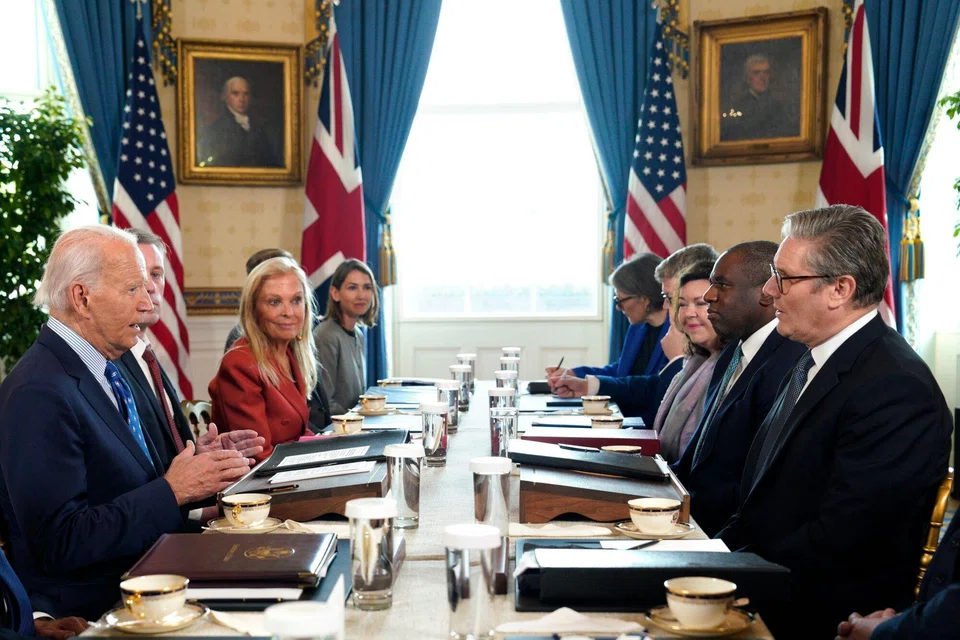
THE UK’s left-of-centre prime minister Keir Starmer has much in common with Democrat US President Joe Biden, whom he met last Friday (Sep 13) at the White House. With the US election approaching in November, however, Starmer’s political nightmare is that of maverick Republican Donald Trump winning against Democrat Kamala Harris.
In the postwar era, the US and UK electoral cycles were well synchronised for several decades: Republicans in power when Conservatives were, and Democrats in power alongside Labour leaders.
However, it remains very unclear whether Starmer – who will probably be in power till at least the next UK election in 2028 or 2029 – will have the political company of Harris or Trump for the next few years. This will be a hugely significant factor for UK foreign policy in the second half of this decade.
To be sure, Starmer and Harris do not have identical political personas and philosophies. Yet, they are much more politically aligned than Starmer and Trump. It is thus more likely that Starmer would be able to restore both countries’ former “special relationship” with her, after years of these ties failing to reach their full potential.
Moreover, both Harris and Starmer would want to forge better relations after these were strained – at least in the eyes of many anti-Brexit Democrats – by the UK’s exit from the European Union.
This is not to have sky-high expectations of a Harris-Starmer relationship. Rather, the bar has been set so low in recent years that constructive cooperation would be a welcome change.
Harris and Starmer would have a complimentary agenda on areas such as the Ukraine war; cooperation on clean energy and advanced technologies; the trilateral Aukus security deal with Australia; and broader global economic and political challenges and opportunities, including a possible post-Brexit trade deal.
The significant overlap between the political agendas of Starmer and the Biden-Harris administration was shown on Friday. The constructive meeting covered topics such as the Middle East, as the one-year anniversary of the Gaza war approaches; Iran and North Korea’s provision of weapons to Russia; Asia-Pacific, including China; and Ukraine.
There will be further conversations between Starmer and Biden next month, at the annual UN meetings in New York. Topics may include potentially giving Kyiv permission to use long-range missiles against targets deep inside Russia, a move which President Vladimir Putin has said would amount to Nato joining the war.
This agenda – permitting Kyiv to launch such long-range missiles – is advocated by multiple UK and US political and defence figures, including former UK prime minister Boris Johnson and former CIA director David Petraeus.
In a recent visit to Kyiv, Johnson said: “It is vital that Ukraine should be able to defend itself properly by stopping the appalling Russian attacks… Every day that goes by means more pointless and tragic loss of Ukrainian lives”.
Don’t count on it
Yet even as there is a significant convergence of agendas between Starmer and the Democrat White House, Starmer knows that there is a very real possibility that Harris won’t win.
Up until the 1990s, there were significant similarities of political and economic philosophy between US presidents and UK prime ministers in office. The early postwar years saw Democrat Harry Truman and Labour’s Clement Attlee in office, followed by Republican Dwight Eisenhower and a string of Conservatives.
A similar pattern continued from the 1960s through to the end of the Cold War: Democrats and Labour leaders in office simultaneously at some points, Republicans and Conservatives at others.
But this political synchronicity broke down soon after. While Democrat Bill Clinton – in office from 1993 to 2001 – partially overlapped with Labour’s Tony Blair, the latter and his successor Gordon Brown then faced Republican George W Bush’s presidency. Democrat Barack Obama mirrored mainly Conservatives: David Cameron, then Theresa May.
Trump’s Republican presidency might have seemed like a return to synchronicity, taking place alongside a string of Tory leaders. But when Democrat Biden entered office, there was no such switch on the UK side. Instead, Biden has spent almost all his presidency with Conservatives Boris Johnson, Liz Truss and Rishi Sunak, before Starmer took over this year.
While there may be policy disagreements between Starmer and a Harris administration, these challenges would be much wider and deeper under a second Trump presidency.
In this turbulent, uncertain context, Starmer’s aim is to develop a “future-proofed” positive UK-US partnership on the foundations of longstanding bilateral warmth – regardless of who is elected in November. This will be supplemented by a long tradition of security cooperation, including the Aukus deal.
Amid the multiple uncertainties, Starmer will want to try to make the relationship work as smoothly as possible based on such policy fundamentals. This may give a baseline for bilateral relations if personal relationships get choppy, as was sometimes the case with Trump and May, for instance, or Biden and Johnson.
The writer is an associate at LSE Ideas at the London School of Economics