Catalist-listed SIAMH may have gone public before it was ready – MAS review group should figure out why
Can the enablers of public listings be incentivised to ensure that companies do not come to market without a credible growth story?

WHEN news broke earlier this month that the external auditors of the Singapore Institute of Advanced Medicine Holdings (SIAMH) had issued a disclaimer of opinion on its latest financial statements, I imagined that the company’s share price would immediately plummet.
Then, I looked at my trading screen and realised the stock could not plummet because it was already on the floor – and had been for some time.
SIAMH listed on Catalist on Feb 16, following an initial public offering (IPO) at S$0.23 per share. It ended its first trading day at S$0.19. Less than a fortnight later, its shares had crashed below S$0.10.
Since then, SIAMH’s shares have drifted lower and lower. They closed last Friday (Dec 13) at S$0.06.
Why did SIAMH’s shares collapse so soon after listing? Some market watchers will, no doubt, blame apathetic investors and burdensome rules in Singapore. Others might try to find fault with the company’s corporate governance standards.
My own view is that SIAMH came to market unprepared to engage with investors, and cope with the demands of a public listing.
The difficulties it has faced could be a useful case study for the review group set up by the Monetary Authority of Singapore (MAS) to recommend measures to strengthen the local market. Ensuring that companies seeking a listing have what it takes to win over investors could be an overlooked but important aspect in making Singapore a more vibrant capital raising hub.
SIAMH describes itself as a healthcare service provider that uses cutting edge technology to detect and treat cancer as well as neurodegenerative and cardiovascular illnesses.
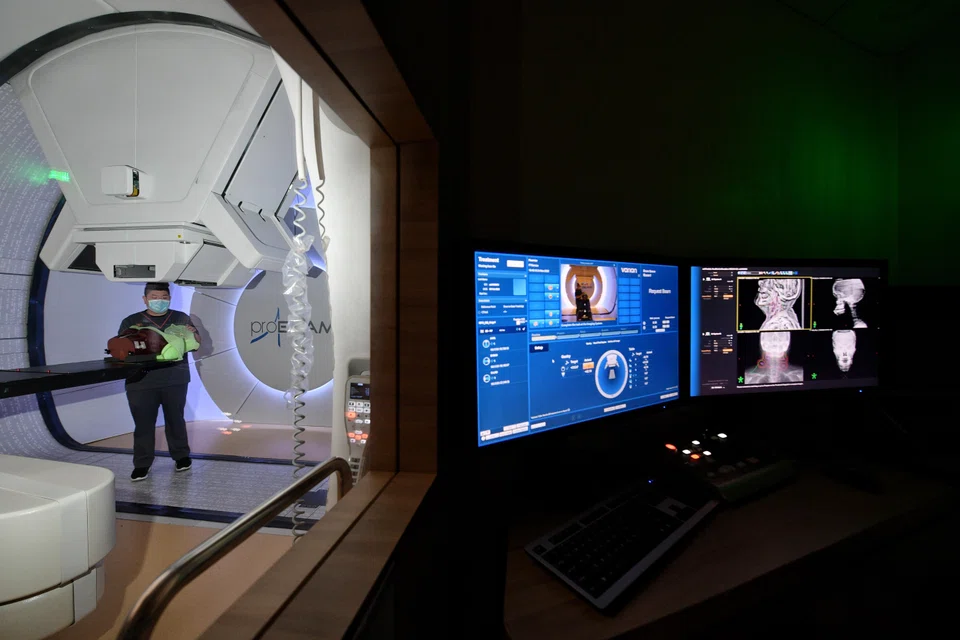
The company is now aiming to create a one-stop ambulatory cancer centre. Notably, it was the first healthcare player in Singapore to install the Varian ProBeam Compact, which uses protons, accelerated to two-thirds the speed of light, to precisely target tumours in the human body.
Exciting as this sounds, SIAMH’s financial performance since its IPO has been weak. It reported a loss of S$37.4 million for the financial year to Jun 30, versus a loss of nearly S$19 million for the previous financial year. Revenue increased 2.5 per cent to S$16.6 million.
Among the factors that contributed to the higher loss were a 46.4 per cent increase in maintenance and repair costs, and a 116.3 per cent increase in depreciation, both driven by the Varian ProBeam Compact. Finance costs surged 377.2 per cent.
Disclaimer of opinion
On Dec 9, SIAMH disclosed that Pricewaterhouse Coopers had highlighted material uncertainties that cast doubt on its ability to continue as a going concern.
Besides the increased loss it reported, SIAMH’s current liabilities exceeded its current assets by nearly S$7.9 million as at Jun 30. On top of that, a subsidiary that the group relies on for cash flow had chalked up a loss of S$21.1 million, and had current liabilities exceeding its current assets by nearly S$146.6 million.
SIAMH’s auditor also highlighted that the company’s management had determined that no impairment charge was required on the carrying value of the group’s property, plant and equipment (PPE), even though evidence from internal reporting suggested economic performance of each cash generating unit within the group was worse than expected.
The auditor noted the carrying value of the group’s PPE amounted to S$130.4 million as at Jun 30, of which S$120.7 million was related to PPE of its radiation therapy unit. It added that it was unable to obtain sufficient audit evidence regarding the reasonableness of the assumptions used to determine the recoverable amount of this key business unit.
The group’s auditor also highlighted that receivables from the radiation therapy unit at the holding company totalled S$84.3 million, after an allowance for impairment loss of S$59.7 million, which SIAMH’s management had determined based on the net liability position of the unit. The auditor said it could not itself determine if any adjustments to this net liability position were necessary.
Shareholder loans
SIAMH’s board maintains the group should still be regarded as a going concern, though. The board pointed out that SIAMH obtained a S$6 million loan from a subsidiary of its controlling shareholder after its financial year-end, and that it expects to be able to obtain another S$6 million if necessary.
SIAMH is also finalising a bridging loan of S$5 million from a party related to a substantial shareholder, and it expects to be able to obtain further financial support of S$5 million from a “prominent third party”.
Malaysia-listed Berjaya Corporation holds a deemed interest of 38.5 per cent in SIAMH. Crescendas Land Corporation holds a direct interest of 10.55 per cent. SIAMH’s chief executive Dr Djeng Shih Kien holds a direct interest of 6.27 per cent, and a deemed stake of 3.35 per cent.
On Dec 12, SIAMH unveiled a strategic review committee comprising its non-executive directors, which will assist the group’s top management in putting its business on a stronger footing.
Among other things, the committee will look into ways to improve the utilisation of SIAMH’s proton beam therapy and photon radiation therapy facilities as well as its medical diagnostic equipment, and address its funding requirements.
Credible growth stories
While drawing down loans from its key shareholders may well keep SIAMH afloat, it creates the risk of minority investors eventually facing significant dilution if the group’s revenues do not quickly improve.
Worryingly, SIAMH said in its Dec 12 announcement that its proton beam therapy business has not taken off as quickly as expected because of delays in being included on the panels of healthcare providers of insurance companies; lower than expected patient flow from referrals; and competition from the two other proton beam therapy healthcare providers in Singapore.
If cancer patients and their doctors are not clamouring for what SIAMH has to offer, and it is not even the only player in its field, does it make sense to bet on an improvement in the company’s profitability?
To be clear, I am not suggesting SIAMH is doomed. Demand for the technologically advanced healthcare services that it provides will probably grow over time. SIAMH may also eventually figure out how to beat the competition by delivering a uniquely positive user experience, or focusing on an especially profitable segment of the cancer market.
This sort of strategising ought to have been done before SIAMH sought a listing, though.
While there is a dearth of new listings in Singapore, too many companies that come to market do not offer investors a convincing narrative about how they will grow and drive shareholder value. The result is a vicious cycle of weak valuations and investor apathy.
Indeed, I often wonder what motivates companies such as SIAMH to list at all. With its shares trading at a fraction of their IPO price, it seems unlikely that its listing is currently serving its own interests any more than the interests of the wider public market ecosystem.
The MAS review group should perhaps closely examine how the various enablers of a public listing can be incentivised to ensure that companies do not come to market until they are fully prepared to communicate and deliver on a credible growth story.
This could well increase the likelihood of the review group achieving its primary objective of drawing more quality listings to the local market.