

In a chaotic world, Singapore doubles down on being a safe harbour
The president’s address to Parliament presented a sombre assessment of external threats, but his core message was a return to the nation’s foundational strengths
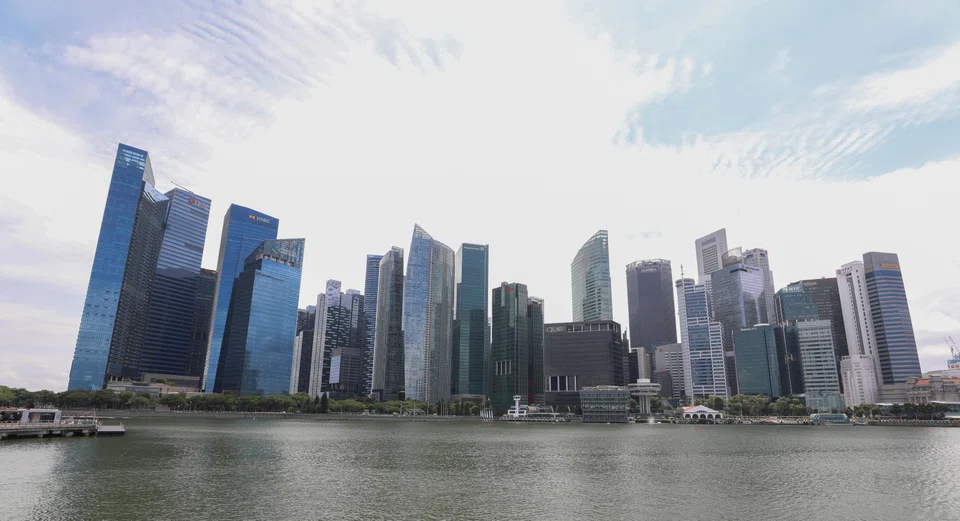
[SINGAPORE] The relative political lull after the 2025 General Election, through which the ruling People’s Action Party secured a firm mandate, has now made way for the urgency of action in a more capricious world.
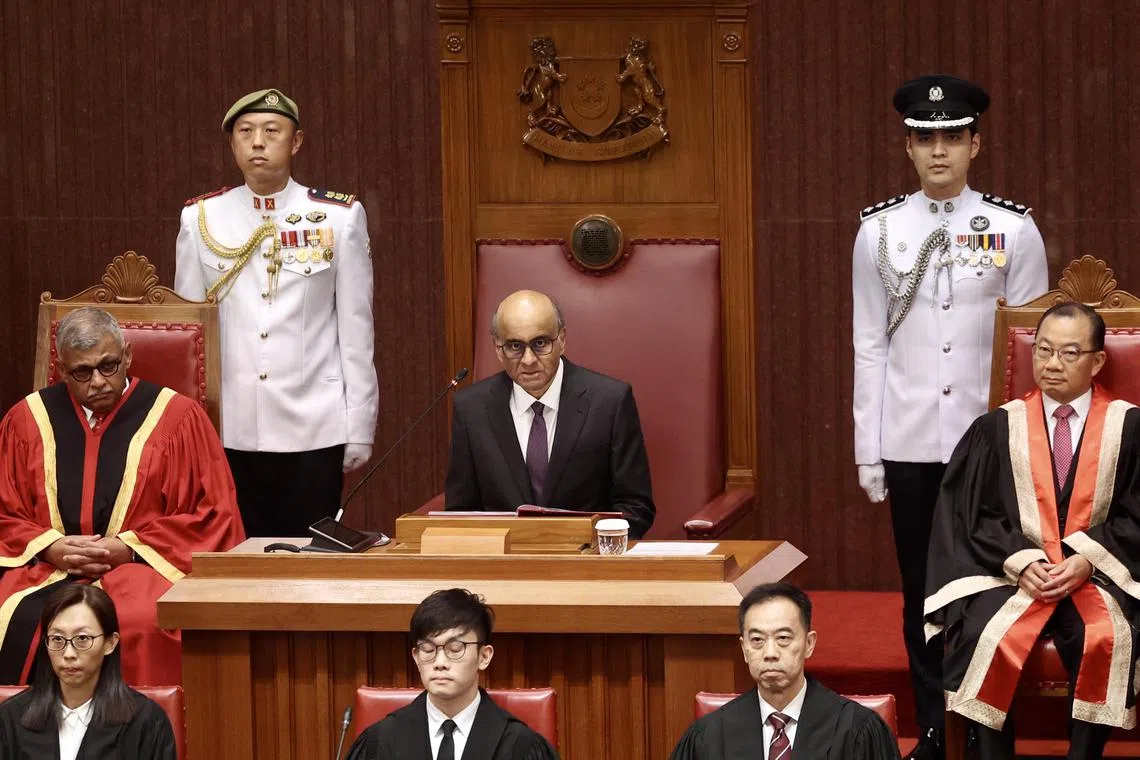
The opening of the 15th Parliament and the President’s Address last Friday (Sep 5) set out the government’s necessarily ambitious priorities, policies and programmes for the coming five years.
With Singapore at a “critical juncture” and the old playbook no longer sufficient, significant change is in the air. Yet, the salient subtext of the address is that what the nation needs in these unnerving times is to double down on the fundamentals.
This back-to-basics approach is about leveraging on the city-state’s core values and hard-earned exceptionalism to thrive against the odds.
Asserting agency navigating global disorder
Unlike past addresses, President Tharman Shanmugaratnam’s was notable for analysing Singapore’s rapidly evolving operating environment straight off the bat. It was a pointedly sombre assessment of the changed world: a “more unsettled and chaotic world… (with) fundamental shifts in the tides”.
The government’s stark, perhaps even withering, assessment was that the rules-based and inclusive global order under which Singapore thrived is severely under threat. With American leadership in question, the weaponisation of trade and economic interdependence and intensifying Sino-American rivalry, international relations are “more fraught and complex than ever”.
There is therefore no alternative to Singapore seizing its agency to chart and shape its own destiny. This, to me, is the existential challenge to Singapore in this transitionary phase in world history. If Singapore is unable to secure its place in and be relevant to the world, the prognosis will not look good.
Gloomy as this readout is, there is no doubting the political resolve to turn adversity into opportunity.
Thus, Singapore intends to help shape “a fair and stable global order”, promote deeper Asean integration, support reforms for effective multilateralism in international organisations such as the United Nations and World Trade Organization, and strengthen partnerships with like-minded nations to preserve and open up flows of trade and investment.
Dignity and a strong economy in a safe harbour
Alongside society, the economy was writ large in the President’s Address. A basic ingredient and a sine qua non in Singapore’s success is a strong economy. As the president emphasised, it is a means to the end of having the wherewithal to secure Singapore’s future and improve the lives of Singaporeans.
Reiterating the “Forward Singapore” movement, Prime Minister Lawrence Wong’s signature policy, the president reminded Singaporeans that the nation’s success must be judged “by how we support the vulnerable, and how we enable every Singaporean – young and old – to contribute, and to live with dignity”.
The economic mission ahead is to ensure Singapore remains “a safe harbour: a reliable base from which to navigate global complexities, and a gateway to Asia’s dynamism”. Furthermore, Singapore will be a place where “ideas can take root”, and where entrepreneurs can thrive and become regional and global leaders in their respective fields.
These are not wholly new ideas, but the changed world has now made them imperatives.
Even as economic strategies are being rejuvenated for a fragmented world, it is clear that Singapore aspires to be a key player in “every sector of the future”, which needs to be undergirded by “an outgoing and experimental spirit” in Singaporean enterprises and the country’s people. How we will get there after earlier attempts at building the economy’s external wing will be closely watched.
Advanced and emergent technologies are critical. The president highlighted that artificial intelligence (AI) will be pervasive in the economy, the vital tool in improving efficiency and complementing human abilities to the objective of sharing gains broadly and involving all Singaporeans in building new sources of competitiveness.
The President’s Address highlighted the government’s approach to AI, augmenting what PM Wong had said at the National Day Rally on Aug 17: There will also be the push towards having firms embark on “serious transformation” to using AI by making it “practical” for them to harness AI, while “stepping up the reskilling and upskilling of every segment of our workforce”. Tripartism is seen as providing the edge in deploying new technologies.
But there is no magic in AI. Every technology has its limits, and the president cautioned that AI “must be actively fostered”. A recent MIT study argued that billions of dollars of investment in AI pilots are yielding little to no returns, perhaps indicating a bubble or even an AI winter. This points to AI’s resilience problem, in which impressive short-run efficiency morphs into long-run stagnation.
A limitation of large language models and reasoning systems is they do very well in areas where they have copious data, but flounder when faced with novel problems.
As Oxford don Carl Benedikt Frey recently observed: “If the world were a static distribution, progress would require nothing more than more data and compute: observe everything, perform well everywhere. But the world changes constantly. Durable progress demands algorithmic innovation – methods that generalise and recover when plans fail – not just bigger models.”
Can Singapore innovate amid incumbent AI power and prowess resting in the US and China?
Role of enterprise and business writ large
Although not explicitly referred to, the role of business and enterprises was the subtext in the President’s Address.
With plans to use new technologies for decarbonisation and coastal protection, we will see the push to develop “breakthrough” environmental solutions and a robust carbon credits market to finance sustainable infrastructure in the region.
Given the priority of enhancing assurance at every stage of life, business has a critical role, and this is where the “We First” philosophy transitions from slogan to strategy.
Empowering workers as the economy transforms entails provisioning them with the needed skills and knowledge. Similarly, the business sector’s embrace of schemes such as the Jobseeker Support Scheme for those displaced, and the SkillsFuture Level-Up Programme for mid-career workers, will determine whether these are stop-gap measures or meaningful way stations to a more resilient workforce.
Even for quotidian anxieties over rising costs and keeping opportunities open to promote social mobility, the government cannot go alone. Businesses must play their part and recommit to their social responsibilities as corporate citizens.
Similarly, businesses are essential change agents in shifting mindsets about what constitutes valuable work, duly recognising the dignity in every job – be it the trades, crafts or service – and ensuring that everyone who contributes to society earns respect.
The government’s agenda for action will be clearer when the various ministries issue their addendum to the President’s Address in the days ahead.
There will be details galore, but underlining the best-laid plans for societal transformation is the imperative to double down on the core values, which the president highlighted: unity amid diversity by building a common ground through shared experiences, nurturing a culture of contribution (promoting the common good, rather than personal achievement, as a measure of success), and deepening trust between the government and the people and among citizens.
These will provide the vital social glue and assurance at a time of epochal change. It’s all hands on deck.
The writer is associate professor of law at the Singapore Management University and a former Nominated Member of Parliament
TRENDING NOW

If Europe goes to war, the fallout will be felt in East Asia

Philippines’ FDI slowdown exposes uneven investment prospects across S-E Asia
Who are some of the longest-serving CEOs among Singapore’s blue-chip companies?

Debt funding for S-E Asia startups ticks up as it gets tough to raise money via exits, equity

