China cements ‘senior partner’ role in Russia relationship
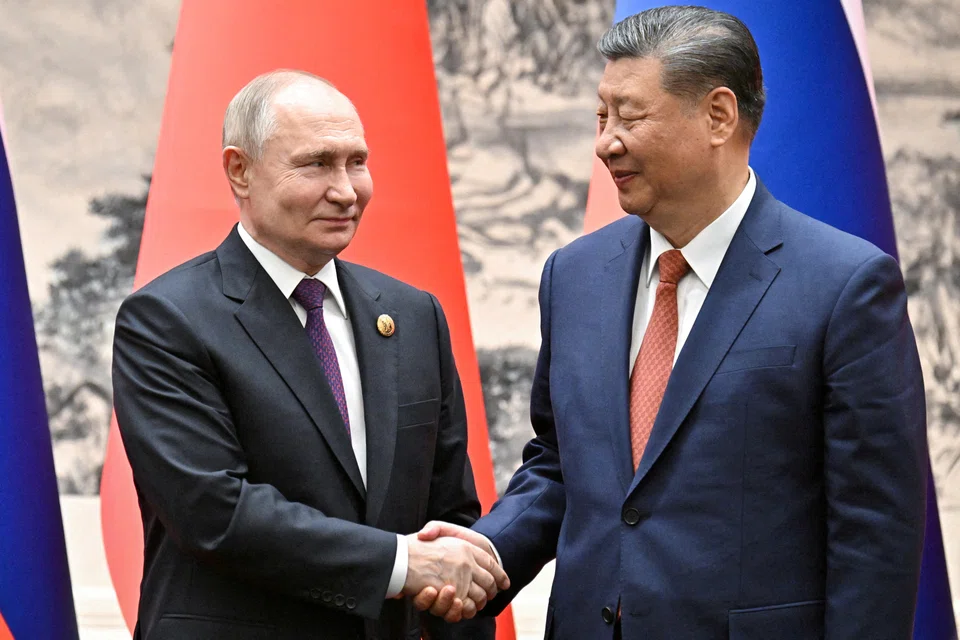
OVER the last decade, Russian President Vladimir Putin has met his Chinese counterpart Xi Jinping over 40 times. However, there has been a significant change during this period, with Beijing increasingly the senior partner in bilateral relations.
This development is a significant shift from 75 years ago when the Soviet Union officially recognised the People’s Republic of China, which former leader Mao Zedong declared in 1949, when Beijing was very much the junior partner of Moscow. In the last decade, and especially since Moscow’s invasion of Ukraine, this trend has become more pronounced as economic and diplomatic ties between the two nations grow – a trend that the West is watching closely.
Yet, the trajectory of Moscow’s higher dependency on Beijing goes back even further till at least 2014, the year Xi and Putin first met, when the Russian leader travelled to Beijing for a two-day state visit to discuss a major gas supply deal. That trip came on the heels of Russia’s annexation of Crimea, which was a key turning point in Moscow’s isolation from the West under Putin.
In the decade since, Moscow has become significantly more dependent on Beijing as an economic partner. For instance, annual bilateral trade hit a record US$240.1 billion, which may even be a significant underestimate, given that some goods – including dual-use technology for the Ukraine war – are reportedly being delivered from China to Russia via third countries.
Little wonder therefore that Putin made China his first foreign trip since being sworn in on May 7 for a record fifth six-year presidential term. It is a clear statement of intent, reinforced by the large delegation that accompanied him, including five deputy prime ministers, plus heads of economic, diplomatic and security agencies.
On the corporate side, attendees reportedly included Finance Minister Anton Siluanov, central bank governor Elvira Nabiullina and chief executive officers from the banking and energy sectors, such as Sberbank’s Herman Gref, VTB’s Andrey Kostin, Rosneft’s Igor Sechin and Novatek’s Leonid Mikhelson. This underlines how much emphasis Moscow and Beijing are putting into their officials developing stronger working relationships.
The two-day trip saw a summit in Beijing on Thursday (May 16) between Xi and Putin. However, the second leg of the state visit on Friday was in Harbin (sometimes called “Little Moscow”), a transit point for cross-border exchanges located a few hundred kilometres from the border with a significant Russian population. The fourth Russia-China Forum on Interregional Cooperation and eighth China-Russia Expo were held on the day.
One of the key reasons that last week’s Xi-Putin meeting was being widely watched in the West is China’s potential leverage over Russia in Ukraine. Around a year ago, Beijing did develop a peace proposal, but that has not gained traction.
While the interests of China and Russia are not identical in that conflict, Beijing is increasingly defaulting to a position of tolerance of it. Xi said last week that bilateral relations are “everlasting” but had “not come easily”, and were “worth cherishing and safeguarding by both sides” as “a model for a new type of international relations”.
This at the same time that Beijing increasingly becomes the senior partner in bilateral relations.This is shown, for instance, in Xi seeking to secure more positive terms for Beijing from enhanced bilateral economic ties, after Western sanctions cut much of Moscow’s access to the international trading system.
Increasingly, the two sides are also looking for ways to, in Putin’s words last week, “reliably (be) protected from the negative influence of third countries”, including making more settlements in their national currencies. Putin highlighted last week that 90 per cent of all bilateral Russia-China trade payments are now made in roubles and yuan.
Part of the urgency for this discussion last week is that Western sanctions have in recent months seen a reduction in Chinese exports. This follows several years of fast-growing bilateral trade.
The challenge is that Western countries have progressively taken a series of measures, including agreeing to remove several Russian banks from Swift, the world’s main global payments network. Moscow has therefore proposed to Beijing an increasingly decentralised payment system that the West will find more challenging to monitor, potentially developing tools that could be used by other countries seeking to evade Western sanctions.
This work builds from numerous Russian cooperation projects previously announced with China. These include a new method of inter-bank transfers, and a joint credit agency that seeks to create a shared financial and economic infrastructure, to try to allow them to function independently of Western-dominated financial institutions.
China and Russia are also among the states involved in creating alternative fora to the World Bank and International Monetary Fund, including the New Development Bank. This will finance infrastructure and other projects in the Brics states, and a related special currency reserve fund.
Outside of the financial sector, Putin said last week that both countries are seeking to establish closer ties in broader areas such as “industry and high technology, space and peaceful nuclear energy, artificial intelligence, renewable energy sources and other innovative sectors”. Take the example of energy, where there is already much cooperation.
The two sides have for instance previously signed a big natural gas supply deal, which will see an approximately 3,220-km gas pipeline from eastern Siberia to north-east China, plus construct a second major gas pipeline from western Siberia to China’s Xinjiang province. Moscow has also opened parts of its upstream oil and gas sector to direct investment from Beijing.
While the warming in ties since the Ukraine crisis is sometimes overstated, with uneven substantial progress made so far on an array of economic and financial projects that have been announced, the bilateral cooperation agenda is significant and has helped enable work toward stronger, common positions on key regional and global issues, too, including not just Ukraine, but also the periodic tensions on the Korean peninsula.
This builds from their self-professed stance, outlined again last week, that both parties see themselves as adhering to principles of non-alignment and non-confrontation against third countries. Plus also the emergence of a multipolar world in which the West is less powerful, and a world order based on international law.
Taken together, last week’s widely watched meeting indicates that there is unlikely to be any imminent rupture in China-Russia ties, as some in the West hope for. Beijing and Moscow do not have identical interests, but any fundamental change in China’s stance towards key issues like the Ukraine war are unlikely in the short term, especially ahead of the US presidential election.
The writer is an associate at LSE IDEAS at the London School of Economics