China-EU summit has low expectations

    • A challenge for European Commission President Ursula von der Leyen is the differences in how the 27 European Union member states view Beijing.
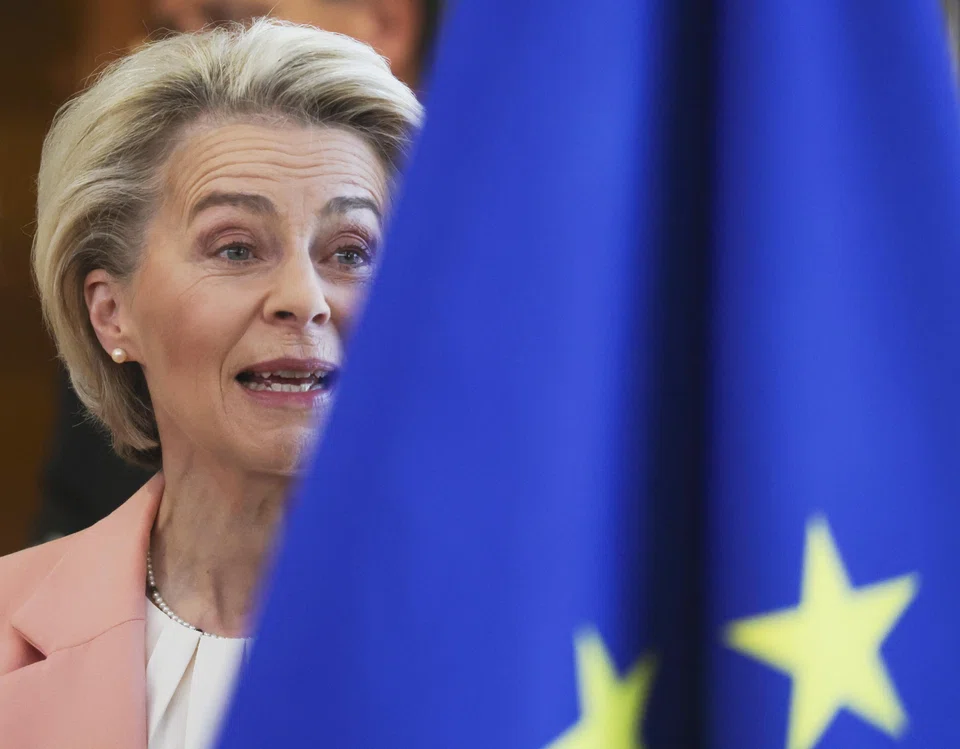
    • A challenge for European Commission President Ursula von der Leyen is the differences in how the 27 European Union member states view Beijing. PHOTO: EPA-EFE
    Published Tue, Dec 5, 2023 · 05:54 PM

    FORMER US secretary of state Henry Kissinger was widely attributed to have asked, “Who do I call if I want to speak to Europe?” This telephone number question has been repeated often since to highlight the lack of a unified foreign policy across an European Union (EU) currently comprising 27 countries.

    The implication of the telephone question is that there could be significant potential benefits for other foreign powers if there is a single interlocutor in the EU to speak with. However, an increasingly common criticism in Europe of China is the opposite: namely, that Beijing favours a splintered EU so that it can “divide and rule”.

    This is one reason why the latest annual EU-China summit, coming on the 20th anniversary of the strategic partnership of the two powers, will be more important than most. There is an undeniable chill in relations that could see the two sides fail to even issue a joint statement following their summit in Beijing on Thursday (Dec 7) and Friday.

    The context here is the attempts by European Commission President Ursula von der Leyen, and other top EU officials, such as the High Representative of the EU for Foreign Affairs and Security Policy Josep Borrell, to enforce a common bloc-wide stance vis-a-vis China.

    Yet, despite these greater attempts at more unity, Brussels is struggling to find common ground on Beijing across all its member states.

    Worse still, top EU officials have also become increasingly concerned in recent years about whether the nature of China’s external interventions in Europe represent a “divide-and-rule” strategy to undermine the continent’s collective interests. EU foreign affairs chief Borrell even asserted that Beijing is a “systemic rival that seeks to promote an alternative model of governance” to that of Europe.

    The background to this is that Europe is becoming an increasingly important foreign-policy focal point for Beijing, including as an economic market. The rising superpower had, until recently at least, generally enjoyed growing influence across much of the continent.

    This includes in Eastern and Central Europe, where China regularly holds “16+1” summits aimed at intensifying and expanding cooperation in the fields of investment, transport, finance, science, education and culture. There are also key Western European states such as Italy, which is the only G7 country to endorse Beijing’s Belt and Road Initiative (BRI).

    Underlying this, it is becoming increasingly clear that Beijing is tailoring its approach around bespoke needs of individual states or blocs of countries such as the 16+1 group in East Europe.

    Further, Chinese overtures to Europe are coming with a clear quid pro quo, as underlined by Italy signing up for BRI in exchange for China’s investment.

    Post-pandemic and Russia’s invasion of Ukraine, Brussels has therefore sought to bring the bloc together around a stronger policy towards China. Dr von der Leyen and Borrell have led on this, even though the European Commission president’s role does not have a formal foreign-policy mandate.

    Both Dr von der Leyen and Borrell have made recent, hard-hitting speeches.

    Take the example of Dr von der Leyen who said in Germany last month at the Mercator Institute for China Studies that “we must recognise that there is an explicit element of rivalry in our relationship. We must also recognise that China’s views on the global security architecture are not by default aligned with ours”.

    So the direction of travel for EU policy on China is clearly in a more hawkish direction. Even on issues where breakthroughs have been made with Beijing in recent years, such as the bilateral Comprehensive Agreement on Investment, the “long grass” of Brussels has prevented ratification in the European Parliament owing to EU concerns over China’s behaviour.

    A central challenge for Dr von der Leyen and Borrell, however, are the splits on Beijing within the 27-member bloc. It is too simplistic to refer to an East-West dichotomy in the continent, in part because Hungarian Prime Minister Viktor Orban favours strong ties with China.

    However, there are nonetheless clear differences in outlook between hawkish Eastern European nations such as the Czech Republic, Poland and Lithuania, versus Western counterparts such as France, Spain and Germany that do much more bilateral business with China. One concern here is that China is showing significant favour to states that show support, including the recent unilateral announcement of a 15-day visa-free entry for citizens from France, Germany, Spain and Italy.

    Perceptions of a divided EU have also been publicly highlighted by several Chinese officials, including EU ambassador Fu Cong, who has cast doubts on whether all member states are behind the agenda of Borrell and Dr von der Leyen. Cong recently said that “Europe has not formulated a coherent policy towards China” and that it felt like “people quarrelling with each other”.

    The positions of Western European nations such as Germany and France are particularly problematic for Brussels given that both want to continue engaging extensively, economically, with China.

    The longstanding, deep business ties that Berlin has with Beijing are widely documented, and so it is no surprise that Chancellor Olaf Scholz is more equivocal than Dr von der Leyen and Borrell on China.

    However, what has surprised many is the relatively soft stance that French President Emmanuel Macron has taken.

    During a joint visit this year to Beijing with Dr von der Leyen, the French president – remarkably – took a business delegation estimated at around 50 people (about four times larger than which accompanied Scholz on his separate trip last year), and deployed the language of economic reciprocity rather than de-risking.

    Perhaps most surprising of all was the fact that Macron did not appear to apply significant pressure on Beijing regarding its support for Russia in Ukraine, and moved away from prior positions on Taiwan.

    So whereas Dr von der Leyen asserted on the trip that “stability in the Taiwan Strait is of paramount importance” and that “threat of use of force to change the status quo is unacceptable”, Macron said Taiwan is a “crisis that is not ours” and that Europeans should not be “America’s followers”.

    While the full motivation for Macron’s comments remain unclear, his position is out of sync with not just the EU position, but also key G7 statements on Taiwan that France signed up to. His remarks are premised on a highly questionable assumption that Europe can completely insulate itself from tensions between China, Taiwan, and the United States.

    Taken together, this challenging background underlines why expectations are so low about this week’s summit.

    Overall, EU relations with China are frozen, and could yet go from bad to worse in 2024.

    The writer is an associate at LSE IDEAS at the London School of Economics