

Is China ready to take on Airbus and Boeing? Not just yet

TO HEAR it said on social media, China is going to be the next top aircraft manufacturer, all set to sweep away the likes of Europe’s Airbus and America’s Boeing. It’s true that both Western aircraft manufacturers are beset with problems, with huge delivery backlogs. Airbus has admitted to “persistent specific supply chain issues mainly in engines, aerostructures and cabin equipment”. Boeing’s woes are well-known. The firm is facing financial as well as technical problems and will axe 10 per cent of its workforce. Both firms are being investigated for false regulatory filing related to the authentication of aerospace-grade titanium parts. But does all this mean the end for Airbus and Boeing is nigh? Not just yet.
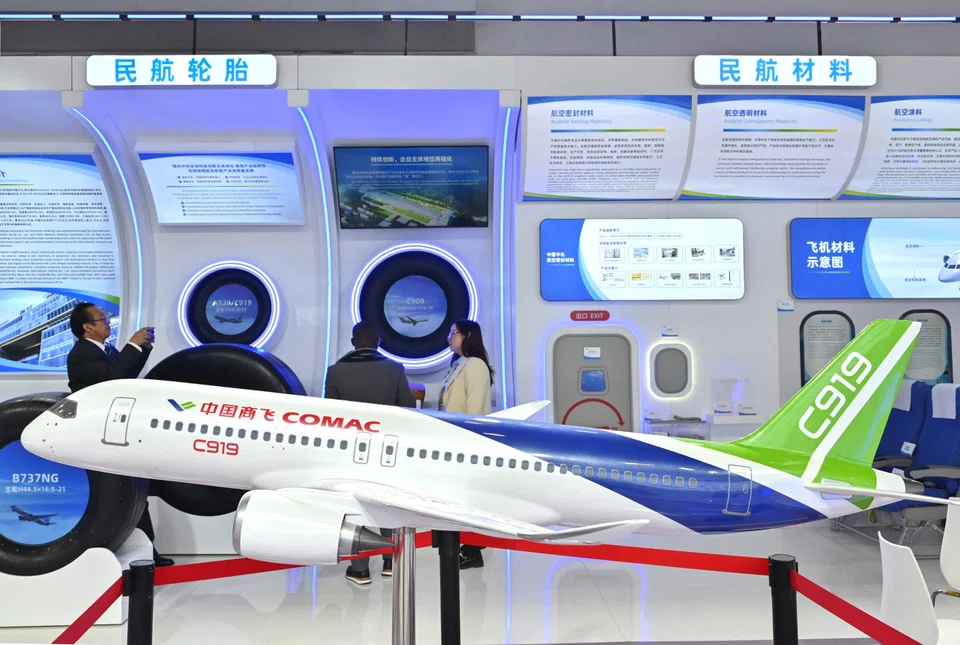
To be clear, China is making great strides in the commercial aerospace industry. The Commercial Aircraft Corporation of China (Comac) launched its first medium-range airliner, dubbed C919, in May 2023 as a competitor to the Airbus 320 and the Boeing 737, suitable for flights of up to four or five hours. Since then, the C919 jetliner has reportedly garnered over 300 orders from Chinese airlines.
One of its selling points is that it is more environmently friendly than its European and American counterparts. Comac designed its C919 with environmental sustainability as an objective – the jet made its first commercial flight on sustainable aviation fuel (SAF) in September. The biofuel can be made from algae or agricultural, forestry, food or even municipal waste. It is claimed to cut carbon emissions by up to 80 per cent compared with petroleum-based jet fuel. It has been reported that GallopAir, a Brunei-based startup airline, has placed an order for the C919. Vietnam Airlines, Indonesia’s TransNusa, Air Asia and Brazil’s Total Linhas Aereas have expressed interest.
In the pipeline is Comac’s C929, a larger 290-passenger aircraft. The Chinese firm is also working on an even bigger plane, a wide-body jet which would be in the same league as Boeing’s 787 Dreamliner.
All well and good. But it is important to note that Comac’s first airliner, the C909, which had its first commercial flight in June 2016, sold only about 100 planes. And none of China’s planes have received regulatory approval in the EU or the US. The European market is considered to be the easier one to crack and the C919 is reportedly at the third stage of the four-step EU process for getting certification. The European Union Aviation Safety Agency’s engineers conducted an on-the-ground inspection of the aircraft’s flight simulator and assessed its compliance with EU regulatory requirements for structural and electrical systems. Chinese media says the assessment was positive.
All that happened before Donald Trump’s election. It remains to be seen if the EU will come under pressure from Washington to withhold approval. Any attempt to break into the US market, if at all it happens, will be a long time coming.
That said, any development that heightens competition in the aviation market, where Boeing and Airbus remain the only companies that make the full-size airliners, should be welcomed. Asia-Pacific is estimated to require 19,500 new aircraft in the next two decades to meet demand. A third player can be expected to bring down prices and improve market efficiency. Aircraft manufacturers will be forced to invest more in safety and build fuel-efficient and environmentally sustainable planes to remain in business. And that’s patently good.






