

China’s delivery drivers are its most obvious underclass
New rules aim to help, but the economy will keep them down
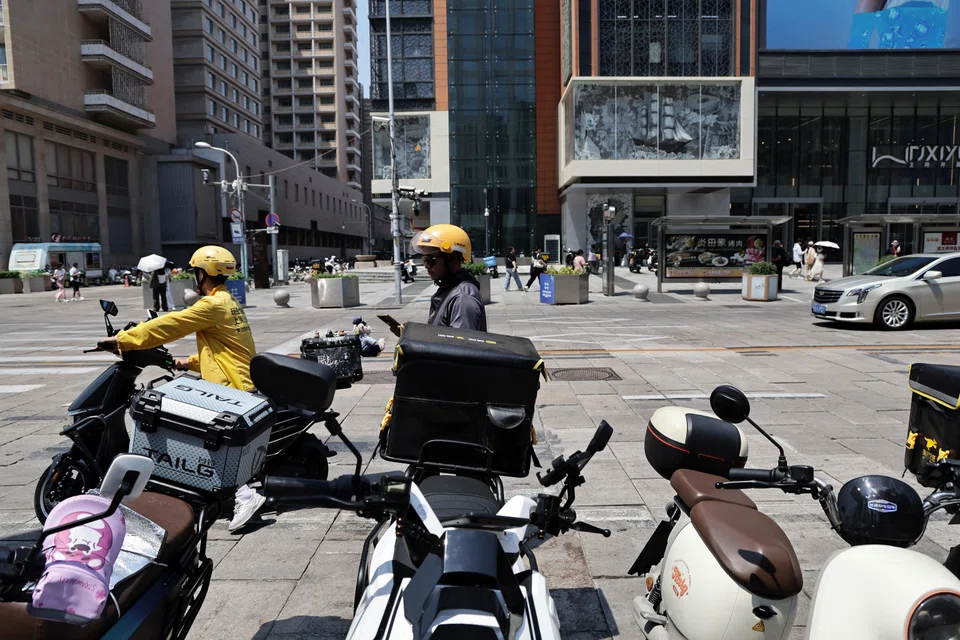
CHINESE cities can look like a tableau of bold colours, as delivery drivers on scooters – some yellow, orange or blue – zip through traffic bearing cargo for waiting customers.
It is in the distant outskirts that the colours come to a rest. Amid the warrens of buildings, drivers rent cheap rooms, park their scooters in the narrow streets and hang their matching jackets from windows to air them out.
One colour absent from their uniforms – each associated with a different delivery service – is gloomy grey. But speak to them as they return home, and that is the dominant hue.
For years, the delivery industry attracted strivers who knew they could earn more than in factory jobs or who wanted easy cash while awaiting better opportunities.
These days, the realisation has set in for many: This may be as good as it gets, and it is worse than it used to be.
“Whatever you do, nothing’s easy,” said Wu, a driver for Taobao Flash, a delivery service. On his break after a long morning, he took off his orange jacket, revealing tattooed arms.
He used to make seven yuan (S$1.33) for each order, but that has fallen to four yuan, in part because millions are chasing gig work as the wider economy slows.
“After food and housing, there’s barely anything left,” he added.
Many couriers have gruelling schedules, working as many as 14 hours a day and rarely taking time off. Being late cuts into earnings, so they race to beat deadlines.
Accidents are common. Guan, in the blue uniform of Shansong, a parcel service, accepts danger with fatalism.
“There is nothing more frightening than not being able to eat,” he said. “Every morning when I wake up, it’s not safety I think about. It’s about earning enough.”
The Economist spoke to these drivers in Yuxinzhuang, a commuter enclave in the north of Beijing. Over the past month, it achieved modest fame, sparked by a new documentary about migrant workers.
The half-hour film, 2026 Chinese Delivery Drivers Survival Report, is an unflinching look at their lives.
The movie follows them from their cramped quarters in Yuxinzhuang through Beijing’s streets. The news website that hosted the documentary pulled it after it was online for a couple of days.
Whether because of official censorship or corporate pressure, it made for a Streisand effect with Chinese characteristics: A documentary that probably would have received scant attention ended up on YouTube, attracting viewers around the world.
In the past, Chinese media and officials have not shied away from discussing the pressures and perils faced by delivery drivers.
Delivery drivers – a lifeline for many
With the number of them estimated to be as many as 20 million, they are simply too ubiquitous and too woven into daily life to be ignored, bringing people food, clothes, medicine and more.
During Covid-19 lockdowns, these drivers were a lifeline for many.
They have been the subjects of articles, films, podcasts and books. Indeed, a book by a former courier was a publishing sensation in China in 2023.
Chinese President Xi Jinping himself met delivery drivers on the eve of Chinese New Year a few months ago, noting that cities could not function without them.
Much of the commentary from state media conveys compassion, implicitly promising that the Chinese Communist Party (CCP) is attuned to their challenges and will help them.
On the street level, that is not the direction of travel.
Many drivers point to the end of China’s Covid-19 restrictions in 2022 as the moment when things started to sour. The hoped-for economic rebound never materialised and consumer spending – the ultimate source of demand for their services – has stayed sluggish ever since.
More controversial is the government’s role as the regulator and enabler of persistent problems. Many concerns focus not on drivers’ wages, but on their working conditions. Algorithms dictate order flows, pushing them to work faster. Delivery platforms almost always side with consumers in disputes.
And drivers are typically contractors for third-party staffing companies. This allows big e-commerce platforms to avoid payments for medical insurance and pensions. This adds up to extreme hazards and scant buffers. Surveys of drivers indicate that roughly a third have been hurt on the job and only a fifth have insurance against workplace injuries.
On paper, rules to protect delivery drivers, introduced by the government in 2021, appear to be on the mark. They guarantee minimum wages and require platforms to make order-dispatching algorithms more humane, for example.
However, in practice, officials have generally failed to implement these standards and punish violations. In April, the CCP’s central committee – China’s highest governing authority – issued new labour rules for all gig workers, including delivery drivers.
Yet, these largely restate existing measures, fuelling scepticism about whether they will actually make a difference.
Tomorrow will not be better
Even if officials are stricter in enforcement, the structural realities stack up against drivers.
With a low barrier to entry, the delivery industry is a final refuge for those unable to find more stable jobs elsewhere. This ensures that wages will remain under pressure for as long as the economy is weak.
Most drivers come from poorer parts of the country, and they struggle to acquire residency rights where they work. That limits their access to local social services, from unemployment insurance to hospitals. They are vulnerable not just due to e-commerce platforms exploiting them, but also because the state has made them so.
Underlying this is the basic fact that drivers cannot engage in true collective bargaining.
Drivers are allowed to join unions, but these all operate under the CCP, which is more committed to stamping out occasional protests than uniting workers as a social force.
“Everyone knows that organising is useless,” said Guan.
After a bowl of noodles, he headed back to the roads for an evening of work. Daytime deliveries have fallen well short of his target, but he remains hopeful he will get there if he stays out past midnight.
“The point is not that it’s exhausting. There’s just no other way.” ©2026 The Economist Newspaper Limited. All rights reserved
TRENDING NOW

DBS, OCBC, UOB rout lops billions off STI as inflation, rate concerns spook investors

Grab CEO’s wife Chloe Tong on life with Anthony Tan and finding her purpose

OCBC sheds S$8 billion in value as shares close nearly 6% down; analysts cautious on banks

Deal between tycoon friends sparks scrutiny of Philippine power sector

