China’s Polar Silk Road takes shape, putting Singapore’s maritime future in focus
The opening up of Arctic routes and shortening of Asia-Europe voyages could have implications for established shipping hubs, including the city-state

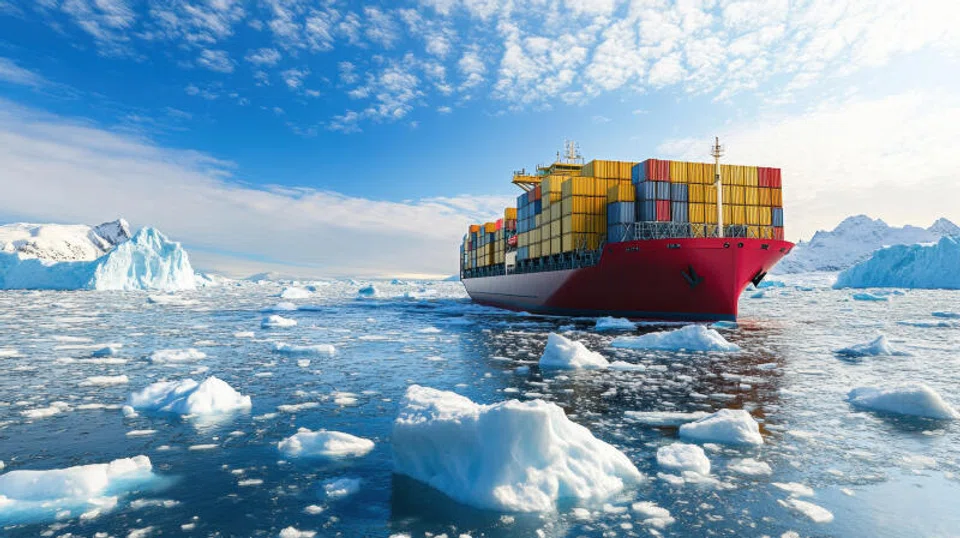
[SINGAPORE] Chinese carrier Sea Legend Line made maritime history in October, becoming the first to offer a liner-type shipping service with multiple stops from Asia to Europe through the Arctic.
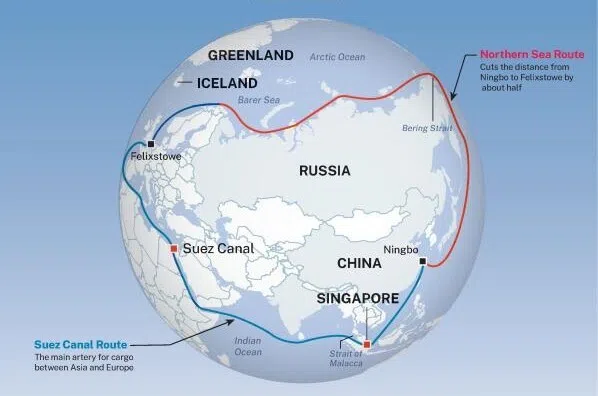
The voyage through the Northern Sea Route (NSR) in the Arctic by the fully loaded container ship Istanbul Bridge took only 20 days from Ningbo-Zhoushan in China to Felixstowe in the United Kingdom, with subsequent port calls at Hamburg in Germany, Gdansk in Poland and Rotterdam in the Netherlands.
Sea Legend Line named the service the China-Europe Arctic Express. It reportedly plans to establish regular summer voyages along the Arctic route by 2026.
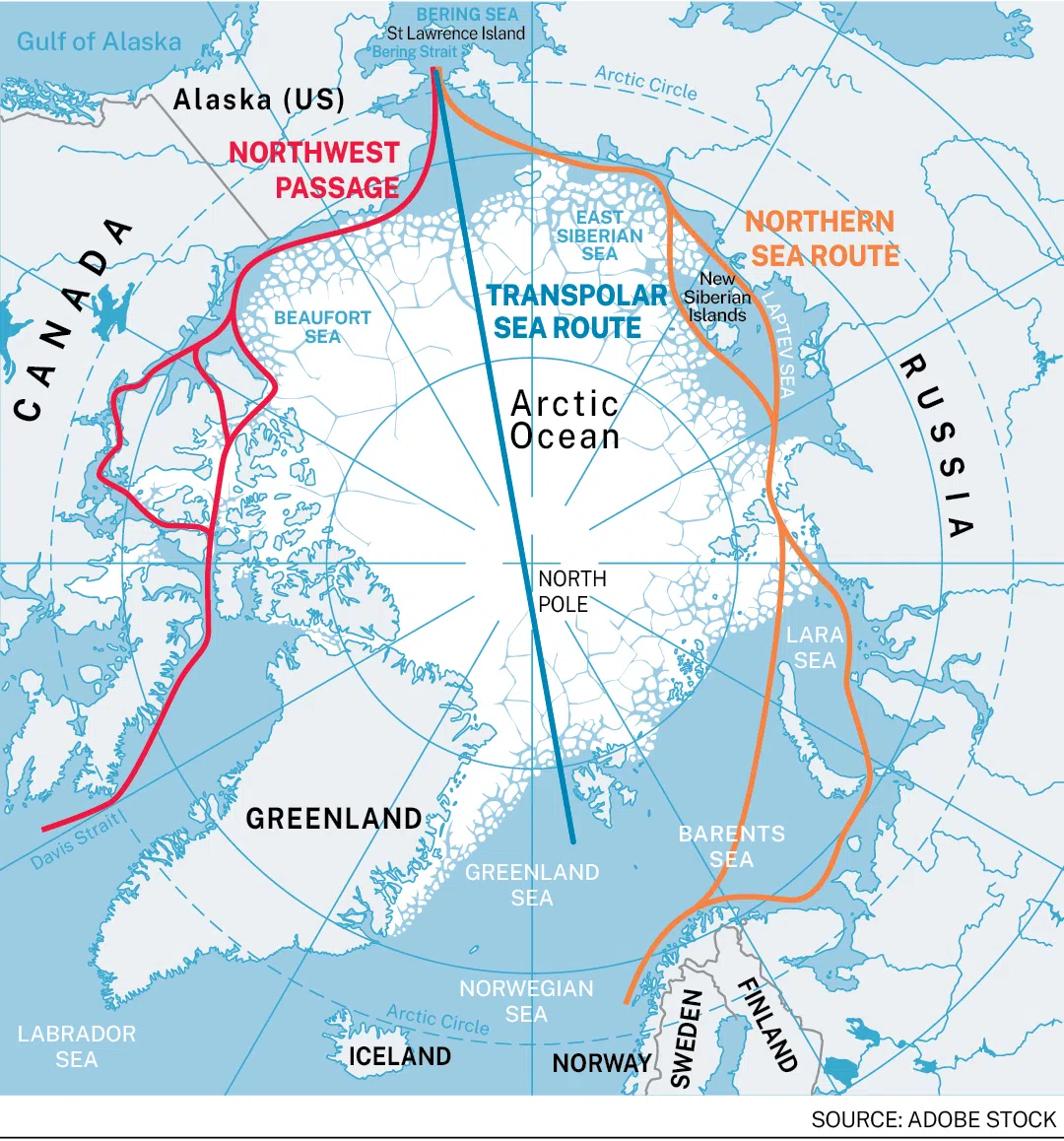
The NSR is the shortest maritime route linking the Atlantic Ocean and the Pacific Ocean, stretching about 5,600 km along northern Russia. It is one of the main Arctic shipping routes, with the others being the Northwest Passage (NWP) and the Transpolar Sea Route (TSR).
Among the three, the NSR is likely to be free of ice first.
The NWP runs through US and Canadian waters that are choked with sea ice. The TSR, which stretches from the Atlantic to the Pacific Ocean from the centre of the Arctic Ocean, is on the high seas and away from the territorial waters of the Arctic states. It is shorter and deeper than the NSR and would connect markets in North America, Europe and Asia, but is covered in thick ice.
China initiated a “Polar Silk Road” project in 2018 through developing the Arctic shipping routes as a part of its Belt and Road Initiative. It encourages its enterprises to participate in the infrastructure construction for these routes and conduct commercial trial voyages with the aim of regular commercial operation.
Meanwhile, South Korea will begin pilot operations on the Arctic shipping routes next year, with a government task force dedicated to the project established to devise a mid-term to long-term road map. It has plans to provide significant financial support to pursue its Arctic shipping ambitions, including a subsidy for ice-breaking vessels.
The investment is part of a strategy to position South Korea as a key stop along the expanding polar shipping lanes. The funding will also look at climate change’s impact on Arctic shipping lanes and increased training for polar marine engineers.
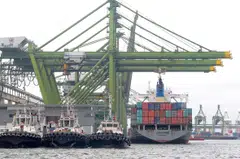

For Singapore, long anchored as a transhipment hub on the Asia-Europe trade corridor, the rise of Arctic shipping poses a quiet but consequential test.
If more cargo shifts north, fewer vessels may pass through Singapore, potentially forcing a rethink of how the city-state can stay relevant as a maritime hub.
Game changer?
The Arctic routes would be a game changer for the shipping industry – if they take off.
The NSR, for example, takes as much as only half of the travelling time between East Asia and Europe, reducing fuel consumption and carbon emissions, compared to the conventional routes via the Suez Canal or the Cape of Good Hope. In addition, it offers faster restocking and lower inventory costs for European importers.
The Arctic Ocean is increasingly navigable, and access to more locations in the polar region is improving as sea ice melts and its extent shrinks.
This could lead to the NSR being navigable beyond the summer – when ice conditions permit passage – and transform trade lanes, with potential significant implications for Singapore.
If more ships use the Arctic, fewer ships will pass through Singapore’s port en route to the Suez Canal or the Cape of Good Hope.
The Centre for High North Logistics, a non-profit foundation that promotes economically and environmentally sustainable transport and logistics solutions in the High North, counted 15 voyages through the NSR in 2025, compared with 11 last year.
All but one were between Russian and China ports in both years, with the odd one out being the voyage made by Istanbul Bridge from Ningbo to Felixstowe.
Will Singapore melt away as a maritime hub?
“I have read many, many times that Arctic shipping was about to boom since the turn of the century,” says Frederic Lasserre, a professor at Laval University in Canada who has studied Arctic shipping for three decades.
The researcher categorically dismisses the notion of Arctic upending the Suez Canal route. “Never. I think the Suez route will remain dominant, because there are markets along the route (such as the Mediterranean, Middle East, India and South-east Asia), a market diversity that the Arctic route – with no intermediate market – cannot compete with.”
The NSR may be a shorter route, but Prof Lasserre notes that distance is just one factor among several others, including security, cost, marketing, logistics and reliability.
“Cargo vessels, except for bulk, do not merely transport goods from point A to point B; they (make) several stopovers, and they are constrained by just-in-time structures, which do not fit well with seasonality – and seasons change in the Arctic,” he adds.

Ian Storey, a senior fellow at the Iseas-Yusof Ishak Institute, continues to hold the view he had in 2014, when he published a paper entitled Will Arctic Shipping Routes Eat Singapore’s Lunch? Not Anytime Soon, and Maybe Never.
He says all the problems and limitations with the NSR are still apparent. Container ship companies, for one, operate on the basis of schedule reliability: offloading and uploading containers at multiple ports along designated sea routes all year round. There are few places to do so along the NSR, and severe weather disrupts sailing schedules.
Dr Storey notes that the costs of using the NSR in the summer months can be higher due to increased insurance premiums, the need for ice-strengthened vessels, expensive crew training requirements and Russia’s mandatory ice-breaker escort fees.
Hao Nan, a research fellow with the Charhar Institute, an independent think tank on diplomacy and international relations, also does not expect Arctic shipping to become dominant, causing vessels to bypass Singapore.
“The Arctic will tweak margins, not overturn Singapore’s position in global trade,” he says.
In the next decade, Arctic shipping will remain a narrow, seasonal and politically constrained supplement to existing routes, not a game-changing alternative, says Hao.
“Large-scale, schedule-reliable container traffic by 2030 is very unlikely,” he says.
“Ice models suggest ‘practically ice-free’ summers could appear between the 2030s and 2050s, but predictable navigation, ports, search-and-rescue coverage, insurance norms and political arrangements will lag physical melt by at least a decade.”
He adds that a realistic window for a seasonal, commercially meaningful Asia-Europe trade lane is closer to the 2040s, possibly expanding in the 2050s if climate trends, infrastructure and governance all move in the same direction.
“Even then, the Arctic will remain one corridor among many, not a dominant global backbone.”
Challenging climate
While there are models that predict the Arctic sea ice might disappear for a limited period of time in the summer, Prof Lasserre notes that the ice will always reform in autumn and winter. There is no projection that ice will disappear year round.
For year-round shipping, one must consider high ice-class vessels that can navigate 11 months and are more expensive to build and run than present ice-class vessels, the researcher says.
Ice-class vessels are those built with strengthened hulls, powerful engines and reinforced structures to navigate through sea ice in polar or icy waters.
Arctic shipping is presently performed by small ice-class vessels. The Istanbul Bridge has a capacity of under 5,000 containers. In comparison, vessels plying the Suez Canal could transport as many as 22,000 containers.
Dr Storey says there are “no economies of scale” because the NSR’s waters are “relatively shallow”, which limits the size of container ships to 4,000 to 5,000 20-foot equivalent units (TEUs) of containers.
“By way of comparison, Singapore can handle the largest container vessels with capacities of 24,000 TEUs,” he adds.
Prof Lasserre believes the Arctic route will “gradually develop” for the transit market. “But it will take years, and I don’t expect it to shake the present world trade structure.”
He notes that an average of 18,000 ships used the Suez Canal annually before Yemeni rebels started attacks on merchant ships en route to the Red Sea area. Ships plying through the NSR and the NWP, on the other hand, total fewer than 100.
“Just not the same league,” he says.
The harsh ice environment aside, Arctic shipping has a host of other challenges.
Hao points out that infrastructure is sparse, with “few deep-water ports, almost no repair yards, limited bunkering, weak search-and-rescue and environmental response capacity”.
“Economically, ice-class vessels, Russian ice-breaker escorts, high insurance premiums and seasonal closures make per-voyage savings far less attractive than distance maps suggest, especially for hub-and-spoke container networks,” he adds.
“Institutionally and politically, the most viable route (in the Arctic), the NSR, is tightly controlled by Russia, subject to changing fees, regulations and pilotage rules, and heavily entangled in sanctions and Nato-Russia tensions.”

Hao believes that these factors are hard to overcome in the short term, resulting in Arctic shipping staying a niche play for energy, bulk and symbolic container sailings.
“Over the longer term, technology and gradual infrastructure build-up could make them more manageable, but that is a multi-decade horizon.”
China’s Polar Silk Road
On China’s Arctic ambitions, Hao says the country does have the interest, capacity and partners to build a limited Polar Silk Road, but not to replace existing trade arteries.
Strategically, China views the Arctic as a backup: an extra corridor if Eurasian rail is cut by war or sanctions, or if Malacca-Suez routes are disrupted by Red Sea or Indian Ocean crises.
“However, going ‘all in’ on the Arctic would effectively concentrate China’s external trade on infrastructure controlled by a single partner, Russia, which is inconsistent with Beijing’s longstanding diversification instinct,” Hao explains.
“Realistically, the Polar Silk Road will develop as one supplementary strand in a wider web of maritime and overland corridors, not China’s main lifeline.”
For China and Russia, the Arctic will slowly gain importance as a strategic hedge, but not as a replacement for Malacca-Suez, he adds.
Geopolitical and environment issues
Dr Storey says that the economic outlook for the NSR has “worsened” since Russia’s invasion of Ukraine in 2022.
The author of the book Putin’s Russia and Southeast Asia: The Kremlin’s Pivot to Asia and the Impact of the Russia-Ukraine War expects that an end to the war won’t improve the prospects for the NSR, with European countries retaining sanctions on Moscow because they continue to view Russia as an existential threat.

“As such, European shipping and maritime insurance companies will avoid it,” says Dr Storey. “Besides, even before the war started, the biggest container lines announced they would not use the NSR due to environmental concerns.”
Danish shipping and logistics player Maersk does not see the NSR as viable.
“The environmental risks are significant, and from an operational standpoint, there are considerable limitations regarding navigable time windows, infrastructure, vessel size, vessel type and safety in general,” says the company, adding that it does not have any business activities in Russia.
Mediterranean Shipping Company, which has the world’s largest box-ship fleet, has reaffirmed its commitment to avoid the NSR around the time the Istanbul Bridge made its historic voyage.
It says there is no operational reason for its fleet and standalone network to transit the Arctic, as it has the capacity and means to safely and reliably transport customer cargo globally without using the NSR.
Hao sees these statements as sincere but incomplete. Concurring with Dr Storey, he says geopolitical and environmental reasons are obstacles hindering carriers from embracing Arctic shipping, though some may quietly reassess if politics, governance and risk improve dramatically over time.
However, for the foreseeable future, Arctic shipping will be driven mainly by Russian and Chinese actors, not by European or US carriers, he adds.
Singapore monitors shipping developments
Singapore is alive to the threats to its port. The Maritime and Port Authority of Singapore (MPA) says the Republic monitors global shipping developments, including interest in Arctic routes such as the NSR.
MPA says it will work with partners and stakeholders to strengthen the Port of Singapore’s connectivity, productivity, service offerings and competitiveness, to meet the long-term needs of international shipping and global supply chains.
The sea transport industry is a key pillar of Singapore’s economy, with the maritime sector contributing about 7 per cent of gross domestic product and employing about 170,000 people.
The Republic has been an observer state in the Arctic Council, an inter-governmental organisation that sets the rules for the future development of the polar region, since 2013.
Hao points out that Singapore’s role as a primary hub at the crossroads of the Indian Ocean-Pacific system, with deep hinterland links, services, finance and logistics ecosystems, will remain central.
“For Singapore, the more interesting question is opportunity: It can export port management, financing, insurance, digital maritime services and green-shipping expertise into Arctic-related projects, while leveraging its relatively balanced political ties.”
Dr Storey sees that Singapore has two important advantages with its port: operational efficiency and lack of corruption. “These advantages will be burnished as the Tuas Superport opens in stages out to 2040.” Although he does not believe the NSR poses a significant threat to Singapore’s shipping interests, the TSR by mid-century might impact the city-state’s maritime trade interests, as it does not suffer from the same problems as the NSR.
“I think Singapore will be paying closer attention to the TSR than the NSR.”
Decoding Asia newsletter: your guide to navigating Asia in a new global order. Sign up here to get Decoding Asia newsletter. Delivered to your inbox. Free.
Copyright SPH Media. All rights reserved.