

Abe's US visit reinforces a historic partnership
It has sealed Japan's place as a staunch ally central to the geostrategic concept of an American "pivot" to East Asia though question marks still remain over TPP
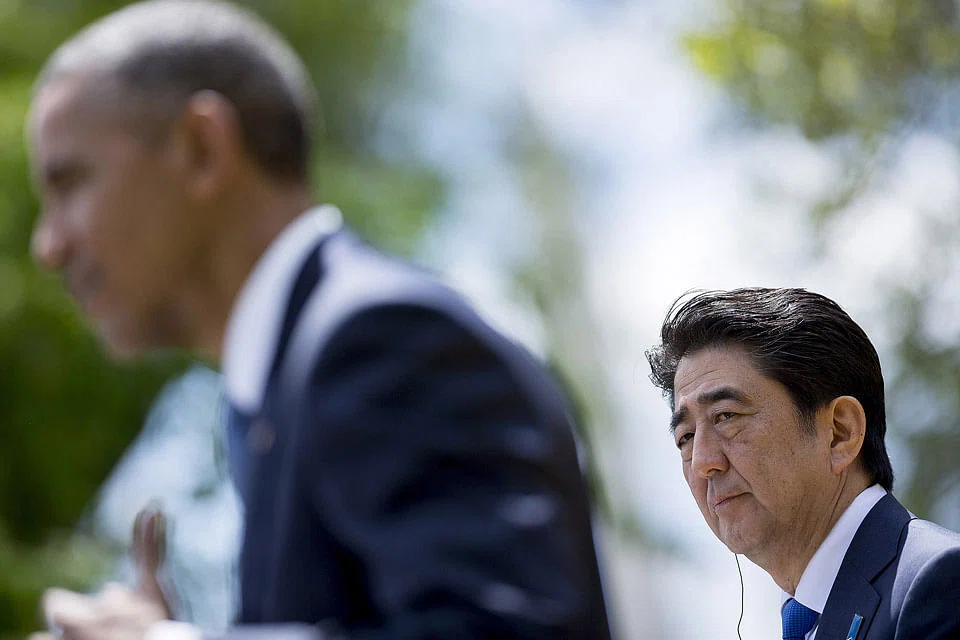
AS Japanese Prime Minister Shinzo Abe concluded his historic visit to Washington - the first by a Japanese premier in nine years, and the first Japanese leader to address a joint meeting of the US Congress - it may be difficult to imagine that it was only five years ago when some officials and pundits in Washington considered saying their Sayonara to Japan.
Then Japan prime minister Yukio Hatoyama of the Democratic Party of Japan (DPJ), calling for a review of Japan's ties with the United States, made it clear that he wanted to shift his country's focus from a more America-centric foreign policy to a more Asia-focused policy.
Infuriating American policymakers and lawmakers, Mr Hatoyama called for a "close and equal" Japan-US relationship, and insisted that Japan should not continue to be subservient to Washington. In addition to ending a Japanese refuelling mission in Afghanistan, which, he argued, violated Japan's pacifist constitution, he refused to commit himself to an earlier accord that was supposed to relocate the American Futenma Air Base to another part of Okinawa. He also seemed to be siding with those in his party that wanted the United States to move its military bases off the Okinawa islands altogether.
At the same time, Mr Hatoyama was taking steps to improve Japan's ties with other East Asian countries, in particular with South Korea and China, and there was even talk about reconciliation with China and Korea under which Tokyo would apologise for its conduct vis-à-vis those two countries during World War II.
Indeed, some were speculating at the time that Japan was in the process of reorienting its foreign policy from a United States that seemed to be heading towards geostrategic and economic decline, and in the direction of the rising China, and that the post-World War II alliance between Washington and Japan was becoming an historical anachronism.
This may sound now like ancient history. Prime Minister Abe of the Liberal Democratic Party (LDP) has been presiding over major changes in the direction of foreign policy and the transformation of Japan's relationship with the United States. But if anything, Mr Abe is taking the exact opposite path on which Mr Hatoyama was heading five years ago.
Mr Abe wants to change Japan's post-1945 pacifist constitution and embrace a more assertive military stance that would allow the Japanese to play a more activist role in the context of an upgraded US-Japan partnership. He also wants this bilateral military alliance that has lasted more than six decades as part of the Cold War, and which had brought Japan and the United States together, to become a cornerstone of a long-term strategy aimed at containing China and not being co-opted by it. If for 50 years or so the Americans and the Japanese were standing up together against the Soviet Union, in the next 50 years they'll be doing the same thing in dealing with the new global and regional challenge, China.
So, yes, the relocation of American Futenma Air Base will take place as agreed and there won't be any challenge to the presence of the US military in Okinawa. And what about those apologies to China (and Korea) regarding WW II atrocities? Well, forget about it (and also add "alleged" before "atrocities").
Which explains why despite Mr Abe's questionable views on his country's wartime history, American officials and lawmakers gave the high-five sign to the prime minister during his visit to Washington. And that includes US President Barack Obama who welcomed Mr Abe not as the leader of a country that the United Stated defeated 70 years ago but as a staunch ally that has become central to the White House's geostrategic concept of an American "pivot" to East Asia.
There was the magnificent arrival ceremony at the White House, and the first White House state dinner in more than a year which had plenty of sake and during which President Obama recited a haiku, the first US president to do so ("Spring green and friendship/ The United States and Nagoyaka ni (harmonious feeling)".
And there were symbolic gestures by the Japanese leader, including visits to the Lincoln Memorial, the Arlington National Cemetery and the Holocaust Museum, and his address before the joint meeting of Congress in which the Mr Abe did admit that his country's "actions brought suffering to the people in Asian countries" during WW II, but didn't offer a more effusive apology. "History is harsh. What is done cannot be undone," he said.
President Obama, who has been dragged into new military entanglements in the Middle East, has been constrained in his ability to advance his plan of shifting American strategic and economic focus to East Asia or to even outline a coherent strategy in response to China's assertion of military power in the Pacific. So he was hoping that the visit by the Japanese leader would provide an opportunity to highlight US interests in East Asia and to point out Japan as a major partner in his "pivot" to that region.
The signing of a new agreement between the two governments on defence cooperation, the first upgrade since 1997, was clearly a big plus for Mr Obama's East Asia policy, although Mr Abe's nationalist stance, including his somewhat revisionist reading of his country's conduct in WW II, would make it difficult to achieve the US goal of enhancing security cooperation between Japan and America's other military ally in the region, South Korea. Indeed, officials in Seoul were getting worried that Washington was centralising its Asia policies in Tokyo.
Nevertheless, some observers believe that the revised treaty was "a genuinely historic event" that could alter the bilateral relationship in a fundamental way by bringing to an end "decades of official US ambiguity about Japan's place in American national security planning and in world politics itself", as East Asia analyst Alan Tonelson put it.
While for the last 50 years Tokyo was never pressed to promise to help defend the United States or its interests, the new US-Japan guidelines "take an unprecedented step in turning the security relationship with Japan into a genuine alliance", according to Mr Tonelson, obligating the Japanese to use their military power to help the United States and other allies if and when they would come under attack.
It's still not clear when Mr Abe would be able to mobilise the Japanese people in support of revising the nation's pacifist constitution and adopt a more assertive military approach. At the same time, while the new guidelines may indicate that it would now be difficult for Americans to criticise Japan for continuing to "free ride" on US security protection, Americans may be concerned over the possibility that a more nationalist Japan could take unilateral military steps in dealing with its territorial disputes that could draw the United States into a military confrontation with China.
Moreover, it's not clear whether the Japanese leader's visit to Washington has helped President Obama to advance the economic component of his "pivot" to East Asia, the proposed Trans-Pacific Partnership (TPP) accord between the 12 economic powers in the region, including the United States and Japan.
The proposed treaty is facing political opposition both in Washington and Tokyo. In fact, the majority of the Democrats and some Republicans in the US Congress were not inclined to vote in favour of the TPP and were sceptical of President Obama's entire global trade liberalisation agenda.
In that context, the Japanese leader failed to alleviate the concerns of those American lawmakers, refusing to make a clear commitment in response to American pressure to open his nation's agriculture and auto markets. Without concessions in those two areas, the United States would reject Japan's membership in the TPP. And such a protectionist Japanese stand is also bound to play into the hands of opponents of the TPP in the US Congress.
During the Cold War, when the Soviet threat dominated American considerations, the United States was willing to tolerate efforts by Japan to protect its economy from foreign competition, even when that ended up hurting the interests of American companies. US strategic interests overrode its economic ones.
It's quite possible that Mr Abe believes that Washington once again would be willing to accept Japanese economic protectionism, this time because the Chinese threat would become the overriding concern when it comes to its East Asia policy. But the Japanese leader should recognise that things have changed and that just as it was necessary to end Japanese free riding on US security protection, he would have to end Japan's economic free loading.
TRENDING NOW

He built the Vingroup empire. Now South-east Asia’s richest man is handing some key roles to his sons

32 companies, 6 individuals bag accolades at Singapore Corporate Awards 2026
Can a first-time homebuyer couple earning S$18,000 a month afford a new EC unit?
Floods compound Philippine growth woes from public-works scandal

