The art of widening tastes
Global art auctioneers have been working to attract Chinese bidders to segments of the art market other than that for Chinese art.
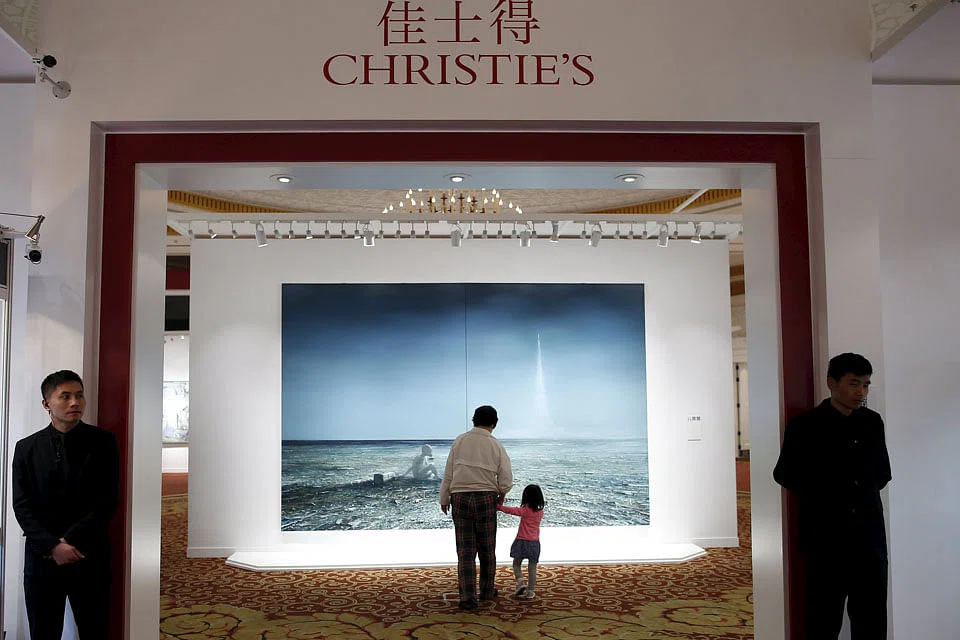
SUPPOSE you have a growing pool of ultra-high-net-worth Asian art collectors on the one hand, and a pile of Western art on the other. How do you ensure the two meet for your greatest benefit? This is basically the conundrum facing global auction houses Christie's and Sotheby's in their competition to dominate a global art market increasingly geared towards China and its deep-pocket bidders known for their insatiable passion for collecting art.
Since the early 2000s, Chinese collectors have taken the art world by storm, contributing massively to Christie's and Sotheby's impressive rise in sales. In 2014, Christie's sold US$8.4 billion in fine and decorative arts (up 17 per cent year on year); Sotheby's total sales hit US$6 billion (up 18 per cent year on year). Last year, Asian art sales totalled US$717 million at Christie's and US$900 million at Sotheby's. Asian buyers represent 27 per cent of Christie's global clientele and 17 per cent of Sotheby's - still behind American and European clients, but representing the bulk of first-time bidders in both auction houses.
Chinese collectors have customarily focused on Chinese art, both traditional art - which encompasses decorative art, old ink calligraphy and paintings - as well as modern and contemporary paintings, thus fuelling an unprecedented boom in Chinese artefacts' auction prices globally over the last decade. Star lots such as the Qianlong Emperor's zitan dragon throne and a doucai chicken cup, both sold at Sotheby's Hong Kong and bought by Shanghai billionaire Liu Yiqian for his Long Museum, have made headlines worldwide; the dragon throne cost US$11 million in 2009 and the chicken cup, US$36 million in 2014.
Chinese in high-profile auctions
In recent years, Chinese collectors have noticeably extended their reaches beyond Chinese art to grab some of the most expensive works for sale at high-profile auctions of modern and contemporary Western art abroad.
Wang Jianlin, chairman of Dalian Wanda Group, a real estate and entertainment conglomerate, bought a 1950 Picasso painting for US$28.2 million at Christie's New York in November 2013. Movie mogul Wang Zhongjun bought a 1890 Van Gogh painting for US$62 million at Sotheby's New York in October 2014. In May 2015, also at Sotheby's New York, the pair made headlines again - Wang Zhongjun for buying a US$29.9 million Picasso painting and Wang Jianlin for a US$20.4 million Monet painting. These high-profile transactions are part of a myriad of auction purchases by Chinese collectors. Over the last few years, they have also bought museums' worth of works by major modern artists such as French impressionists Claude Monet and Camille Pissaro, American pop artist Andy Warhol, British artist Francis Bacon, American sculptor Alexandre Calder, American painter Mark Rothko, and other trophy names. Sotheby's estimates that Chinese bidders on non-Chinese art doubled from 2010 to 2014; during the same period, 650 winning bidders from mainland China spent a total of US$410 million for non-Chinese art at the auctioneer's sales.
Beyond the financial benefits that investing in Western art might carry for Chinese ultra-high-net-worth individuals looking for ways to park their cash, these purchases worth hundreds of millions of US dollars are the results of global auctioneers' deliberate attempts to attract Chinese bidders to segments of the art market other than that for Chinese art, traditional or contemporary. This is where the growth opportunities are for art market professionals, both at auctions and private sales. However, selling non-Chinese art to Chinese collectors is a challenge inasmuch as nothing in China's tradition and culture naturally steers collectors towards non-Chinese art, which was at best seen as exotica by Chinese elite for centuries. Art collecting in China used to, and does still, convey a sense of nationalistic pride deeply rooted in history.
Passion for timepieces
During the Ming and Qing dynasties, Chinese scholars and ruling classes were avid collectors of mostly, if not exclusively, Chinese artefacts. One notable exception to this very domestically focused collecting style is the Chinese elite's passion for European timepieces, which first entered China thanks to Jesuit priests settled in Peking under the Wanli Emperor of the Ming dynasty, who ruled from 1572 to 1620. Two centuries later, in 1796, the English ambassador leading a delegation to meet with the Qianlong Emperor in his mountain-resort palace in Jehol (modern day Chengde, Hebei) estimated the value of mantelpiece clocks made in Great Britain and exported to China during the 18th century at today's equivalent of £65 million (S$135.1 million). Indeed, Chinese amateurs were extremely good clients of British and Swiss watchmakers, as they usually bought pocket watches in pairs.
In their quest to open up China to non-domestic art, global auction houses have few references to rely on, as Western history of tastes is of little help when dealing with the modern-day Chinese's idiosyncratic appetite for art. At the turn of the 19th century, American millionaires who were self-made industrialists akin to today's Chinese billionaires, were fascinated by old European art from the Renaissance onwards. Savvy art dealer Lord Duveen (1869-1939) made a considerable fortune by selling European Old Master paintings, sculptures, furniture and tapestries to this clientele. For American business tycoons such as Carnegie Steel chairman Henry Clay Frick, bankers JP Morgan and Andrew Mellon, buying the relics of a declining European aristocracy was essentially a way to become part of the same upper-class elite. The link of the Chinese nouveaux riche with the Old Continent is obviously more elusive.
Faced with this situation, Christie's and Sotheby's have become experts in widening Chinese collectors' tastes. Their "haute couture" outreach efforts rely on an in-depth and subtle knowledge of cultural codes, both Eastern and Western, that will make collectors react and ultimately bid up at auctions. The techniques implemented by global auction houses focus on three pillars: exposure, education and VIP treatment, with the last-named a given at the top end of the art market.
Exposure matters
Art specialists employed by the two firms are credited with exposing top Chinese collectors to Western artists such as Morandi, Calder and Twombly by relying on correspondences between these artists' styles and Chinese art. This "East-meets-West" approach, which teases aesthetic similarities between artists and cultures across time and continents, might be non-sense for art historians, but proves efficient. Christie's used it to promote Western art in Hong Kong last November, by presenting a series of carefully selected paintings (from 16th-century old Masters to 20th century Picasso and Chagall) in a private sale organised according to the wu xing framework, or that of the five elements used in traditional Chinese culture.
Auction houses also cater to Chinese collectors' interest for foreign artists who have influenced Chinese art. Chinese-French artist Zao Wou-Ki who lived in Paris for most of his artistic life falls into this category. A 1958 painting by him titled Abstraction, formerly in the Art Institute of Chicago collections, was sold for the record price of US$14.7 million at Sotheby's Beijing in December 2013.
Education plays a key role in auctioneers' growth strategy in greater China. Sotheby's relies on its Institute of Art to offer lectures and panel sessions in parallel to its mainland sales. One such event organised before its modern and contemporary Chinese art sale in Beijing in June includes a discussion on global influences on contemporary ink art, which is yet another angle on the "East-meets-West" theme.
Since 2012, Christie's has been proposing seminars and special events in greater China known as Christie's Art Forum. This annual series of scholarly events, organised during Christie's Hong Kong and China auction seasons, embodies the auctioneer's dedication to "providing collectors and art enthusiasts with ample opportunity and knowledge to enjoy art, navigate the market and share in the passion of building magnificent collections".
Exposure and education bring collectors and artworks in physical contact so that knowledge, and possibly desire triggered by proximity, might generate business. This practice can turn auctioneers into VIP tour operators when art specialists accompany clients to exclusive visits of art museums and galleries worldwide.
Hence, a Chinese collector couple fond of sculpture might be invited for a private tour of the Rodin Museum in Paris to take in a close encounter with the 19th century French sculptor's masterpieces. Alternatively, auctioneers might bring artworks to mainland collectors by organising exhibitions in China. In December 2013, in parallel to its first auction of Modern and Contemporary Western Art in the mainland, Sotheby's exhibited a Rembrandt painting in Beijing. Similarly, Christie's held an inaugural exhibition of its Old Master paintings department in Beijing last April, marking the start of a national tour of Western Old Masters paintings selected from its upcoming sales. The exhibition was accompanied by Christies' specialists' lectures as well as various events, including an Art Dialogue with Chinese contemporary leading artist Zeng Fanzhi, who explained his love for Western Old Master drawings and how they influenced his works.
Interestingly, Chinese collectors are known to be keen on works on paper, given their appreciation of ink paintings and calligraphy. Building on this cultural affinity with paper to promote Old Masters in China and linking Old Masters with one of the hippest artists in modern China is intercultural marketing genius.
Old Masters, old gold
Western old Masters and European decorative art are an important category for Christie's and Sotheby's in China. While the two auctioneers' licences to hold auctions in mainland China put the lucrative traditional Chinese art and antiques off limits, traditional Western art which can be marketed in many ways (for instance, in lifestyle sales such as Christie's Art of the Horse private sale showcased in Shanghai and Hong Kong last November) is possibly one of the few segments where Christie's and Sotheby's can truly differentiate themselves from their powerful mainland competitors such as Poly Auction. For collectors mindful of investment values, it also makes a lot of sense to consider this segment of the market. Less speculative, albeit less glamorous, than Impressionists, 20th century masters and contemporary artists alike, museum-quality Old Masters represent time-tested blue-chip names, whose rarity on the market supports the price.
Chinese collectors are not the first Asians to splash out on Western art. In the 1980s, Japanese corporations drove the auction prices of Impressionist and modern paintings to dizzying heights, until the Bank of Japan's change in monetary policy and the collapse of the Tokyo stock market in 1990 marked the end of the party.
Whether the impact Chinese collectors are having on the global art market is a bubble or a sustainable phenomenon is beyond the clout of art-market heavyweights. The answer lies with China and its ability to thrive as an economic superpower. In that respect, the role of auctioneers who spare no efforts to expose the Chinese public to non-Chinese art - notwithstanding the fact it is self-serving - is the best thing that could happen to wealthy Chinese collectors: To make choices underpinned by an appropriate level of connoisseurship with regard to quality, price and lasting aesthetic enjoyment is ultimately the best way to avoid disappointments when buying art.
Share with us your feedback on BT's products and services