

ASEM summit signals new European focus on Asia
Region is a growing priority for EU, other European states trying to steal a march on other big powers, in a bid to drive economic and political competitive advantage.
 Add BT as a preferred source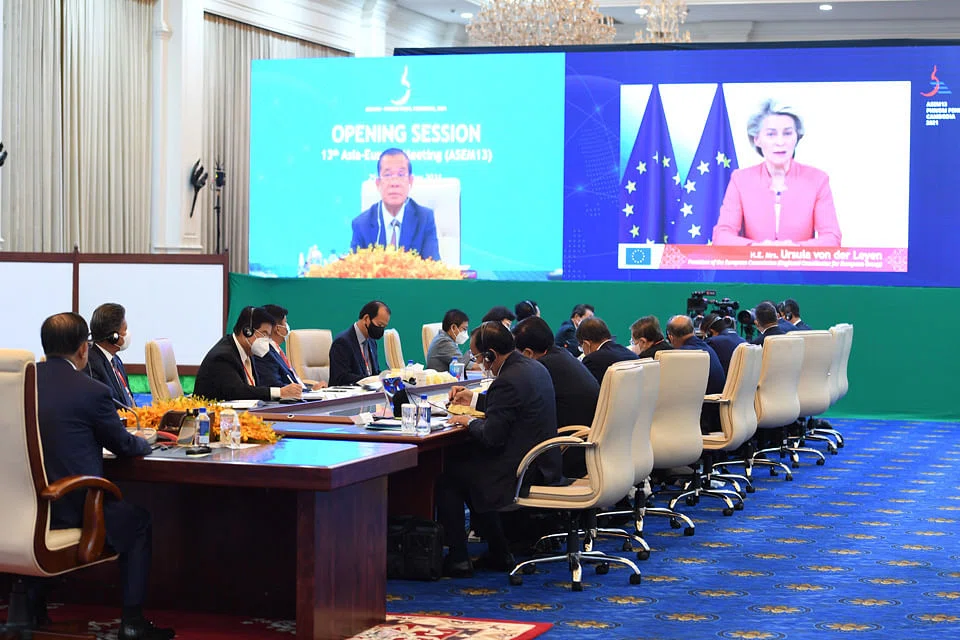
WHILE many 2021 headlines have been made by the intensified United States focus on the Asia-Pacific under President Joe Biden, the growing attention that Europe is devoting to the world's fastest growing economic region is often overlooked.
The latest signal of European intent towards Asia came last Thursday (Nov 25) and Friday with the 2-day Asia-Europe/ASEM summit which was hosted by Cambodia Prime Minister Hun Sen in Phnom Penh. First conceived by France and Singapore, where the forum is headquartered, it now comprises 53 partners, including 21 Asian countries, 30 European nations, plus Asean and the European Union (EU) institutions. President of the European Council Charles Michel, President of the European Commission Ursula von der Leyen, and High Representative for Foreign Affairs and Security Policy Josep Borrell represented the EU.
Postponed from last year because of the pandemic, the end of week meeting laid the framework for further political and economic cooperation between the two regions based on mutual respect and equality. Collectively, the two mega regions represent around 60 per cent of global gross domestic product (GDP), population and trade, with significant forward potential.
The overall theme of the summit was strengthening multilateralism for shared growth. Key topics addressed were post-pandemic health and socio-economic recovery; the rules-based international order, including trade; tackling climate change post-COP26; connectivity; women, peace and security; and inclusive and sustainable growth and development
Europe's underlying goal of engagement with the Asia-Pacific is to build competitive advantage vis-a-vis other world powers, including the US. While states across Europe, including the United Kingdom, have ramped up engagement with Asia-Pacific partners in recent years, it is the 27-member EU that's at the vanguard of this.
EU'S NEW STRATEGY
Navigate Asia in
a new global order
Get the insights delivered to your inbox.
Earlier this year, the Brussels-based club agreed a new Asia-Pacific strategy to reinforce its strategic focus, presence and actions in this region of prime strategic importance. The aim is bolstering regional stability, security, prosperity and sustainable development, at a time of rising challenges and tensions in the region, in a bid to uphold democracy, human rights, the rule of law and respect for international law.
The EU's approach and engagement seeks to foster a rules-based international order, a level playing field, as well as an open and fair environment for trade and investment, reciprocity, the strengthening of resilience, tackling climate change and supporting connectivity with Europe. Outside of economics, free and open maritime supply routes in full compliance with international law are key too, and Europe intends to work increasingly closely with partners in security and defence, not just addressing maritime security, but also malicious cyber activities, terrorism, and organised crime.
As well as last week's ASEM summit, another manifestation of European intent towards Asia-Pacific is the EU annual conferences with key emerging market giants like India and China, plus major industrialised nations like Japan. This is also already paying dividends.
Take the example of India which with the EU-27, as a whole, are the world's two largest democracies and keen to forge stronger ties. Continental Europe is already India's largest single trade and investment partner, hence why a new bilateral trade deal under discussion is a key potential prize for both parties. There are wider reasons behind converging interests, including a growing need to develop shared defence forums such as maritime security in the Indian Ocean where 40 per cent of bilateral trade passes.
While India is therefore a pre-eminent European target in Asia, it is by no means the only one. Inevitably, China is also on Europe's radar here, despite the chilliness in ties since the pandemic. Top of the EU-China agenda is a new Comprehensive Agreement on Investment which, while agreed last December, remains yet to be ratified.
The EU-China dialogue is multi-faceted with both sides keen to stress areas of common interest and cooperation, including tackling climate change. The reason why EU-China discussions on global warming are generally so cooperative is that, fundamentally, both share a vision of a prosperous, energy-secure future in a stable climate and recognise the need for bilateral collaboration to realise this agenda.
Their 2015 global warming agreement, for instance, intensified cooperation in domestic mitigation policies, carbon markets, low-carbon cities, greenhouse gas emissions from the aviation and maritime industries, and hydrofluorocarbons. China's planned investment in the green economy is huge in coming years, a fact that Europe is increasingly recognising, and there are thus substantial commercial opportunities for the region's technology and science firms which are leaders in much of this clean technology agenda.
Yet, important as Europe's relations are with emerging markets, industrialised nations are important too. With Japan, for instance, the EU enjoys a burgeoning bilateral agenda with the two powers, for instance, stepping up in recent years their leadership on international trade and the rules-based economic order.
ECONOMIC AGENDA
Japan remains the world's third largest economy, and is one of Europe's top export markets in Asia. In the EU, it is estimated that some 600,000 jobs are now tied to bilateral trade, with an estimated 74,000 European firms exporting to Japan.
This core economic agenda was given a fillip in 2019 when the EU-Japan free trade agreement entered into force, covering around a third of global GDP and almost 650 million people. The accord took years to agree with the headlines captured by the scrapping of almost all duties of Japanese and European imports respectively.
Beyond the numbers, however, both sides have stressed that the trade treaty is also important because it rests on values and principles. In part, this relates to the fact that the agreement is the first to be struck by the EU which includes language upholding the Paris climate agreement.
Specifically, there is a commitment to support the Paris treaty by making a 'positive contribution' to reducing global warming by cutting greenhouse gas emissions. This follows a move by the European Commission to try to ensure, going forward, that all EU trade agreements include reference to meeting Paris goals.
These three, diverse examples showcase why Europe perceives such a massive opportunity in Asia. From its emerging markets to its industrialised economies, the region is a growing priority for EU and other European states trying to steal a march on other major powers, especially the US, in a bid to drive economic and political competitive advantage in the post-pandemic era to come.
- The writer is an associate at LSE IDEAS at the London School of Economics
Decoding Asia newsletter: your guide to navigating Asia in a new global order. Sign up here to get Decoding Asia newsletter. Delivered to your inbox. Free.
Share with us your feedback on BT's products and services
TRENDING NOW
Middle East-linked energy supply shocks put Asean Power Grid back in focus

JLL Singapore cuts over 20 jobs or 1% of workforce; Knight Frank Singapore also lays off staff
How China’s young workers are securing their future even as AI disrupts job market, triggers pay cuts

DBS CEO Tan Su Shan strikes upbeat tone on deposits, wealth growth after strong Q1

