

Asia in the long aftermath of Afghanistan
The US is big on firepower but small in staying power. Asian states beholden to American power cannot but reconsider what its limits mean for them.
 Add BT as a preferred source
DeeperDive is a beta AI feature. Refer to full articles for the facts.
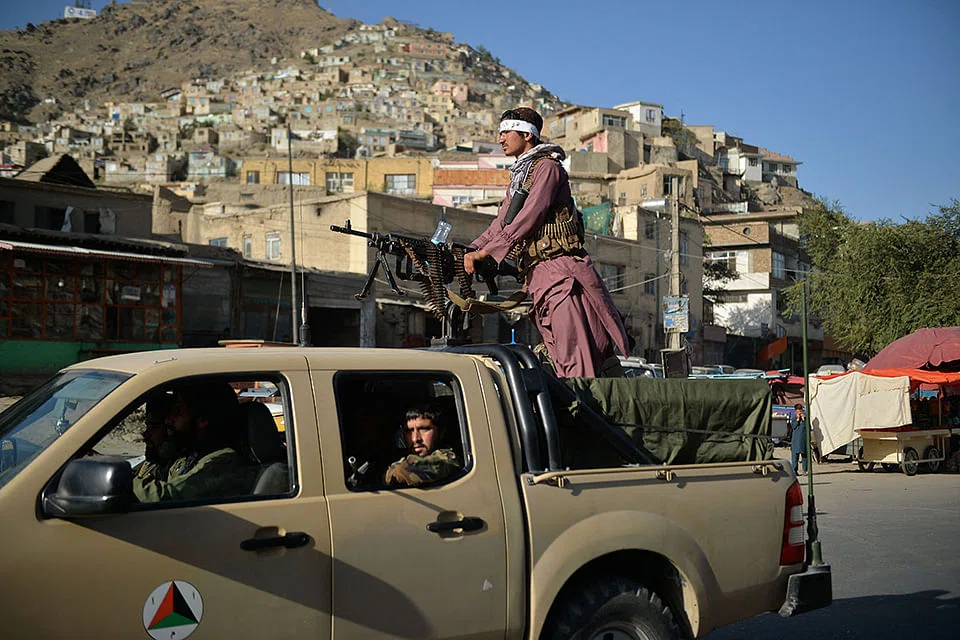
THE chaotic American withdrawal from Afghanistan and the Taliban's unresisted recapture of power cannot but revive Asia's need to come to terms with the resurgence of China as a global rival to the United States.
Many Asian states want Washington to act as a counterweight to Beijing, but they are courting a powerful China as well in case America withdraws from its forward military presence in Asia because of China's countervailing rise.
True, America cannot be written off because of Afghanistan. Reverses suffered by a global hegemon in one country at a single point of time cannot be held up as incontrovertible proof that the hegemon has passed its global shelf date. America's allies still need it in their immediate neighbourhoods. American retrenchment from the Indo-Pacific region is not something that Australia, Japan, the Philippines, South Korea and Thailand would encourage, no matter how dramatic television footage might be of Kabul's reversion to Taliban rule.
Nevertheless, as America withdraws from Afghanistan after having fought the longest war in its history, it leaves behind the latest debris of its efforts at democratic nation-building through war.
By contrast with the US, China has not been at war since its hostilities with Vietnam in 1979. Since then, the US has waged several wars in the Balkans and the Middle East. China has risen peacefully.
Admittedly, China's international remit denies the agency of democracy, but America's democratic claims are not convincing either. Asian nations see through the protective indulgence that the US displays towards a veritable constellation of undemocratic states in the Middle East, for example, so long as they give it an advantage over its adversaries.
Navigate Asia in
a new global order
Get the insights delivered to your inbox.
America's hegemonic attractiveness has been eroded by its invasion of Iraq and its support for violent regime change in Libya. They have removed two formerly viable states effectively from the strategic geography of the Middle East without having reduced the region's democratic deficit tangibly. Syria would have met the same "democratic" fate but for Russia.
This is where China is stepping in, with a narrative based not on democracy but on the stability which its historical dominance of Asia produced.
Sinic dominance has been the historical norm on this continent. The idea of tianxia, or the aspiration of ruling all under heaven, was developed during the Zhou dynasty (1045-221 BC). It inspired the formation of the Chinese tributary system at least as early as the Han dynasty (206 BC to 220 AD). The system, whose prowess was demonstrated by the great trans-oceanic voyages of Zheng He during the Ming dynasty (1368-1644), lasted till the Western introduction of the treaty system in China's international dealings after the Opium War of 1840. Chinese power guided Asia for centuries.
FAR DEEPER ROOTS
By contrast with the Chinese tributary system, what the academic Khong Yuen Foong calls the American tributary system is but a 20th-century creation that emplaces the US as "the hub or epicentre of the most extensive network of formal and informal alliances ever built".
For all its extant power, the American tributary system arguably could be subverted by as early as the middle of this century. China, then, has far deeper roots in Asian history than the US.
As for the economic present, the unipolar moment of American supremacy produced by the end of the Cold War passed with the onset of the global financial crisis of 2008. It destroyed, perhaps forever, the Washington Consensus, or neoliberal congruence achieved among the International Monetary Fund (IMF), the World Bank and the US Department of the Treasury that had underpinned the global expansion of free markets and the corresponding contraction of state involvement in national economies after World War II.
The Beijing Consensus, a loose model of authoritarian capitalism, came to the fore after the 2008 crisis had torn its way through the structures of Western global dominance. China's Belt and Road Initiative of 2013 and its Asian Infrastructure Development Bank of 2016 are heavily state-driven enterprises. They do not challenge the Western Bretton Woods system of the IMF and the World Bank directly, but they do offer prospects of an alternative economic order free of its recent Western, free-market provenance.
On this economic front, the US cannot replicate its Cold War strategy with the Soviet Union to contain China. The Cold War was fought between the two irreconcilable economic systems of capitalism and communism. By contrast, the current US-China rivalry is being conducted within a single capitalist system.
In this system, both the US and China accept the need for a rules-based international order. Where they diverge is in the Chinese rejection of the Western demand that the order be liberal, in the particular sense that it be based on the practice of liberal democracy within nations.
Asian and many other states are unlikely to be swayed by the Western insistence on the piety of domestic liberal democratic politics because China's remarkable economic and military ascendancy has occurred without liberal democracy at home (apart from the selective American use of democracy to identify friends and foes mentioned earlier).
In the longue duree of Asian history, China has re-emerged as a peer power of the US. To pretend otherwise would be to indulge in expensive self-delusion.
Militarily, of course, America remains nuclear miles ahead of China, but the fall of American Kabul to a ragtag band of insurgents (which spent two decades in military exile) without so much as a firefight demarcates the limits of American power. It is big on firepower but small in staying power. Asian states beholden to American power cannot but reconsider what its limits mean for them.
GLOBAL PRESENCE
However, there are lessons for China as well in all this. One reason for America's woes is that its hegemony obliges it to take responsibility for the entirety of the global commons. America is affected by whatever happens around the world because that world is its to keep or lose.
China, though, has been far more discerning in its global interventions, choosing when and how to intervene at its own pleasure.
That happy state of affairs will not last as China seeks to supplant America. The world, which both lauds and humbles the US, will celebrate and humiliate China as well. China will not be able to pick and choose which parts of the world it wishes to "rule".
One essential feature of the international system that it will have to confront will be the resilience of extremism and terrorism. Terrorists attack the global presence of the US today because it prevents them from expanding their local power. Tomorrow, they will do the same for an ascendant China. How it intends to fight non-state actors such as terrorists will help determine how credible Chinese power will be to Asian and other nations.
Chinese happiness over the fall of Kabul is understandable but premature. Seeking power is easy, gaining it is difficult, but keeping power is much more difficult.
Just ask the Americans who have fled Afghanistan.
- The writer is a Singapore journalist.
Decoding Asia newsletter: your guide to navigating Asia in a new global order. Sign up here to get Decoding Asia newsletter. Delivered to your inbox. Free.
Share with us your feedback on BT's products and services
TRENDING NOW

From 1MDB to ‘corporate mafia’: Is Malaysia facing a new governance test?

Higher costs, lower returns: Why are Singaporeans still betting on real estate?
South-east Asian markets account for 8.8% of global capital inflows from 2021 to 2024: report

Richard Eu on how core values, customers keep Singapore’s TCM chain Eu Yan Sang relevant

