

Balancing the reform of financial services
To build resilience with growth, G-20 regulators should not pursue safety past an untenable social and economic cost, choking off commerce and economic recovery.
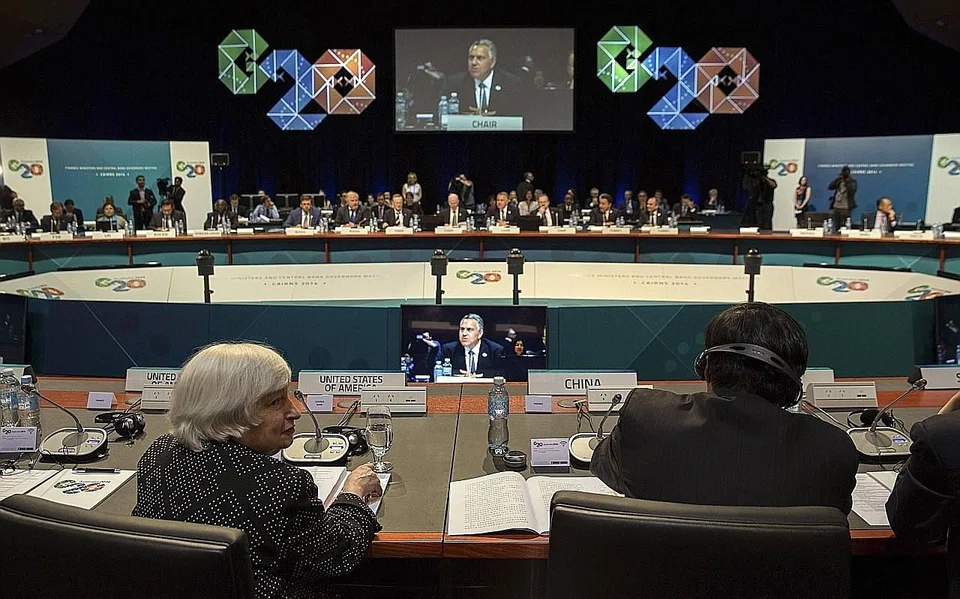
THE Group of Twenty (G-20) meets this weekend in Brisbane, Australia, in what is hoped will be the last time a significant political impetus is required to set global regulatory reform in financial services firmly on its way.
The key focus of the G-20 agenda will be job creation and growth for a global economy finally moving beyond the shadow of the last global financial crisis. A key component of these discussions will be discussions of key financial services regulatory reform issues to promote financial stability.
These include whether banks "too big to fail" should be required to hold a minimum amount of gone-concern loss absorbing capacity, as well as other issues surrounding shadow banking and international consistency in the regulation of derivatives markets.
With Singapore as a major financial services hub, many industry observers here will be watching the conversations in Brisbane closely.
It will be difficult to manage the dichotomy of wanting financial stability while heeding calls for the financial services sector to help create jobs supporting economic growth.
While the world economy may have stabilised, it remains fragile.
The number of financial services firms has declined since the crisis, challenging the ability of the sector to sustain competitive and innovative markets.
Inconsistent implementation of agreed financial sector reforms across countries is also leading to overall higher regulatory costs and greater uncertainty, stymieing the ability of the sector to play a greater role in fuelling economic growth.
At the same time, financial services reforms, themselves a long term endeavour, cannot be a bridge too far. It cannot be pursued past a tipping point where financial safety comes at an untenable social and economic cost.
Caution must rule. In balancing building resilience with growth, regulators need to ensure that what will not result is a lack of available financing which itself then chokes commerce.
They should also consider how to maximise the contribution of the financial sector to jobs and growth at this stage of the global economic recovery.
If needed, a "pause" button may be needed for additional major reform initiatives so that the overall strength of the world economy has a chance to stabilise.
At the same time, it is important that the G-20 recognises the many contributions that the financial sector can make to jobs and growth.
The key growth strategies identified by the G-20 - investment in infrastructure, reducing trade barriers, competition and labour market participation - can all be supported by the financial sector through for example, lending, investment, capital markets and more.
The G-20 therefore should shift its focus on regulatory reform to consider how the financial services sector can be encouraged to play a greater role in creating jobs and stimulating economic growth.
We believe the financial services sector can play its part in what we hope will be the great global economic recovery story of the 21st century unfolding before us.
For a start, this involves balancing implementing the learning points from the crisis of yesterday with building growth and jobs for tomorrow.
This means forging new relationships built on trust between the financial services sector and regulators, which delivers increased stability while stimulating economic growth.
Growth strategies already agreed by G-20, such as increasing investment in infrastructure, can be accelerated by the financial sector. For example, adjusting the capital and liquidity rules on banks undertaking long term financing should boost investment.
Self-regulation is always preferable to being regulated, so the way to build trust must be so that regulators do not believe they need to tackle everything, because the sector manages its responsibility as a corporate citizen well.
On their part therefore, banks too must intensify their efforts to introduce culture and behavioural change promoting greater transparency. They need to intensify efforts to rebuild the trust which was lost during the financial crisis so regulators can more comfortably step back.
In this spirit, my colleagues and I have made four proposals for consideration at the G-20 meetings:
The discussions taking place this weekend at the G-20 meetings in Brisbane have the potential to stimulate investment which will create significant numbers of new jobs and as a result accelerate the global economic recovery. The decisions reached will be of critical importance to the future strength of the world economy, to financial institutions and to their customers.
We hope that a more informed debate here between policy-makers and the financial sector will ultimately set the scene for a renewed contribution by the financial services sector to global economic recovery.
The writer is head of Financial Services, KPMG in Singapore. The views expressed are his own
TRENDING NOW

Simba admits exceeding spectrum limits amid failed M1 deal; full-year profits surge 277%

He built the Vingroup empire. Now South-east Asia’s richest man is handing some key roles to his sons
What’s on the agenda when Xi and Trump meet in Washington

Ex-execs of CW Group, Allied Tech charged with offences linked to lawyer’s S$76 million misappropriation

