

Beijing seeks to wrong-foot Biden with Brussels deal
Much of the sudden urgency to move forward with the EU-China investment deal reflects Beijing's desire to get it 'over-the-line' before Joe Biden's inauguration.
A COMMON frustration of commuters across the world is lengthy waits only to find that two trains or buses then arrive at once. This is a predicament that the European Union related to in the last week of December, with a brace of key trade and investment deals finally agreed, after years of difficult negotiations.
It is the politics, rather than the economics, of the two agreements that is the more fascinating. The Christmas Eve UK-EU trade deal was, of course, widely anticipated and ultimately secured once United Kingdom Prime Minister Boris Johnson decided that it was too risky -- even for his "high-wire" style of politics - not to agree to a post-Brexit trade deal with the EU-27 in the midst of a once-in-a-century pandemic.
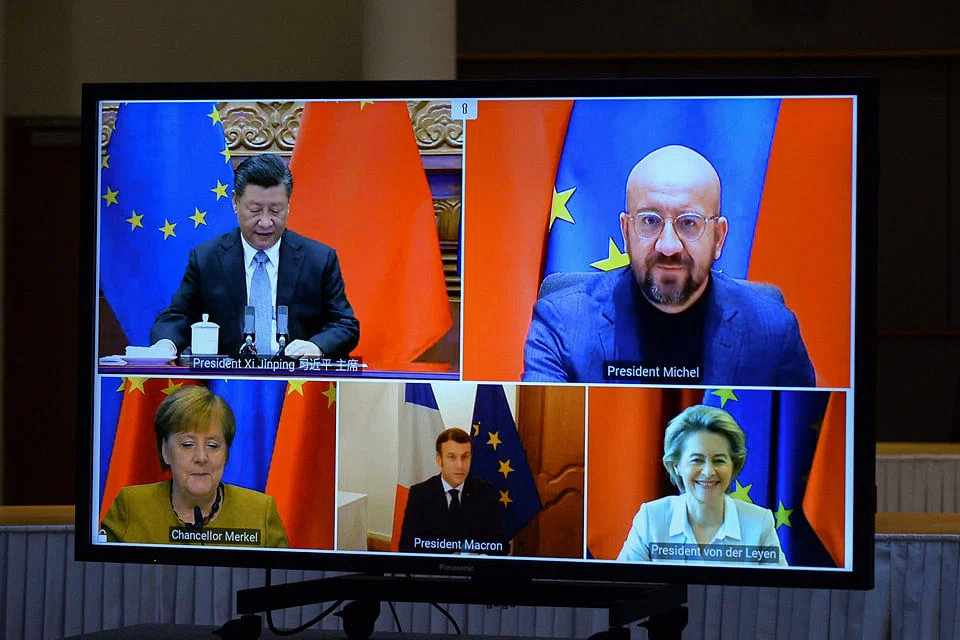
Much more of a surprise was the timing of the agreement, subject to the uncertain ratification by the European Parliament, on Dec 30 between the EU and China of the Comprehensive Agreement on Investment (CAI) that will see European and Chinese firms get better access to each market.
That deal, which has been discussed since 2014 by Beijing and Brussels, suddenly developed new momentum around Christmas, despite the wider chill in bilateral relations post-pandemic, which saw the EU only a few weeks ago urge a joint initiative with the United States to "address the strategic challenge from China's growing international assertiveness".
Late December is a peculiar point in the diplomatic calendar for such an unscheduled breakthrough, with no negotiating deadline to force the issue as there was with Brexit. Much of the sudden urgency to move forward with CAI reflects Beijing's desire to get it "over-the-line" before Joe Biden's inauguration as US president on Jan 20.
WINDOW OF OPPORTUNITY
China's calculus here is at least two-fold. Firstly, it is acutely aware that the incoming Biden team has concerns about the deal and the window of opportunity to close it may not last indefinitely. One of the president-elect's worries is that some Chinese companies will gain a stronger foothold in Europe by using Uighur Muslim forced labour for their products.
The EU side is conscious of US concerns and at least one country in the European club (Poland) suggested delaying action until after consulting the Biden team in late January. However, most EU states are keen to take advantage of the political "window of opportunity" that has, unexpectedly, opened up with Beijing.
A second reason for Chinese proactivity is that Europe is becoming an increasingly important foreign policy theatre for Beijing. The rising power has generally enjoyed growing influence across much of the continent in recent years from Eastern and Central Europe, where it regularly holds '17+1' summits, to key Western European states like Italy which last year became the first G-7 country to endorse the Belt and Road Initiative.
The unexpected EU-China breakthrough raises the question, going forward, of whether there might now be a significant warming in ties in 2021 after the chilliness of recent months. After all, 2020 had previously been heralded as one to deepen the economic and strategic relationship on the 45th anniversary of diplomatic ties between the two powers. So recent tensions were not the manner in which either China or Europe intended the year to play out.
Yet, while the new investment deal will do much to improve the atmospherics in diplomacy between Brussels and Beijing, it is significantly less likely to promote a fundamental positive reset in relations for at least three reasons.
Firstly, there are multiple issues clouding the bilateral agenda, in the short term at least. These include the opaque way that Beijing is perceived by Europe to have handled the novel coronavirus crisis outbreak in early 2020; the new Chinese security law in Hong Kong; Uighur human rights in Xinjiang province; and growing pressure on continental European leaders not to allow Huawei technology in their 5G networks following the earlier decisions of the UK, US, and Australia to this effect.
Secondly, the Biden team will now double down with the EU-27 to try to agree on a common transatlantic approach towards China. On Dec 22, for instance, incoming US National Security Adviser Jake Sullivan tweeted that "the Biden-Harris administration would welcome early consultations with our European partners on our common concerns about China's economic practices".
Thirdly, Brussels has also become increasingly concerned in recent years about whether the nature of China's external interventions in Europe represent a "divide and rule" strategy to undermine the continent's collective interests. EU foreign affairs chief Josep Borrell even asserted last year that Beijing is a "systemic rival that seeks to promote an alternative model of governance" to that of Europe.
In this context, several Western European countries began in 2020 to think much more carefully about their future ties with Beijing. And had it not been for the fact that the Atlantic relationship with the US under Donald Trump appeared so fragile, there could have been much more remonstration with China.
Rather than seeing a fundamental reset in relations, the most likely outcome of the investment deal is for the EU to double down on a constructive engagement approach with China. This will see differences, diplomatically, called out while emphasising areas of common interest, including the importance of an open financial and multilateral trading system, and tackling climate change.
Brussels asserts that the new investment deal, which the European Parliament will scrutinise carefully including over issues like human rights, will help move towards the goal of an open, transparent financial and multilateral trading system.
Moreover, the two sides are also likely to place growing emphasis on global warming, long an area of fruitful bilateral dialogue, in 2021 and beyond.
Collectively, the EU and China account for around one third of global greenhouse emissions and both share a vision of a prosperous, energy-secure future in a stable climate. Indeed, their 2015 bilateral climate change declaration was one of the key drivers of the Paris deal that year.
So, despite post-pandemic tensions, both Europe and China recognise that they have much to potentially gain from their partnership. Brussels sees CAI as part of this, and the decision to push forward so quickly with the deal largely reflects China's calculus that the the window for closer collaboration may not remain open indefinitely, especially given the imminent change of leadership in the White House which may do much to rejuvenate the Atlantic alliance post-Trump.
- The writer is an associate at LSE IDEAS at the London School of Economics
Decoding Asia newsletter: your guide to navigating Asia in a new global order. Sign up here to get Decoding Asia newsletter. Delivered to your inbox. Free.
Share with us your feedback on BT's products and services
TRENDING NOW

Simba admits exceeding spectrum limits amid failed M1 deal; full-year profits surge 277%

He built the Vingroup empire. Now South-east Asia’s richest man is handing some key roles to his sons
What’s on the agenda when Xi and Trump meet in Washington

Ex-execs of CW Group, Allied Tech charged with offences linked to lawyer’s S$76 million misappropriation

