Biden and Xi mark out their turf
But both agree it's important to establish common-sense guardrails, so that competition does not turn into conflict.
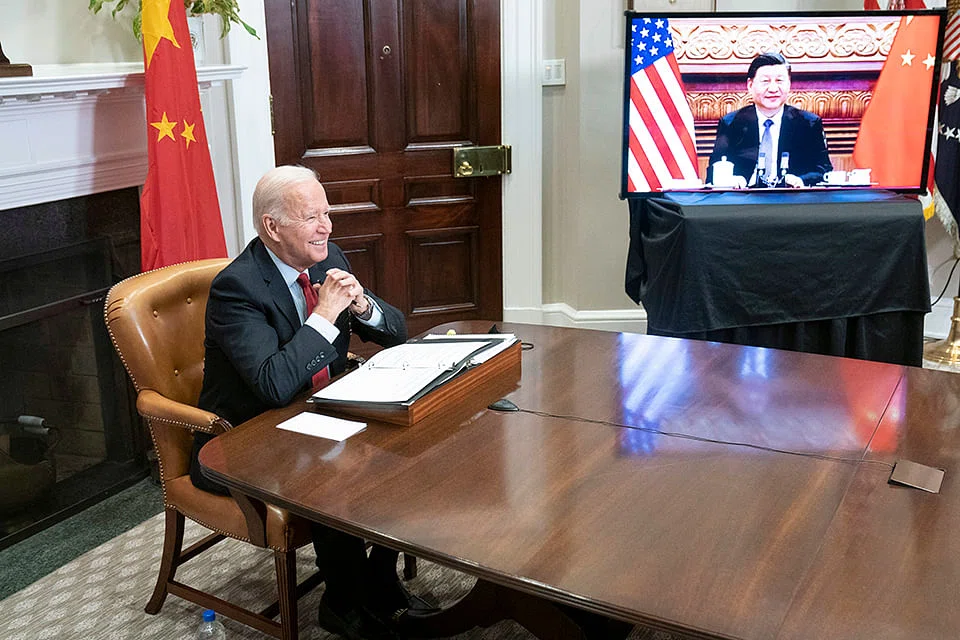
EXPECTATIONS had been set deliberately low for last week's first presidential summit between Joe Biden and Xi Jinping. Yet, they spoke for an unexpectedly long 3.5 hours, with the Chinese leader greeting his US counterpart as his 'old friend'.
It is much too optimistic to say that bilateral ties have now turned a corner, amid the wide-ranging security and economic-related disagreements that exist.
This was illustrated only on Friday, post-summit, when Biden said that he is considering a US diplomatic boycott of the 2022 Winter Olympic Games due to be held in Beijing because of China's human rights record.
Nonetheless, atmospherics have - at least temporarily - improved and this underlines that the direction of bilateral relations need not inevitably be towards ever greater hostility.
Perhaps the most tangible evidence of that is the agreement in the summit to explore talks on nuclear arms control, building from the climate change cooperation accord at COP26 in Glasgow.
The nuclear mini-breakthrough reflects the acknowledgment of both parties of the need to avoid nuclear conflict, yet China had previously rejected such talks when Donald Trump invited Xi to enter a bilateral security dialogue in 2019.
The United States currently has a vastly greater nuclear arsenal of some 5,550 warheads, but Beijing has ramped up its nuclear weapons posture away from its former policy of 'minimum deterrence'.
The Pentagon's annual report on China's military progress, published before the summit, said that Beijing aims to treble its nuclear stockpile to about 1,000 warheads by 2030.
Moreover, China tested a nuclear-capable hypersonic weapon in August that could use low-orbit space to evade US missile defences. Chairman of the US Joint Chiefs of Staff General Mark Milley said the test was akin to a 'Sputnik moment', referring to the Soviet Union launching a satellite in 1957, which heralded the Cold War space race.
To be sure, the agreement on nuclear talks is tentative, but could be important in the future as was shown during the Cold War with the wide-ranging US-Soviet security dialogue.
The Biden team is acutely conscious that China's nuclear arsenal remains unconstrained by any international treaties.
DIALOGUE
One potential way forward might be for both sides to build confidence by establishing a dialogue between non-government experts on both sides, such as those launched between the US and the Soviet Union during the 1960s. These talks, which were initially problematic, eventually helped forge a platform for government-to-government negotiations.
This uptick in nuclear diplomacy builds from the unexpected bilateral climate cooperation deal announced at COP26 in Glasgow. This provides another example that there may remain scope to work together where there are clearly defined common interests.
After all, tackling global warming is a key political priority of both nations, and Xi said in the summit that 'humanity lives in a global village, and we face multiple challenges together. China and the United States need to increase communication and cooperation'.
The fact that Biden and Xi have a personal backstory, getting to know each other originally when they were both vice-presidents, may be proving helpful too in ensuring that worst-case scenarios are avoided.
This is because, while potentially very difficult economic and security fundamentals will largely determine the course of ties in coming years, personal chemistry helps and Biden told Xi last week that "we need to establish some common-sense guardrails, to be clear and honest where we disagree, and work together where our interests intersect" so that competition does not turn into conflict.
The importance of this personal factor was shown during the Trump presidency when the-then US leader's erratic nature accentuated the natural zig zags in ties.
During the Obama years, by contrast, relations remained generally cordial, in significant part because of the commitment of Xi and Barack Obama to bilateral stability.
At that time, Xi even outlined a desire to fundamentally redevelop a new type of great power relationship with the US to avoid the conflictual great power patterns of the past.
That latter goal still lacks any obvious definition the best part of a decade later, and the dynamics of the bilateral relationship have changed very significantly after a fraught period that has seen relations deteriorate to their worst level since the countries normalised diplomatic ties in 1979. This is not just because of the controversies of the pandemic, and the extra uncertainty injected into ties by Trump.
Take the example of Taiwan where China's recent incursions into Taipei's Air Defence Identification Zone have alarmed many in Washington. During last week's summit, Biden said he opposes unilateral efforts to change the status quo or undermine peace and stability across the strait, while Xi said that the US president is playing with fire on the issue.
IN-BUILT HAZARDS
Even if such tensions can be managed in coming years - a big 'if' - there are wider in-built hazards in the bilateral landscape. This includes US legislation such as the Hong Kong Democracy Act, plus a bill requiring the US Commerce Secretary to deliver a "report on Chinese investment" in the US to Congress every two years up to 2026, which will see relations periodically flare up.
Amid all these challenges, a key question that Xi will be pondering is how long Biden will be in power. For while the Chinese president is tightening his grip with a third term, it is not certain that his US counterpart will even seek a second one in 2024 when he will be in his early 80s.
This is a non-trivial point as Xi would be more likely to engage, substantively, with Biden if he knows the latter will be in power for 8 rather than 4 years. Both may ultimately favour a strategic dialogue to try to find a framework, or 'grand bargain', to renew bilateral relations, but this is the type of initiative that may require more than a single US presidential term to formulate.
Xi is also acutely aware that, for all of the new US president's indications that he might row back some of Trump's overt hostility to China, Biden has yet to reverse any of his predecessor's fundamental policies. Indeed, he has reaffirmed numerous of them, including rejecting nearly all of China's maritime claims in the South China Sea.
The most likely prognosis for US-China ties in the short to medium term is therefore one of biding time and tensions. However, this is not inevitable, despite the growing conventional wisdom that views bilateral ties from an ever more pessimistic prism.
- The writer is an associate at LSE IDEAS at the London School of Economics
Decoding Asia newsletter: your guide to navigating Asia in a new global order. Sign up here to get Decoding Asia newsletter. Delivered to your inbox. Free.
Share with us your feedback on BT's products and services