
Editorial

Biden needs to enhance his Asia strategy with a firm commitment to free trade
Published Tue, May 3, 2022 · 02:54 PM
    • President Biden has now an opportunity to upgrade his Asia policy by taking steps to promote and liberalise trade in the region.
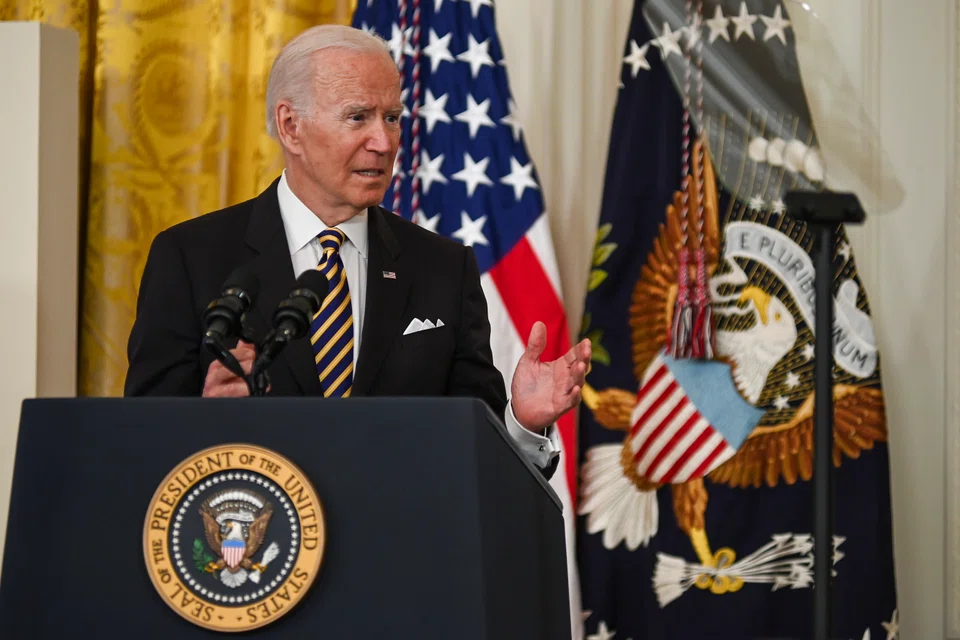
    • President Biden has now an opportunity to upgrade his Asia policy by taking steps to promote and liberalise trade in the region. Photo : NYT

    AMERICA'S allies in the Indo-Pacific region have welcomed US President Joe Biden’s introduction of a coherent strategy to dealing with Washington’s challenges in Asia, led by the rising economic and military power of China.

    Since entering office, President Biden and his top foreign policy aides have made it clear that they intend to boost the US pivot to Asia, shifting the geo-strategic and geo-economic focus of US policy from the Atlantic and the Middle East to Asia. And in contrast to his predecessor in office, President Biden has insisted that this more forceful US approach to the Indo-Pacific would not be unilateral in nature but be based on working together with America’s allies instead of bickering with them the way former President Donald Trump did.

    Hence the Biden administration strengthened US alliances with Japan, South Korea, Australia, New Zealand, and in particular, with India, and also increased support for Taiwan, with a clear message to China: The US is here to stay in Asia.


    In that context, President Biden has revitalised the “Quad” - the Quadrilateral Security Dialogue consisting of the US, Japan, Australia and India. Washington has also announced the formation of a trilateral security pact between Australia, the United Kingdom, and the US (Aukus) under which Australia would operate, and potentially construct, nuclear-powered submarines, and the 3 governments would work together on developing hypersonic missiles.

    But as some observers have noted, President Biden’s evolving strategy in the Indo-Pacific region has focused almost exclusively on the military aspects of US presence in the region.

    That national security-oriented approach could now face challenges as pressure mounts on the Biden administration to shift more military resources to support its Atlantic allies in response to Russia's invasion of Ukraine and the threat it poses to the balance of power in Europe.

    Yet President Biden has now an opportunity to continue pressing forward in upgrading his Asia strategy by doing what it has resisted until now - by taking steps to revive America’s activist policy of promoting and liberalising trade in the region.

    During more than 4 decades when serving in Congress and later as vice-president, Biden demonstrated a commitment to an internationalist foreign policy and a liberal trade agenda. That should have led him to do what would be the sensible move and rejoin the Trans-Pacific Partnership (TPP), the 12-nation trade deal signed in 2016 by the US administration in which he served as vice-president.

    But former President Trump pulled out of the TPP at a time of rising protectionist sentiments in Washington, which are also shared by members of the powerful progressive wing of President Biden’s Democratic Party. That explains why the administration has resisted re-joining a revamped successor to the TPP.

    Instead, President Biden is expected to soon launch the Indo-Pacific economic framework (IPEF) which would address such issues as securing supply chains, infrastructure, clean energy and digital trade. But the IPEF seems to focus on the need to promote “fair trade” as it relates to labour and environmental issues as opposed to free trade.

    The lack of traditional commitment to tariff reductions could upset some of America's partners in the region. But by introducing a meaningful economic strategy in Asia, the Biden administration is at least taking a step in the right direction. It should now go further towards liberalising trans-Pacific trade.


