

'Big Bang' moment for Cambodian stock market
The listing of the country's largest commercial bank Acleda on one of the world's youngest bourses can serve as a role model for other companies.
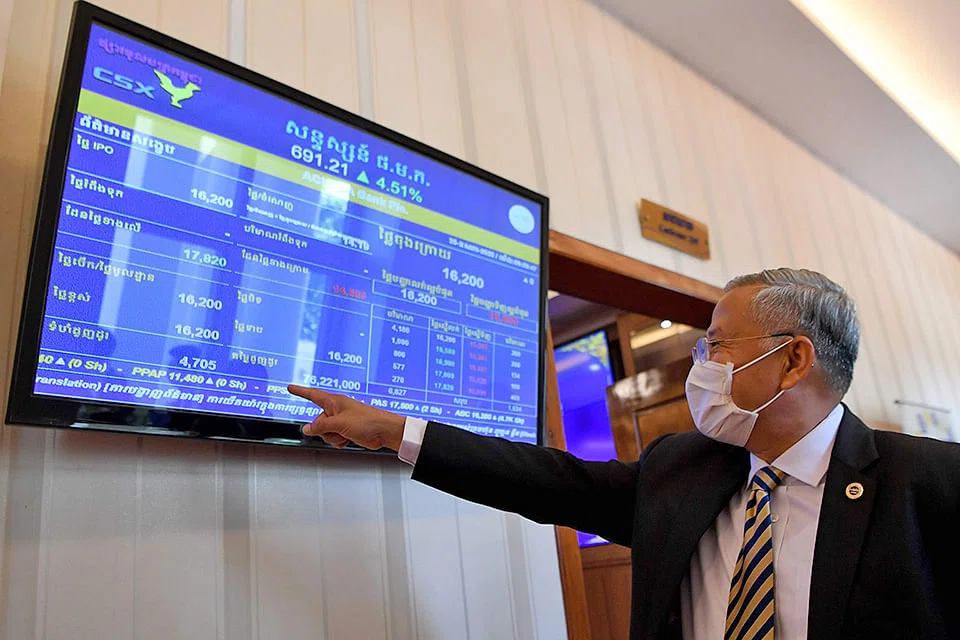
ONE of the world's youngest and smallest bourses, the Cambodia Securities Exchange (CSX), is breaking the shackles of the coronavirus with the recent listing of the country's largest commercial bank, as it moves ahead to implement a blueprint to develop its capital markets.
The event was ground-breaking because Acleda Bank Plc is not only the first local bank to list, but it is also the first private company to join the bourse which is dominated by five state-linked firms.
The vice-chairman and COO of the CSX, Jong Weon Ha, has described the listing as "a really big deal", "a game changer", and "a big moment".
Acleda Bank's president and group managing director, In Channy, declared that the bank's listing was a reflection of investor confidence in the financial institution and in the national economy, especially amid the Covid-19 pandemic. Cambodian Minister for the Economy and Finance, Aun Pornmoniroth, believes that the listing could serve as a "role model" for other banks and companies that were eager to list, or were hesitant about raising capital from the stock market. Cambodia has, as of July 27, reported 226 cases of the coronavirus, 147 recoveries, and no deaths.
Acleda's current shareholders include a group of Cambodian investors who control a 51 per cent stake. Foreign entities hold the remaining 49 per cent; they include Japanese firms Sumitomo Mitsui Banking Corporation and Orix Corporation, as well as Compagnie Financière de la BRED, a subsidiary of France's BRED bank, and three investment funds of Triodos Bank of the Netherlands.
NO FUND-RAISING TARGET SET
Acleda made its debut on the CSX on May 25, raising US$17.5 million in its initial public offering (IPO), but according to market sources this amount was well below its target of about US$34 million. The bank, however, said it had not set any fund-raising target, and it may sell the remaining shares to private investors. The bank had assets of US$6.18 billion at the end of last year and reached a market capitalisation of US$1.75 billion during the IPO, nearly three times that of the five other listed firms counted together.
With the arrival of Acleda, there are 12 listed companies on the CSX, comprising six companies that have sold their equities through IPOs, and six issuers of corporate bonds that have collectively raised total capital of more than US$240 million from the securities market, according to the CSX's CEO Hong Sok Hour.
The CSX has signalled that it is pushing ahead with its listing plans. Mr Hong is looking to at least two more companies listing on the CSX by the end of this year, including an equity firm and a corporate bond firm. There is growing enthusiasm for investing as some 25,000 individuals and companies have opened trading accounts at the CSX.
A quick check of progress made so far reveals that the Securities and Exchange Commission of Cambodia (SECC) had achieved its targeted number of listing homegrown companies and corporate bonds in 2019, and is looking forward to trading in derivatives and commodities by 2022. The SECC director-general, Sou Socheat, wants more foreign investors to participate in the stock market, especially more institutional investors.
The Cambodian authorities have often tried to model their financial system on that of Singapore and Hong Kong, but they realise that it will be a long journey to get there. Still, they are hopeful because the CSX is already an attractive market with its new stock market listings and the newer bond market serving as investment avenues.
The Cambodian corporate bond market attracted some attention with local microfinance firm Hattha Kaksekar Ltd's 120 billion Cambodian riel (S$41.4 million) debut issue in November 2018. And last year there were two issues: microfinance institution LOLC (Cambodia) Plc issued an 80 billion Cambodian riel bond, and Advanced Bank of Asia Limited (ABA Bank) issued bonds worth 84.821 billion Cambodian riel. And following a positive response from retail and institutional investors, ABA may do a repeat issuance this year.
Although the CSX expects two more listings this year, there could be more. As many as five private companies may list in 2020, according to market sources. In contrast to the large listed companies on the bourse, most of the likely new firms are small and medium-size enterprises. Their learning curve is steep, however. The Cambodian stock exchange has long been hindered by a lack of public awareness on the role and benefits of investing.
For example, the OECD stated in its report, "Corporate Governance Frameworks in Cambodia, Lao PDR, Myanmar and Viet Nam", in 2019 that Cambodia faces major challenges in protecting shareholder rights, information disclosure and the ease of initiating shareholder suits. It explains that Cambodia has no real system for protecting minority shareholders as well as very weak disclosure requirements and limited shareholder rights.
A concerted effort to improve corporate governance is a priority of the Royal Government of Cambodia, laid down in its "Rectangular Strategy" for all-round development of growth, employment, equity and efficiency which began in 1998. The government is working hard to promote access to finance for private companies in the country.
PROMOTING GOOD PRACTICES
The Royal Government has implemented its National Strategic Development Plan for 2014-2018, affirming its intention to "promote the use of international good practices in accounting and corporate governance".
Moreover, the Cambodian Financial Sector Development Strategy for 2016-2025 sets specific targets for 2025, such as: capital market development; improving the performance of state-owned enterprises; making SME listing easier; promoting financial institutional listing; and more transparent disclosure of information by companies.
Some of these goals are proving to be difficult to attain, like in many developing countries. Many small, family-owned companies wish to raise capital at the CSX but they are either unable or unwilling to adhere to the reporting requirements that are needed for listing. The market authorities have been holding seminars to educate the owners of such companies about the need for transparency.
In a bid to woo companies, the government last year introduced major tax breaks for listed companies, such as a 50 percent reduction on income tax for three years and has urged local banks to provide cheap loans to companies on the CSX.
For now, there is no better advertisement for the CSX than the listing of Acleda Bank. The words of CSX's Mr Jong may be prophetic: that the listing was "a really big deal" and "a big moment" as well.
It may, indeed, turn out to be a big bang that could pave the way for the CSX to achieve its target of listing of another four companies by next year, raising the total number of listed companies to ten. It is a good thing that the CSX leadership is dreaming big.
TRENDING NOW

Singapore’s central gas buyer affirms Indonesia’s role as ‘important partner’ amid export review warning

Why the biggest business decision about AI isn’t which model to choose

Is Manila Asia’s new dining hot spot?

KKR founders among investors buying 42% of Peter Lim’s Valencia; club valued at US$1.4 billion

