

Big blow for Macron who misses out on majority
The outcome of Sunday’s legislative election will complicate the president’s domestic agenda for his second term and could undermine wider investor confidence in France.
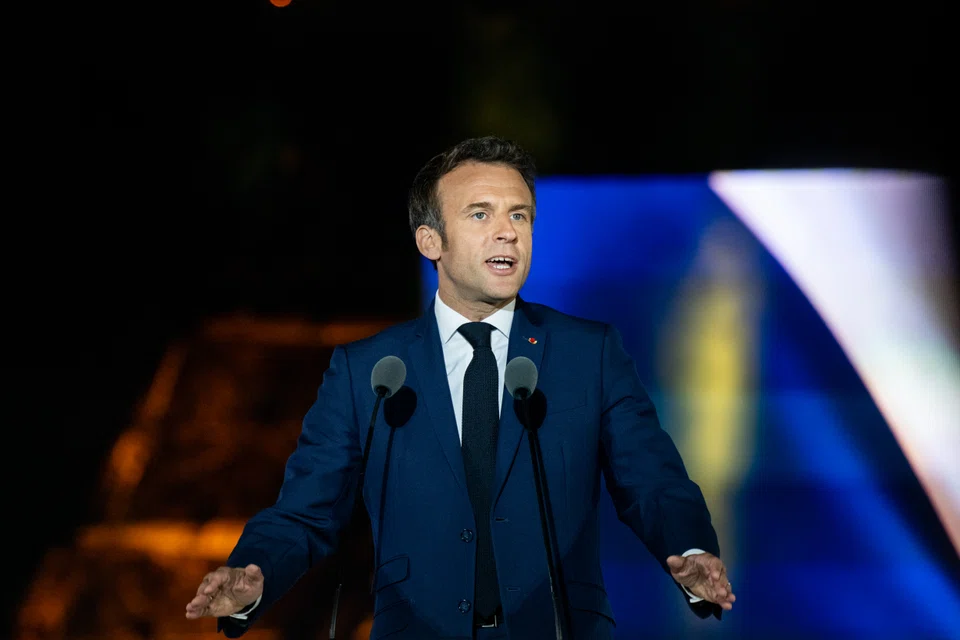
EMMANUEL Macron’s presidential re-election “honeymoon” was shattered on Sunday (Jun 19) when he became the first French president not to win a presidential majority for around a quarter of a century.
This failure of Macron’s Ensemble (Together) coalition to win a majority, for which there had been warning signs for weeks, may also prove significant for Europe at large, not just France, especially if Macron now needs to spend a greater than expected part of the rest of his second term focusing on his domestic agenda rather than foreign policy -- limiting his ability to play the pro-EU “continental statesman” role he enjoys playing.
His economic reform agenda will now be more challenging to push through. This is a blow not just to the president, but also the French economy, and could undermine wider investor confidence in France which had been boosted in the last 12 months according to a recent report from EY.
Investors will be particularly concerned by the challenges stacking up, including the possibility of strikes as labour unrest spikes with rampant inflation and cost-of-living crisis. This is despite the fact that France already has a generous welfare state, and Macron has already capped gas and power price increases.
The health service is also in crisis with a major shortage of medical staff and resources. French Prime Minister Elisabeth Borne has said it is a government “emergency” to implement special measures this summer and deliver on a longer-term review of the health system.
The failure of Macron’s Together bloc to win the 289 votes for a majority is a significant change from 2017 when the president’s group won around 350 of 577 seats. This was one of the most significant majorities since former president Charles de Gaulle’s 1968 landslide victory.
Macron’s coalition will now need to either govern as a minority administration, or form informal or formal alliances with other parties. The most likely group here is probably the right-of-centre Republicans which polled third on Sunday.
Sunday’s results show how simplistic the conventional wisdom is that French legislative elections are designed, almost by default, to hand the president a workable majority. Yet, while the incumbent has for much of the Fifth Republic enjoyed the support of a relatively secure legislative majority from his own party, this is never certain.
This is particularly true in Macron’s case as, a half decade into his presidency, it is sometimes forgotten that France remains in largely uncharted political territory being governed by an alliance that was founded by the young president only in 2016.
Even before Sunday’s first-round ballot, the warning signs were there for Macron. One poll released at the start of the month by the Ifop group suggested that his Ensemble centrist coalition would probably be the largest single party, but probably below the 289 seats needed for an absolute majority.
The big surprise of the night is the relative success of far-right National Rally, led by Marine Le Pen. This group made unexpectedly large gains, and is projected to win around 10 times the small number of seats than in 2017.
Going into Sunday’s second round, momentum had been with the far-left coalition led by hard-left veteran Jean-Luc Melenchon, and the bloc won the second largest number of seats on Sunday. Mélenchon and his team engineered what many had seen as a near impossible feat: developing a broad alliance of France’s deeply fractured left -- the Socialist Party, Greens and Communists -- in an unexpected show of unity. The coalition is united around a common policy platform including restoring a wealth tax scrapped by Macron; lowering the retirement age to 60; and hiking the minimum wage by 15 per cent.
So the left is likely to rally against Macron’s reforms, seeking to repeat the protests against Macron’s last attempts at pensions reforms. Rail and other transport workers launched in 2019 the longest strikes since 1968 against the planned pension overhaul.
Little wonder then that the view of Olivier Véran, the French minister for parliamentary affairs, is that the failure to give Macron a majority represents a “major destabilisation of politics in our country for years to come”. While this language may prove to be exaggerated, politics will become tougher for the president. A minority Cabinet or coalition government is an unusual scenario for modern-day France, and the Fifth Republic was designed to avoid such unwieldy coalitions.
In this context, Macron might also be tempted to use article 49.3 of the French constitution sparingly, which under certain conditions allows him to put a law in place even without approval from parliament. The nuclear (and unlikely) option for Macron would be to dissolve parliament and call new elections in the period to come. That could easily backfire, however, as it did with then-President Jacques Chirac in 1997.
One consolation for Macron is that an even worse case scenario for him did not occur. That is, if the leftist alliance had surprised the pollsters, and won a majority. Macron would then have had to name a prime minister from the winning camp, ushering in a period of so-called cohabitation.
There is precedent for this in the Fifth Republic from 1986-1988, 1993-1995 and 1997-2002 under the presidencies of Socialist Francois Mitterrand and Republicans Jacques Chirac respectively. In these periods, the centre of gravity of domestic policy moves into the hands of the prime minister and the majority party in the legislature, with the president retaining the lead on foreign policy.
Sunday’s result therefore matters not only for the next few years in France, but also could shape the next decade too. As the low turnout shows, there remains widespread anti-establishment anger and, unless Macron is seen to succeed with his reforms, the beneficiaries in the future could be the far right Le Pen and/or far left Mélenchon.
So it is not just the success of Macron’s remaining presidency that will now rest significantly on Sunday’s final round elections. The results will also shape the context for the next presidential ballot in 2027 when a victory by the far right or far left cannot be ruled out.
Andrew Hammond is an associate at LSE IDEAS at the London School of Economics.
TRENDING NOW

Singapore’s central gas buyer affirms Indonesia’s role as ‘important partner’ amid export review warning

Why the biggest business decision about AI isn’t which model to choose

Is Manila Asia’s new dining hot spot?

KKR founders among investors buying 42% of Peter Lim’s Valencia; club valued at US$1.4 billion

