BOJ chief banks on Japan's turnaround
He believes the central bank's monetary policy can make it happen, although sustained price rises haven't quite happened yet, and the soft oil prices haven't helped.
Baku, Azerbaijan
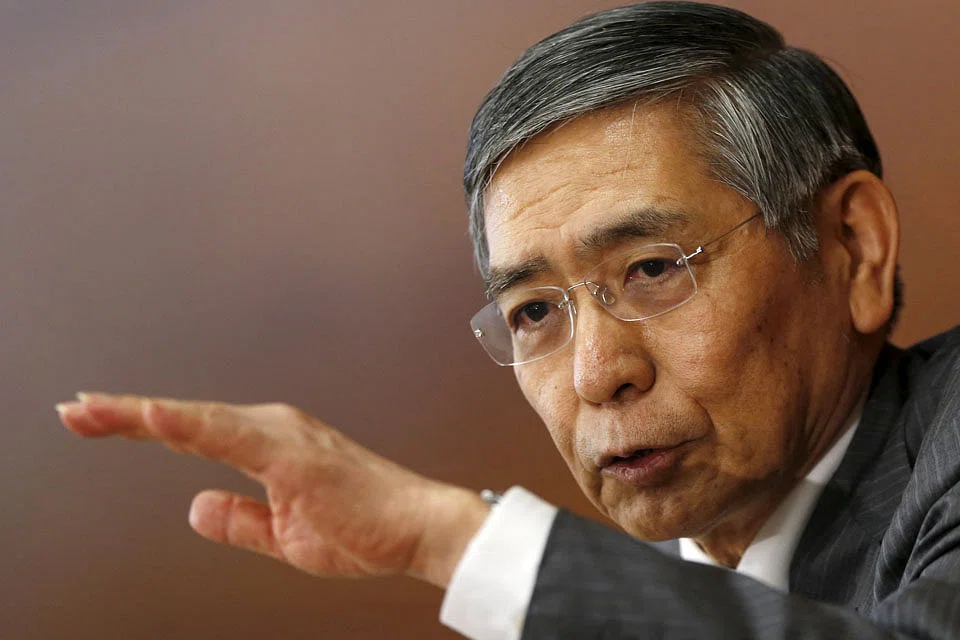
DOUBT, it would seem, is not something which enters the mind of Bank of Japan (BOJ) governor Haruhiko Kuroda when he defends his two-year stewardship of the Japanese central bank.
Even in the face of growing market scepticism over the effectiveness of the BOJ's deflation-fighting policies on his watch, the ever-affable, yet sternly resolute man maintained in an interview with The Business Times that the bank will achieve its elusive 2 per cent annual inflation target or "price goal".
In his quiet but determined way, he told BT on the sidelines of the annual meeting of the Asian Development Bank in Baku in Azerbaijan this week: "In the long run, the inflation rate is determined by monetary factors or monetary policy."
He was equally insistent that, in the longer term, his aggressive monetary easing would bolster Japan's economic growth.
It is tempting to quote Keynes' dictum "In the long run, we are all dead", but if sheer doggedness and determination count for anything, Mr Kuroda may yet prove his critics wrong. Confidence is a valuable commodity and if anything can revive inflation expectations and economic growth in Japan - where deflation has become a way of life - it is probably Mr Kuroda's unwavering faith that all will turn out well.
He said: "I think that quantitative easing (QE) in the US or Japan or by the European Central Bank (ECB) or by the Bank of England - all have had a significant impact on (their) economies.
"Of course, (the impact) has not been uniform. Depending upon economic and financial conditions, there will always be a different impact. But basically, where QE has been implemented, the economy has picked up."
Given the less-than-spectacular recovery of the global economy from the crisis of 2007 to 2008, the still-wavering recovery in Britain and the fact that Europe remains the proverbial "sick man", it is easy to forget that averting economic depression is a major feat.
It is also easy to overlook the fact that Japan has emerged from 15 years of almost continuous deflation, even if that prolonged period of price declines has not yet given way to sustained price rises.
Mr Kuroda said: "In Japan, we expect this fiscal year that real GDP growth will be around 2 per cent, and in fiscal 2016, around 1.5 per cent. Those rates will be well above Japan's potential growth rate, which is less than 1 per cent at this stage. That means the output gap will continue to shrink and could become positive, thereby raising prices and wages."
He freely acknowledged that overall price levels have weakened significantly in many leading economies, despite massive monetary injections by central banks in the form of programmes referred to as QE or QQE (for quantitative and qualitative easing).
He noted that inflation has been negative in the US and the Eurozone, and at "around zero" in Japan.
"But all of them have seen a sharp decline of more than 50 per cent in oil prices in basically six months or so. That has had a major impact on consumer price inflation," he said.
In the medium to long run, however, inflation will eventually pick up pace, since the decline in oil prices should accelerate real income growth.
He suggested that it is important to maintain perspective in the case of Japan, offering what appeared to be a gentle reminder to markets and economists against indulging in too much short-term thinking and in passing judgement on the BOJ's strategy - even if its inflation goal still seems to be distant.
In April last year, we had the consumption tax impact and our inflation reached 1.5 per cent, he recalled.
Thereafter, it declined because of the sharp decline in oil prices. The rate continued to decline; it was zero in February and 0.2 per cent in March.
He stressed that before QQE was introduced in April 2013, the inflation rate was negative 0.5 per cent. Then, in about a year, it hit 1.5 per cent; then in about another year, it declined to around zero again, but this second phase was caused by the decline in oil prices.
He pointed out that the BOJ's projection of economic growth is about 2 per cent this fiscal year and 1.5 per cent next year; it projects that inflation will come in at around 0.8 per cent this year and 2 per cent next year.
"These are based on our assumptions of oil price developments in the coming two years," he said.
"We think that the oil price will gradually rise from US$55 a barrel - this was the average in the last couple of months - towards US$70 a barrel by the end of fiscal 2016."
Almost exactly the same assumption has been made by the ECB and the IMF's World Economic Outlook.
THE OTHER SIDE
Those who doubt the efficacy of QE policies do have arguments on their side, especially in Japan's case. Are we not expecting too much of short-term monetary stimulus as distinct from longer-term structural reform? In particular, is the BOJ placing too much emphasis on raising price levels?
Even Mr Kuroda's former mentor at the Ministry of Finance, Eisuke Sakakibara - a stern defender as he is of his protege's overall record at the BOJ - has argued that Japan and other economies can still grow despite deflation, and that deflation is primarily a structural phenomenon.
Prices in Japan have been depressed by a flood of relatively cheap imports from China and other emerging economies, he has argued.
Mr Kuroda begs to differ. He told BT: "Those goods also go to the US and all developed countries and yet, among developed countries, only Japan has suffered from a 15-year-long deflation."
Another oft-quoted argument is that Japan's inflation rate will tend to be lower because of the country's ageing population, but then again, Spain, Italy and even Hong Kong also have greying populations and workforces, and none of their economies are hobbled by deflation.
Mr Kuroda said: "I think these arguments are not really corroborated by facts - or even by theory.
"I think it is monetary factors which determine the rate of inflation. I freely admit that in the short run, various factors can affect the inflation rate - oil prices, sudden large inflows of goods from emerging economies and so on, but in the long run, the inflation rate is determined by monetary factors."
THE YEN'S FALL IN VALUE
One of the side effects of the BOJ's aggressive monetary easing has been a sharp drop in the value of the yen, which has fallen some 30 per cent against the dollar since Mr Kuroda took over at the helm of the central bank early in 2013.
This has affected Japan's neighbours, and suggestions that China might be forced to devalue the renminbi have been heard.
In meetings the BOJ governor had with his counterparts from China and South Korea during the Baku meeting, he explained the rationale behind his central bank's policies.
"There was not much time for discussion," he said, adding that the communique from the meeting was guarded: "In an uncertain environment of global economy, monetary policy settings should be carefully calibrated and clearly communicated to minimise negative spillovers," it had said.
But in a separate, four-hour meeting of Asean+3 finance ministers and central bank governors, the impending "normalisation" of US monetary policy was a focus of attention, said Mr Kuroda. The feeling there was that normalisation could have some impact on emerging economies in Asia, but that the concern might be somewhat mitigated by the continuation of QE in the Eurozone and Japan.
Meanwhile, he is adamant that the varied timings of entry and exit from QE policies by the leading central banks is likely to make it easier for emerging markets to cope with the situation than if the monetary policies of these leading global economies were to be synchronised.
However, he added that the unique status of the dollar as the most important international currency means that US monetary policy "could have a significantly larger impact on the world economy and on global financial markets than any other central bank's monetary policy".
So "you cannot fully compensate", he said.
That seems to be a signal of possible trouble ahead.