
Boris Johnson’s premiership blowing up

With the resignations of his finance and health ministers on Tuesday following a string of scandals, the UK PM is battling to stay in office.
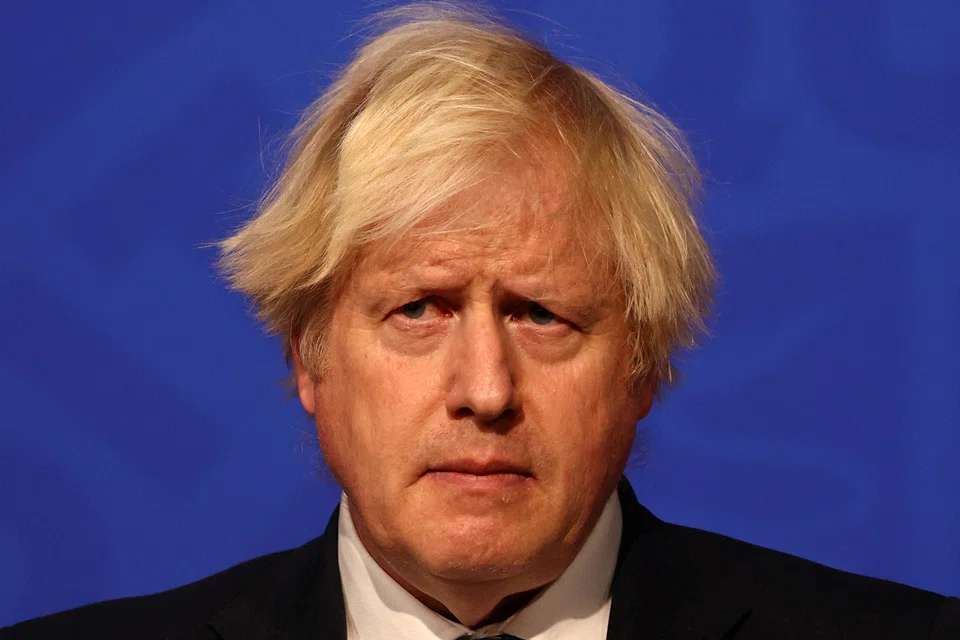
    • The question is now when, rather than whether, his tenure at Downing Street will come to an end.
    • The question is now when, rather than whether, his tenure at Downing Street will come to an end. REUTERS
    Published Wed, Jul 6, 2022 · 01:36 PM

    BORIS Johnson’s three-year anniversary as UK prime minister is on July 21, but celebrations will not be on his mind after the dramatic deepening on Tuesday (July 5) of the crisis surrounding his government.

    Downing Street was rocked by two major Cabinet resignations, Finance Minister Rishi Sunak and Health Secretary Sajid Javid, plus that of around half a dozen junior ministers. There is no question that Johnson now faces the most perilous period of his premiership, and the end-game may be closing in fast.

    Johnson sought to stop the haemorrhaging of his political power on Tuesday with a mini Cabinet reshuffle. Education Secretary Nadhim Zahawi replaces Sunak at the Treasury, while Steve Barclay moves from being Johnson’s chief of staff to health secretary. Zahawi is, in turn, replaced by education minister Michelle Donelan.

    However, a snap poll by YouGov on Tuesday evening found that 69 per cent of the UK population think that Johnson should resign. This is 11 percentage points higher than when the pollsters asked the same question only last month. The proportion who say he should go now includes a majority (54 per cent) of 2019 Conservative voters.

    While Johnson looks unlikely to resign imminently, there are other scenarios for a potential quick end to his premiership. One is that more high level resignations follow in the coming days.

    While remaining publicly loyal, it’s possible that some Cabinet ministers will privately ask Johnson to consider his position. If he refuses to do so, this could provoke further departures. Some such leadership hopefuls, including Foreign Secretary Liz Truss and Justice Secretary Dominic Raab, might get nervous that Sunak (should he decide to seek the top job) will make all the running if they don’t at some point distance themselves politically from the prime minister too.

    It is only last month that Johnson prevailed in a narrow ‘technical sense’ in an internal leadership contest within the Conservative Party getting 211 votes, just over the 180 votes threshold needed to win. However, he lost in a wider, more important “political sense” in that he did not win by enough to end the leadership questions that have long dogged him.

    Technically, there cannot now be another such confidence vote for another year. However, assuming Johnson seeks now to dig in, next week’s elections to the Conservative backbench 1922 committee of MPs could be crucial. MPs standing on a platform of changing the leadership rules may form a majority.

    While it had been anticipated that the rules could be changed to allow a further “no confidence” vote within a year, it had been assumed that such a contest might not take place until the Autumn. However, there is now renewed speculation that a confidence vote could be called within 24 hours of the rules changing. If Johnson were defeated in such a vote, nominations will be open for a new leader, with MPs potentially whittling the candidates down to the final two before the House of Commons summer recess starts on July 21.

    In last month’s confidence vote, a larger than expected 148 MPs voted against Johnson (which is more than 40 per cent of Conservative MPs). This is a worse result than Theresa May experienced in her 2018 confidence vote, and she resigned within six months.

    One other illustration of how disappointing the result was for Johnson is shown by the fact that as many as four in five of the 211 Conservative MPs who backed him may have been on the so-called government “payroll”. Around 160-170 MPs currently hold government roles, such as ministers and parliamentary private secretaries.

    A large majority of these payroll MPs will probably have backed Johnson -- so potentially as high as around 80 per cent of the 211 MPs who voted for him can be said to have done so chiefly out of duty rather than loyalty. This raises the possibility that only a few dozen non-payroll MPs also voted in favour, implying that he has lost the confidence of the majority of Conservative backbenchers. Bad as the result was for Johnson, however, it could have been even worse were it not for the fact that there is no clear, obvious successor yet to him within the Conservatives.

    While the exact end game for Johnson’s prime ministership is still unclear, the odds are growing that it may now be months, if not weeks, away. In the meantime, the danger is paralysis/inertia in the government while he remains in power whereby policy is tactical (designed to carry favour with one sector of the population or another) rather than strategic.

    This type of weak government is bad for the United Kingdom given there is clear need for a post-Brexit vision for the country as it emerges (hopefully) from the pandemic. This point was highlighted in an important EY report released last month which looks at investor sentiment across Europe, and found that the UK remains a top FDI destination in Europe, but confidence is fragile.

    What is increasingly clear is that while Johnson may be one of the best campaigners in UK politics, with an ability to cut through to the electorate with simple slogans such as “Get Brexit Done”, his ability to govern is much weaker. And his period of office reflects this, including the lax managerial discipline that enabled recent scandals to happen.

    His supporters will argue that he achieved at least two big wins. Firstly, in helping win the Brexit referendum in 2016, and then getting the United Kingdom out of the EU in 2020.

    And secondly with his landmark general election victory in 2019, for which the Conservatives redrew, at least temporarily, the UK political map by winning a number of longstanding Labour strongholds, especially in the Midlands and North of England.

    Taken together, despite Johnson’s apparent desire to stay in power, the chances of him being prime minister at the next general election have decreased, and the endgame could now come soon. It has always been dangerous to write him off politically, but the only question surely is now when, rather than whether, his tenure in Downing Street will come to an end.

    Andrew Hammond is an associate at LSE IDEAS at the London School of Economics



